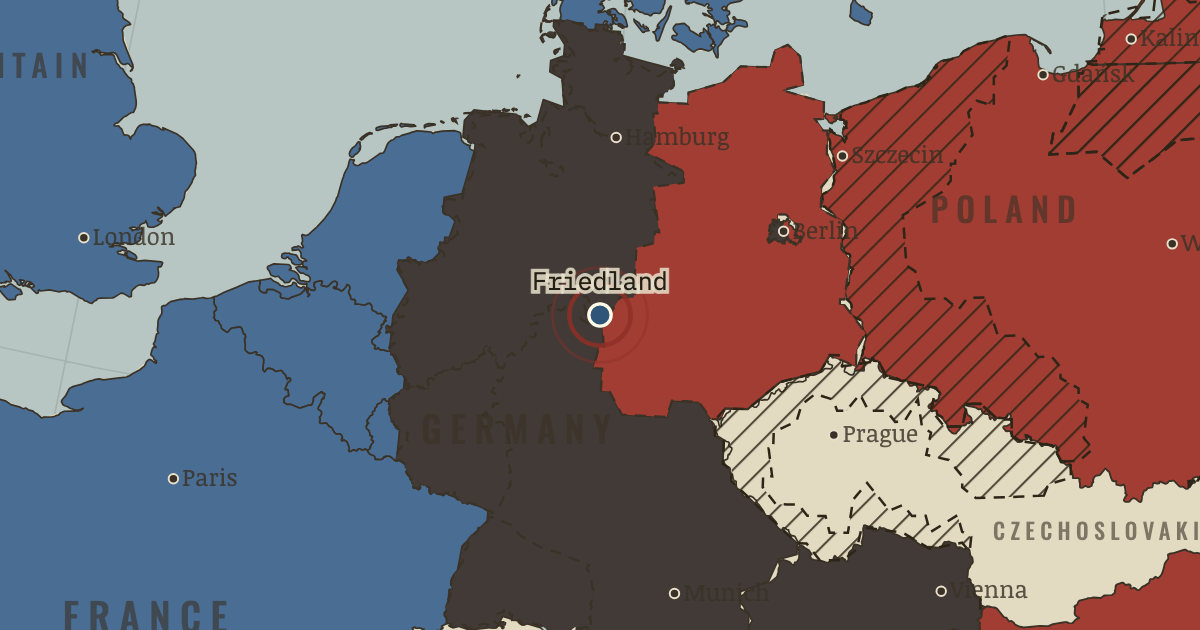
20 Sep 1945 — Britain opens a reception camp in farm buildings where its occupation zone meets the American and Soviet zones. Millions would pass through Friedland: expellees, prisoners of war returning home and, in the decades that followed, ethnic German resettlers. The camp still receives newcomers today.
WW2 is free in full, and chapter 1 of every atlas is free. A free account opens 3 more chapters a day. Starter, at $9 a month, opens all 21 with no daily limit — see the plans.
20 SEPTEMBER 1945 · UPROOTED: REFUGEES IN EUROPE 1945–1960 AND INDOCHINA 1975–1990
The moment in context
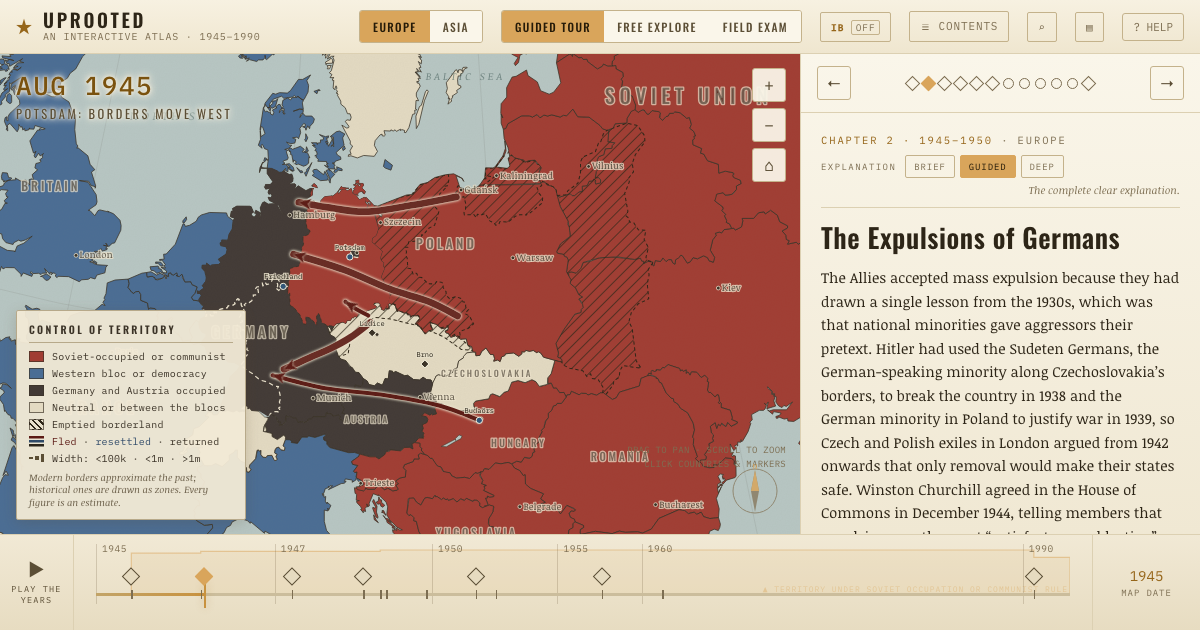
The leaders who advocated transfer believed they had learned something from the road to war. Hitler had used the grievances of Sudeten Germans to dismember Czechoslovakia in 1938, then invoked Poland’s German minority before invading in 1939. If a minority could be used as a pretext for aggression, removing it might prevent a future aggressor from doing the same. From 1942 Czech and Polish exiles argued that removal would make their states safe. Churchill told the House of Commons in December 1944 that expulsion was the most “satisfactory and lasting” method and that “a clean sweep will be made”. Planners could point to the 1923 Treaty of Lausanne, under which about 1.2 million Orthodox Christians left Turkey and about 400,000 Muslims left Greece. This compulsory exchange of minorities seemed a precedent for peace. Its sponsors assumed that transfer could also be humane.
From Expulsion of Germans after WW2, chapter 2 of Uprooted: Refugees in Europe 1945–1960 and Indochina 1975–1990 (1945).
Why it happened — The lesson drawn from Munich. Hitler invoked the grievances of three million Sudeten Germans when he dismembered Czechoslovakia in 1938, and Poland’s German minority when he…
The turn — Potsdam, Section XIII, 2 August 1945. By 2 August 1945 removals were already under way. At Potsdam the three powers declared that transfers from Poland, Czechoslovakia and Hungary “will…
What it changed — A sixth of West Germany. West Germany’s September 1950 census counted 7.9 million expellees, 16.5 percent of its population. Many were first housed in rural Bavaria, Lower…
Then ask the room: How should responsibility for expelling Germans be divided between the Allied powers and the governments that carried out the removals? The argued answer is on the chapter page →