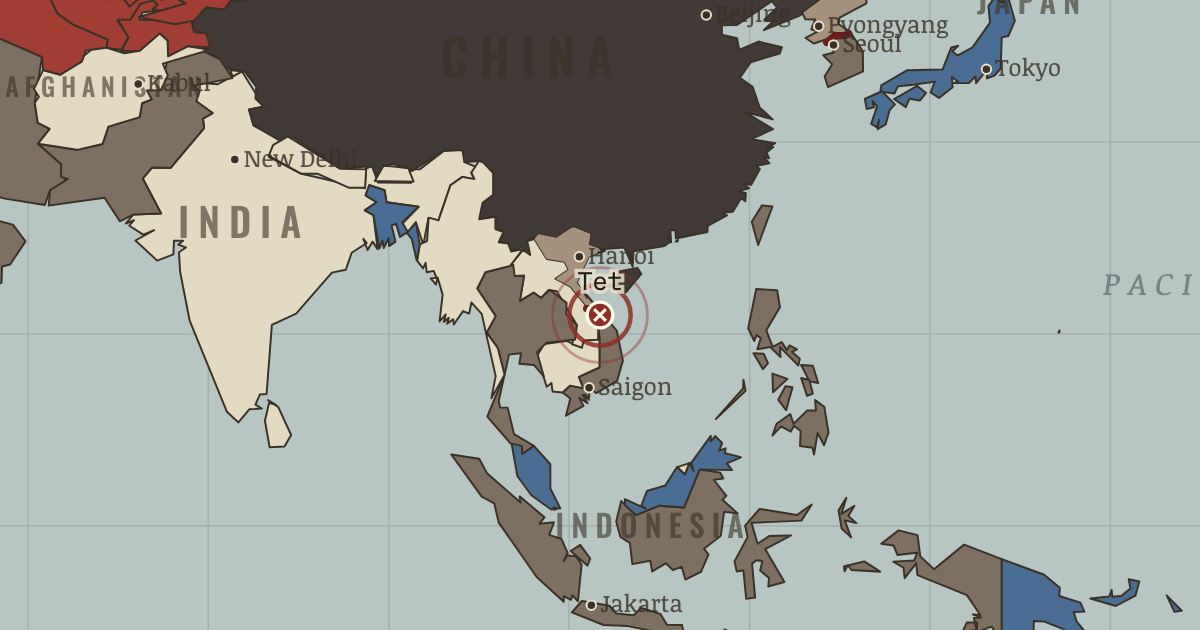
30 Jan 1968 — The NLF attacks 100 cities at once, including the Saigon embassy compound and Hue, which it holds for 26 brutal days. Hanoi suffers a military defeat. On American television, however, the offensive ends the promise of “light at the end of the tunnel.”
WW2 is free in full, and chapter 1 of every atlas is free. A free account opens 3 more chapters a day. Starter, at $9 a month, opens all 21 with no daily limit — see the plans.
France’s defeat at Dien Bien Phu in 1954 ended its colonial war, but it did not settle Vietnam’s future. The country was divided pending elections for reunification, and those elections were never held. As American involvement grew, officials saw the survival of South Vietnam as evidence on which allies elsewhere might judge US promises. A retreat could therefore seem dangerous well beyond Vietnam. This concern made further commitment attractive even when successive governments in Saigon failed to establish broad allegiance among the people they claimed to govern.
From Vietnam War, chapter 7 of The Cold War, 1945–1991 (AUG 1968).
Why it happened — The domino logic and its critics. The domino theory made a Vietnamese struggle against foreign rule appear part of a worldwide threat from Moscow and Beijing. Yet the movement led by…
The turn — Tet, 30 January 1968 — the hinge of perception. The attacks launched on 30 January 1968 brought the war into cities across South Vietnam. Communist forces failed to hold the major cities and paid…
What it changed — The costs, counted honestly. The Vietnamese military and civilian dead are commonly estimated at 1.5–3.6 million across both zones. Hundreds of thousands died in Laos and…