Norse and Aztecs · EPILOGUE ·
Norse and Aztecs compared
Chapter 12 of Climate and Innovation: The Norse and the Aztecs, c. 790–1521: “Two Answers to the Environment”
The Norse met a cold, scattered environment with mobility: ships, seasonal hunting, trade and assemblies. The Mexica met a rich but closed lake basin with concentration: dikes, aqueducts, raised fields and a tribute empire feeding perhaps 200,000 people. Norse Greenland, of perhaps 2,000–2,500 people, had no reserves.
Chapter 12 is included with every paid plan. WW2 is free in full, and chapter 1 of every atlas is free. A free account opens 3 more chapters a day. Starter, at $9 a month, opens all 21 with no daily limit — see the plans.
Free printable Norse and Aztecs study guide, sent by email ↓
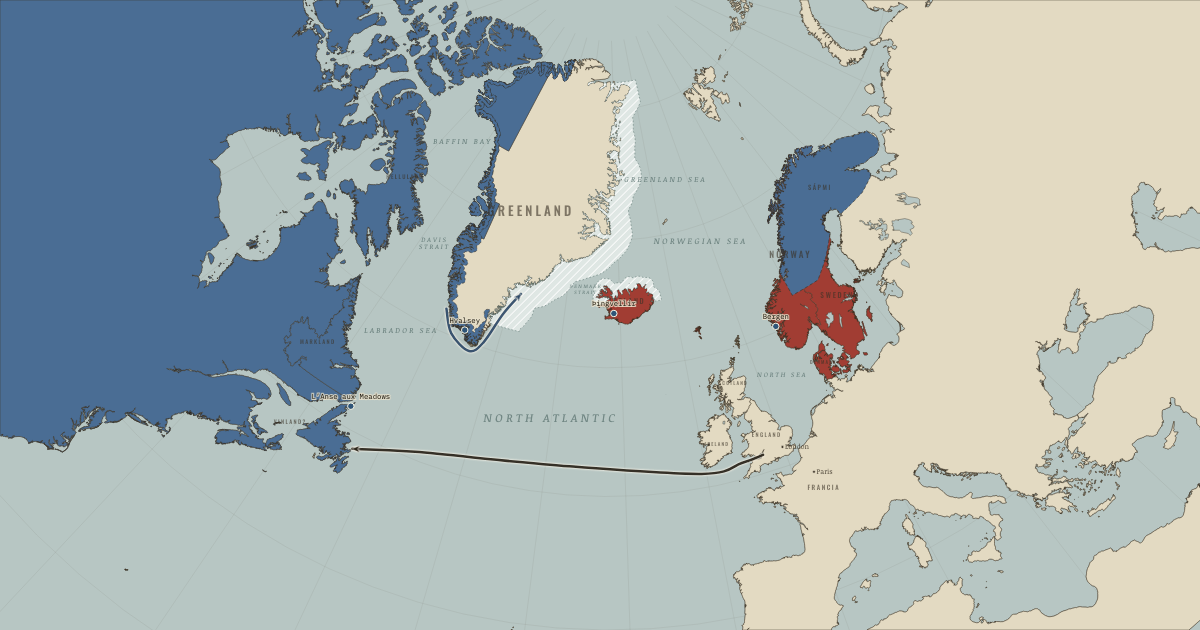
The map above is the world of The Norse North Atlantic, 1500 — Inuit Greenland; Orkney and Shetland to Scotland.
Every state on the map that year: The world in 1500 · Europe in 1500.
Part of IB History: The Norse and the Aztecs →
SHORT EXPLANATION
The Norse and the Mexica found different ways to live in demanding environments. Norse seafarers linked scattered North Atlantic communities with ships, combining livestock farming with seasonal hunting, trade and assemblies. The Mexica, often called the Aztecs, organized labor around a fertile but closed lake basin. Dikes, aqueducts, raised fields and tribute supported Tenochtitlan, an island city of perhaps 200,000. Their solutions drew on the opportunities available in each place.
Norse Greenland's perhaps 2,000–2,500 people adapted as conditions changed, but farming at the margin and dependence on one major export left little room when climate, trade and isolation converged. The settlers eventually left. The Mexica could draw food from lake, markets and empire, yet siege and epidemic overwhelmed their city in 1521. Inuit, who had reached Greenland two centuries earlier with boats and harpoons suited to sea ice, remained; Spanish colonists took the Mexican city and later drained its lake. On the map of about 1500 the Norse farms stand empty, and John Cabot's 1497 voyage reaches what was probably Newfoundland. Clinker ships of overlapping planks, stockfish, Iceland's assembly and the chinampa, a raised lake field, survived changes in political power.
The full story
Climate entered the two histories on different timescales. Relatively warm conditions around 950–1250 made farming possible in Greenland's fjords. Cooling after roughly 1275–1300, and drying near the Eastern Settlement, narrowed the margin on which farms depended. Greenlanders ate more seals and changed their trade as they adjusted to the pressures on their colony.
In the Basin of Mexico, the Mexica faced sudden shocks as well as longer periods of difficulty. Floods came in 1449 and 1499; frost and drought struck in 1450–54, with tree rings supporting evidence of drought in 1452–54. A longer drought from 1514 to 1539 overlapped conquest and epidemic. Waterworks and storage helped the Mexica respond, as did access to food from warmer lands. Climate mattered in both places, but neither society faced climate alone.
The resources available to meet these pressures were very different. Norse Greenland may have had 2,000–2,500 inhabitants, roughly the population of one of Tenochtitlan's seventy neighborhoods. The Basin of Mexico may have held 1–1.5 million. A large population could provide labor for dikes and chinampas—fields raised from the lake bed—and sustain supply networks that helped the Mexica survive famine. Yet feeding so many people also depended on connections a besieging army could attack.
In Greenland, by contrast, a lost ship, failed hay harvest or slump in ivory prices fell on a small community with limited reserves. Population did not determine either ending by itself. It affected the labor, supplies and connections available, and how much loss each society could absorb. The cost chart below shows the difference in scale.
The legacies extend beyond the settlements' endings. Inuit boats, harpoons and lamps suited life on sea ice; the Norse farming landscape at Kujataa, including Hvalsey, is now a World Heritage site. Iceland retained its law and literature. In Mexico Spanish authorities rebuilt the city and chose to drain the lake. They began the Huehuetoca tunnel in 1607–08, but in 1629, with it closed for repairs, heavy rain left the city flooded for about five years. Drainage continued for centuries. Today groundwater pumping compacts the old lake clay, and parts of Mexico City sink by up to about 50 centimeters a year. At Xochimilco, chinampas are still farmed. Communities could keep using some techniques even as the states around them changed.
FULL EXPLANATION
Comparing two very different societies
A comparison of Norse Greenland and the Mexica puts very different kinds of evidence side by side. Sagas, annals and excavated farms inform the Greenland case; codices, post-conquest chronicles and the archaeology of a buried city inform the Mexican one. Their populations differed by several hundred times, as did their political organization and technology. Slow North Atlantic cooling was a different challenge from drought or siege in a tropical highland basin. What can the comparison do? It lets us ask of both cases whether connections spread risk or concentrated it. The long survival of the clinker ship and the chinampa suggests that adaptable techniques could outlast the societies that used them. Similar outcomes alone do not establish the same mechanism, however, and differences in scale and evidence limit what the comparison can settle.
From managing the lake to draining it
Spanish authorities inherited floods when they rebuilt their city on Tenochtitlan's ruins. As Vera Candiani's history explains, they chose to empty the lakes, replacing the dikes and canals the Mexica had maintained for a century. Enrico Martínez's tunnel at Huehuetoca was dug in 1607–08 by a huge forced Indigenous workforce, and soon collapsed in places. When rain began on 21 September 1629, the city remained largely underwater until 1634. Drainage works continued into the twentieth century. A later problem developed beneath the former lake bed. Estelle Chaussard and colleagues showed in 2021 that pumping groundwater compacts its soft clay. The thickest clay produces the fastest sinking: parts of the city subside by up to about 50 centimeters a year, and the compaction cannot be reversed. A lake once managed for food and defense has become a hazard beneath a city of more than twenty million people.
What the two cases can and cannot teach about climate change
Jared Diamond presented Norse Greenland as a warning about societies unwilling to adapt. Andrew Dugmore and Thomas McGovern dispute the premise: Greenlanders changed their diets and hunting, but faced a convergence of environmental, economic and other pressures that no single choice could have avoided. The Mexica, meanwhile, are often praised as masters of sustainable water management. Their engineering was impressive, yet its supporting system also required tribute and forced labor, and it fell to siege and epidemic. These cases direct our attention to the resources and connections through which societies meet shocks, as well as to the shocks themselves. A small society's dependence on one resource and a large society's concentration in one place create different exposures. Spreading risk and retaining the ability to change are useful questions for modern societies, though the two cases do not provide a ready-made prescription.
Key places on the map
Why it happened
Different environments demanded different answers. Grass and rich seas in the North Atlantic lay in scattered pockets separated by dangerous water. Ships, hunting and trade connected those resources. In the Basin of Mexico, a fertile lake system lay concentrated in a closed valley, where organized labor and waterworks could support cultivation. Each environment offered possibilities as well as difficulties, and the societies built different responses around them.
Scale shaped resilience. A few thousand people at most lived in Norse Greenland, compared with perhaps 1–1.5 million in the Basin of Mexico. The contrast mattered for labor, food storage and the losses a community could absorb. Mexica rulers could draw workers for dikes and raised fields and supplies from a wide area. A lost ship or poor hay harvest placed a burden on Greenland's much smaller population. Institutions and connections also shaped what each society could do with its people.
Single points of failure decided both endings. Walrus ivory was central to Greenland's exports, and ships from Bergen connected the colony to Europe. As trade declined, alternatives were limited. Tenochtitlan's dependence was concentrated differently: its aqueduct, causeways and canoe routes crossed one lake, where attackers could cut or contest them. These connections help explain the endings alongside climate, markets, alliances and disease.
Other peoples with different systems replaced both. As Norse settlements withdrew from Greenland, Thule Inuit communities expanded with equipment suited to sea ice. In Mexico, Spanish colonists and Indigenous allies defeated the Mexica state. The colonists brought diseases, livestock and different engineering, and their authorities later changed the lake system. Each environment could support more than one way of life, though each came with its own costs and possibilities.
THE TURNING POINT
Hvalsey and Tenochtitlan: two kinds of ending. Hvalsey's church remains among abandoned Norse farms; colonial Mexico City rose over Tenochtitlan's ruins. Placed together, they show two different endings. Archaeology suggests orderly departure from some Greenland farms, although the choices and fates of all their inhabitants remain unknown. A small, distant society withdrew under accumulating pressures. Tenochtitlan fell in a violent siege, after which new rulers changed its lake system. The two endings differed in pace and in the evidence they left.
What it changed
Greenland becomes an Inuit land, then a Danish colony. Inuit communities had spread along Greenland's west and south coasts by about 1500. Danish colonization began in the eighteenth century and shaped the island for two hundred years. Greenland's colonial status ended in 1953; Home Rule followed in 1979 and Self-Government in 2009. In 2017 Kujataa, the farming landscape that includes Hvalsey and is associated with both Norse and Inuit farming, entered the World Heritage list.
The lake becomes a sinking city. One of the world's largest cities grew on the former lake bed. Pumping groundwater compacts its soft clay, and in some places, especially where that clay is thickest, the ground sinks by up to about 50 centimeters a year. Mexico City still faces flooding and water-supply problems. The challenge of living with water in a closed basin has endured for five centuries.
A question for the present. How can societies adapt to a demanding climate, and which responses will last? That question now faces people dealing with climate change. These histories suggest examining whether resources, places, people and institutions spread risk or concentrate it, and whether institutions can change with conditions. Students can test that argument against the evidence and the differences between the cases.
DISCUSSION QUESTION — Which society’s response to its environment was more successful, and by what standard should success be judged?
We need a standard before choosing a winner. By scale and achievement, the Mexica sustained Tenochtitlan, a city of perhaps 200,000, through dikes, aqueducts, chinampas and tribute; their networks helped them survive famine and flood. Norse Greenland held at most a few thousand people and was abandoned. By duration, the comparison changes: Norse Greenland lasted about 450 years, longer than the Mexica empire's century of dominance after 1428, and Iceland still has its assembly and literature. Both traditions also left innovations in use: clinker construction, stockfish and the Althing on one side, chinampas on the other. Neither ending can be attributed to climate alone. Economic and other pressures accumulated in Greenland; a coalition and epidemic confronted Tenochtitlan. A judgment of success should therefore identify its standard and consider the time over which a system worked and the human and natural shocks it faced.
An interesting fact
When the Norwegian priest Hans Egede sailed from Bergen in 1721, he hoped to find descendants of Greenland's medieval Norse settlers and bring them into the Lutheran church. Scandinavians did not know whether they had survived. Egede found Inuit communities, learned their language and stayed to work among them. His first mission was on a small island. In 1728 the colony moved to the mainland under Governor Claus Paarss as Godthåb, now Nuuk, Greenland's capital. The mission intended for the vanished Norse became part of the beginning of Danish rule over the Inuit who lived there.
Related
THE FREE PRINTABLE STUDY GUIDE
Get the printable study guide for Climate and Innovation free. I’ll send you a few short letters, then one when a new atlas opens. That’s all. — Paul
NO TRACKING · YOUR ADDRESS IS USED FOR THE DISPATCH AND NOTHING ELSE · UNSUBSCRIBE ANYTIME