American Civil War · CHAPTER 8 ·
Gettysburg and Vicksburg
Chapter 8 of The American Civil War, 1840–1877: “The Twin Turning”
Two Union victories a day apart in July 1863 turned the war. At Gettysburg Union forces held for three days and Pickett’s Charge failed on 3 July; on 4 July Vicksburg surrendered to Grant after a 47-day siege, and with the fall of Port Hudson the Union controlled the Mississippi and split the Confederacy.
Chapter 8 is included with every paid plan. WW2 is free in full, and chapter 1 of every atlas is free. A free account opens 3 more chapters a day. Starter, at $9 a month, opens all 21 with no daily limit — see the plans.
Free printable American Civil War study guide, sent by email ↓
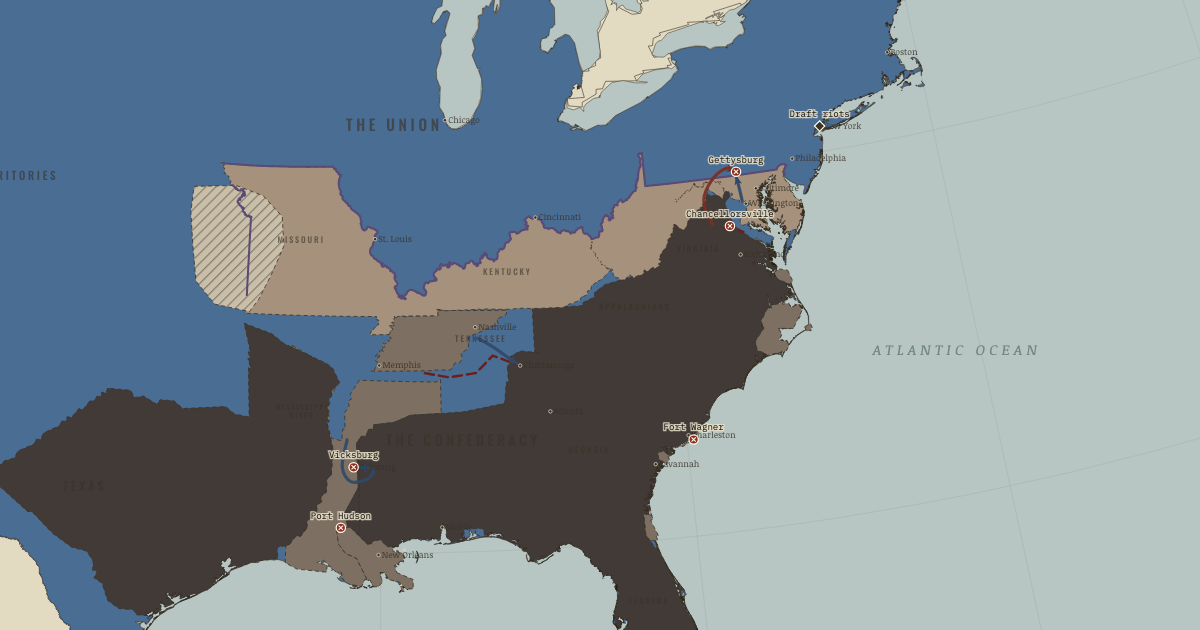
The map above is the world of The United States, July 1863 — The twin blow — Gettysburg and Vicksburg.
Every state on the map that year: The world in 1871 · Europe in 1871.
Part of IB History: The American Civil War →
SHORT EXPLANATION
In July 1863 two Union victories, a day apart, defeated different parts of Confederate strategy. Lee’s second invasion of the North ended at Gettysburg, where Union troops held their lines for three days and Pickett’s Charge failed. He escaped with his army, but it would mount no comparable strategic offensive again.
Grant’s victory at Vicksburg changed the geography of the war. After crossing the Mississippi, separating Confederate forces and besieging the city, he received its surrender on 4 July. Port Hudson soon followed, giving the Union control of the whole river and splitting the Confederacy. Black soldiers’ service and violent resistance to conscription that month showed how deeply the war was changing American society.
The full story
Lee carried the war into Pennsylvania in 1863 with several purposes. His army could find food away from ravaged Virginia, and a decision on Northern soil might shake confidence in the war. The armies met largely by accident at Gettysburg. Union troops established a strong defensive line and held both flanks; on 3 July Lee tried the center. In Pickett’s Charge, Confederate attackers crossed nearly a mile of open ground under artillery and rifle fire. About half fell. The two armies suffered roughly 51,000 casualties in the battle. Lee withdrew across the Potomac with his army damaged but intact, and it fought for two more years. He would not invade the North again.
Grant’s problem at Vicksburg was different. The fortress guarded the Mississippi, and canals and bayou operations had failed to give him a practicable approach from the north. He passed the batteries, moved below the city and crossed into open country. Drawing part of his supplies from the countryside, he defeated separated Confederate forces and kept Johnston and Pemberton from combining. He then besieged Vicksburg for 47 days. Its surrender on 4 July, followed by Port Hudson’s, opened a grey-tan corridor along the whole river on the map. Confederate territory west of the Mississippi remained in Confederate hands, but it could no longer reliably supply the armies east of it.
The two victories narrowed Confederate choices in different ways. Gettysburg denied Lee the military and political decision he sought; Vicksburg removed an army, a fortress and a transport route. The July map also points to a struggle within society. In New York, resistance to the draft became murderous racial violence. Black troops at Fort Wagner and elsewhere, meanwhile, pressed a claim to citizenship through service and sacrifice. The war’s turning point was military and geographic, but it also changed the political meaning of Union victory.
FULL EXPLANATION
Auditing the risk at Gettysburg
Lee had reason to think an attack on the center might succeed. His assaults on the flanks had nearly broken the Union line, and he believed the center had been weakened. To retreat without a decision would also mean abandoning the purpose of the campaign. Those considerations explain the choice; the plan still had to work across the ground in front of him. Its preliminary bombardment did much less damage than expected, the attacking units were imperfectly coordinated, and infantry had nearly a mile of exposed ground to cross. No fresh force was ready to exploit even a narrow breakthrough. Longstreet’s objections show that some difficulties were visible before the attack. Historians continue to debate Lee’s information and alternatives, but the decision also shows how the need for a decisive victory can make withdrawal harder to accept. Courage could not provide the firepower or reserves the plan required.
Why Vicksburg was harder to reverse
The difference between Gettysburg and Vicksburg lies partly in what each victory removed. Gettysburg stopped an invasion. Vicksburg captured roughly 30,000 defenders and took a fortress that controlled a vital transport route. Grant reached it by changing the approach after canals and swamps defeated his earlier attempts: he ran the river batteries, crossed south of the city and operated for a time away from a conventional supply line. Moving between Johnston and Pemberton, he prevented their forces from uniting. This did not mean an army could dispense with logistics. Naval transport, local food, intelligence and Confederate command failures all contributed to the campaign. Once Vicksburg and Port Hudson fell, restoring Confederate traffic would require regaining a long defended river, not merely winning one battle. That lasting loss of capacity gives Vicksburg a strong claim to be the more decisive victory.
Key places on the map
On this day
Why it happened
Why Lee rolled the dice again. Lee presented Davis with a difficult choice: remain behind the Rappahannock while supplies ran short, or invade while his army still had an advantage and seek a decision. Fredericksburg and Chancellorsville had given him reason to trust his soldiers. They also encouraged his belief that those men could break a Union line, a belief that discounted the protection rifled muskets and earthworks gave defenders. The third day at Gettysburg tested that confidence at great cost.
Vicksburg as a problem of approach. A direct river approach to Vicksburg meant facing its batteries; swamps protected the approaches from the north. Grant’s winter experiments with canals and bayous failed to solve the problem. He changed the direction of attack, moving south on the opposite bank and crossing into open country to approach the fortress inland. The defenders would have to fight or endure a siege. At Donelson and later Chattanooga, too, Grant looked beyond a strong front to the system sustaining a position.
Two societies under strain. As the armies’ needs grew, both governments turned to conscription; the Confederacy acted first, in 1862. Yet the burden was not shared equally. Northern men could pay $300 in commutation, while the Southern “twenty-negro” exemption protected certain overseers. Such provisions gave force to the complaint of a “Rich man’s war, poor man’s fight”. New York saw draft riots, and Richmond had bread riots that spring. Each society had to sustain the war amid anger over who bore its costs.
THE TURNING POINT
Vicksburg, 4 July 1863. Lee’s army survived Gettysburg and fought for two more years. Vicksburg produced a loss harder to reverse: about 30,000 defenders were captured, and with Port Hudson’s fall the Union secured the Mississippi. Confederate territory beyond the river was cut off from reliable communication with the east. This is the case for calling Vicksburg the more decisive of the two famous victories. Grant’s success also helped bring him command of all Union armies.
What it changed
The Confederacy is halved. Move the map forward and look at Texas, Arkansas and western Louisiana. They remain charcoal, still Confederate territory, but a Union-controlled Mississippi separates them from the eastern armies. The trans-Mississippi region has become much less able to support the main war effort across the river.
Black soldiers change the war’s meaning. In the summer of 1863 Black soldiers fought and suffered casualties at Fort Wagner, Port Hudson and Milliken’s Bend. Their service challenged Northern doubts about whether Black men would fight, and it strengthened a claim that reached beyond the battlefield. Frederick Douglass put it this way: “He who fights the battles of America may claim America as his country. And have that claim respected.” The Fourteenth and Fifteenth Amendments would later address citizenship and voting rights. Confederate fury at Black service also had deadly consequences, as Chapter 9 shows at Fort Pillow.
The last hope becomes political. The Confederacy could still hope to win politically after July 1863. If continued fighting cost the North enough, voters might reject the war and accept negotiated independence. Battlefield endurance would then serve a political purpose. The campaigns of 1864 unfolded with the November election in view.
DISCUSSION QUESTION — Pickett’s Charge is remembered as an emblem of doomed valor. Was it a blunder or a calculated risk that failed?
Lee’s decision had a purpose. After two days in which Confederate attacks nearly broke the Union flanks, he believed the center had been thinned. He assembled about 150 guns to suppress it and sent his freshest division across nearly a mile of ground. Retreat without a decision would defeat the invasion’s purpose. But the plan depended on calculations that could be challenged. The bombardment largely overshot amid smoke and fuse problems, Union guns covered the stone wall and copse, and the exhausted Confederate army had little capacity to exploit even a breakthrough. Longstreet warned that no 15,000 men could take that ground. Within the hour the attack had failed. It was a calculated risk whose weaknesses were visible at the time; the need to vindicate the campaign made withdrawal harder for Lee to accept.
An interesting fact
Mary Virginia “Jennie” Wade was kneading dough in her sister’s kitchen on the morning of 3 July when a stray bullet passed through two wooden doors and killed her. Twenty years old, she was the only civilian killed in the battle among Gettysburg’s roughly 2,400 residents. After the armies left, about 21,000 wounded remained in and around the town, and thousands of dead men and horses had to be buried in the July heat. A soldiers’ cemetery was chartered to meet the emergency. In November Lincoln was invited, almost as an afterthought, to offer “a few appropriate remarks” there.
Related
THE FREE PRINTABLE STUDY GUIDE
Get the printable study guide for The American Civil War free. I’ll send you a few short letters, then one when a new atlas opens. That’s all. — Paul
NO TRACKING · YOUR ADDRESS IS USED FOR THE DISPATCH AND NOTHING ELSE · UNSUBSCRIBE ANYTIME