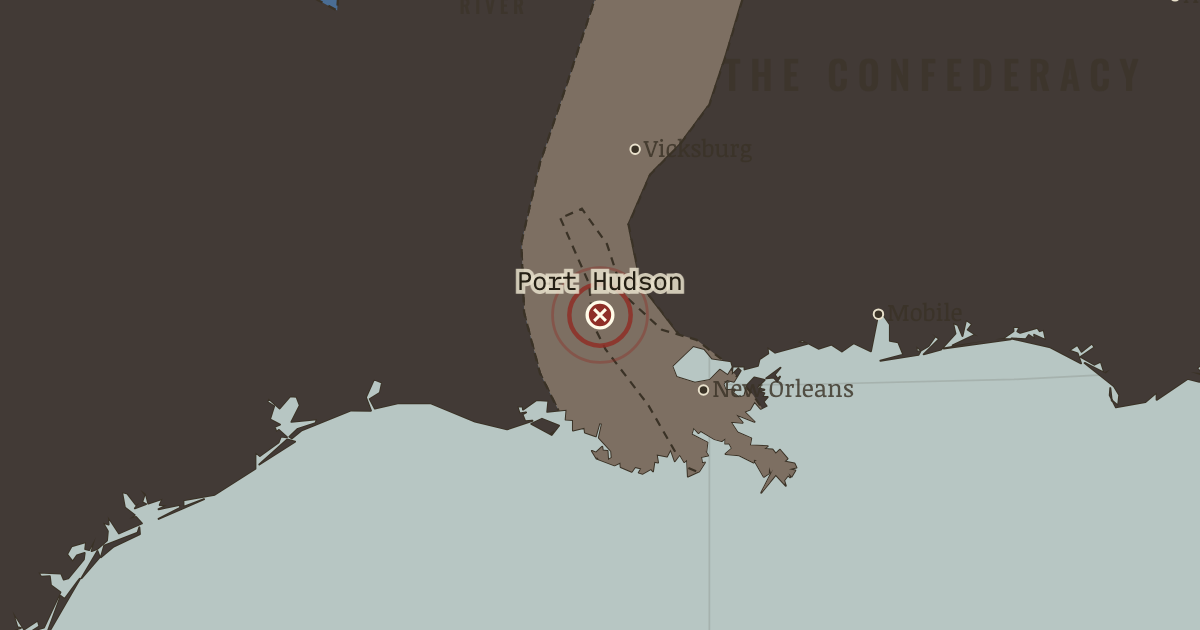
9 Jul 1863 — Five days after Vicksburg falls, the last Confederate post on the river surrenders at Port Hudson. Lincoln writes that “The Father of Waters” “again goes unvexed to the sea.”
WW2 is free in full, and chapter 1 of every atlas is free. A free account opens 3 more chapters a day. Starter, at $9 a month, opens all 21 with no daily limit — see the plans.
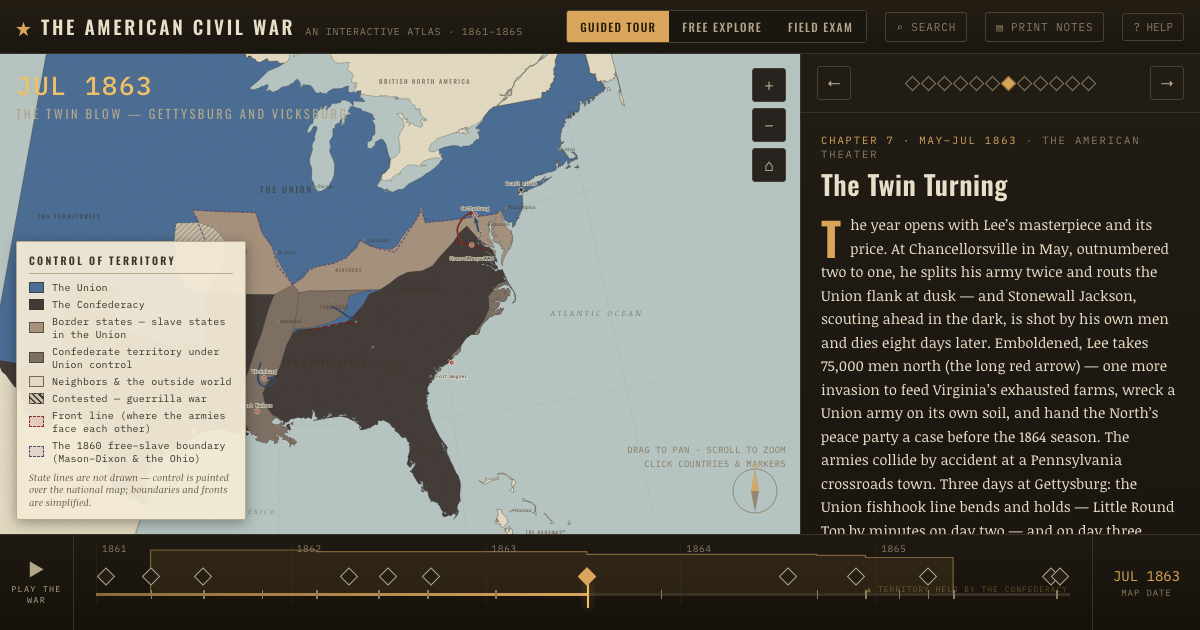
Lee carried the war into Pennsylvania in 1863 with several purposes. His army could find food away from ravaged Virginia, and a decision on Northern soil might shake confidence in the war. The armies met largely by accident at Gettysburg. Union troops established a strong defensive line and held both flanks; on 3 July Lee tried the center. In Pickett’s Charge, Confederate attackers crossed nearly a mile of open ground under artillery and rifle fire. About half fell. The two armies suffered roughly 51,000 casualties in the battle. Lee withdrew across the Potomac with his army damaged but intact, and it fought for two more years. He would not invade the North again.
Why it happened — Why Lee rolled the dice again. Lee presented Davis with a difficult choice: remain behind the Rappahannock while supplies ran short, or invade while his army still had an…
The turn — Vicksburg, 4 July 1863. Lee’s army survived Gettysburg and fought for two more years. Vicksburg produced a loss harder to reverse: about 30,000 defenders were captured, and…
What it changed — The Confederacy is halved. Move the map forward and look at Texas, Arkansas and western Louisiana. They remain charcoal, still Confederate territory, but a Union-controlled…
Then ask the room: Pickett’s Charge is remembered as an emblem of doomed valor. Was it a blunder or a calculated risk that failed? The argued answer is on the chapter page →