American Civil War · CHAPTER 3 ·
Secession crisis and Fort Sumter
Chapter 3 of The American Civil War, 1840–1877: “Secession Winter”
Between Lincoln’s election and his inauguration in March 1861, seven Deep South states seceded and founded a Confederacy whose constitution protected slavery. Lincoln chose to send only food to Fort Sumter in Charleston harbor; Confederate guns opened fire on 12 April 1861, and the Upper South then joined the Confederacy.
Chapter 3 is included with every paid plan. WW2 is free in full, and chapter 1 of every atlas is free. A free account opens 3 more chapters a day. Starter, at $9 a month, opens all 21 with no daily limit — see the plans.
Free printable American Civil War study guide, sent by email ↓
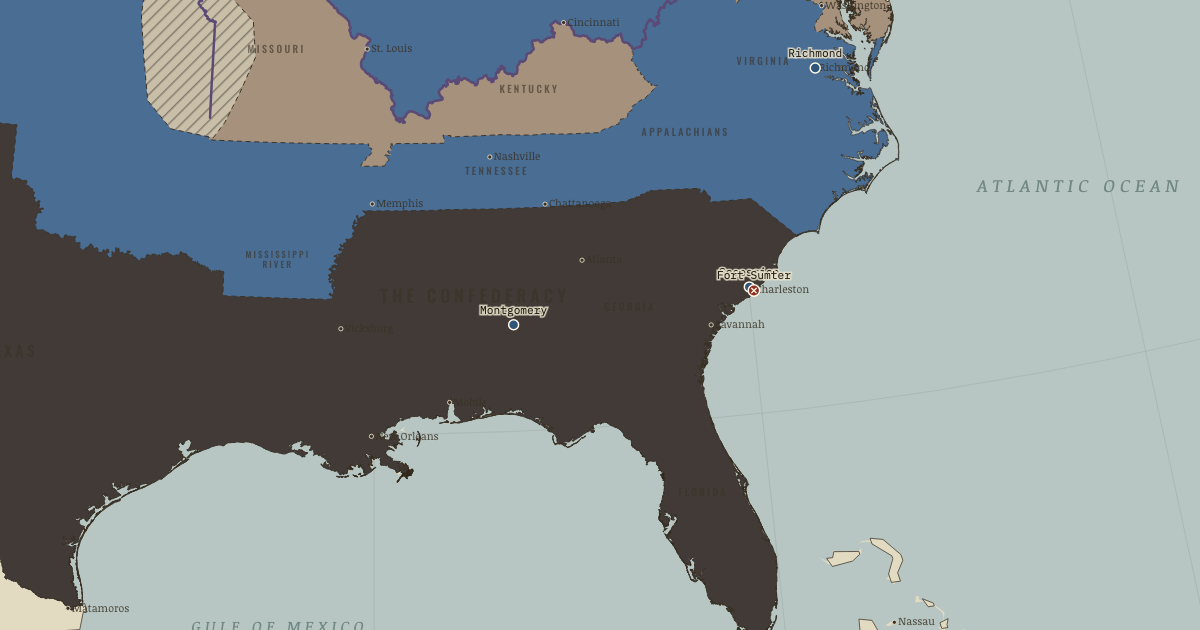
The map above is the world of The United States, April 1861 — Sumter — the house divides.
Every state on the map that year: The world in 1871 · Europe in 1871.
Part of IB History: The American Civil War →
SHORT EXPLANATION
Lincoln’s election in November 1860 settled who would become president, but it did not give him office until March. During that interval seven Deep South states left the Union, seized federal property and formed a Confederacy whose constitution protected slavery. Buchanan considered secession illegal, yet denied that he could use force to stop it. Four Upper South states remained outside the Confederacy, while a federal garrison held Fort Sumter in Charleston harbor.
Sumter put the rival claims to a practical test. Lincoln announced that he would send the garrison provisions; Confederate leaders would have to accept the continuing federal presence or use force against it. Their guns opened fire on 12 April 1861. Lincoln’s call for volunteers then confronted the Upper South with a choice about fighting its neighbors. Virginia, Arkansas, Tennessee and North Carolina seceded, while persuasion and force kept the border slave states in the Union. Their decisions shaped the geography of the war.
The full story
The four months between election and inauguration gave secessionists time to act before Lincoln could exercise presidential power. Buchanan regarded secession as illegal, but he also held that the federal government could not lawfully prevent it by force. While Washington remained caught between those positions, seven Deep South states left the Union, seized federal forts and arsenals, and established a government at Montgomery. Its constitution guaranteed slavery. Lincoln, meanwhile, rejected the Crittenden compromise: it would have permitted slavery’s expansion, the issue his election had settled. By March he faced an organized Confederacy, not simply a threat to create one.
The federal garrison at Fort Sumter stood inside Charleston harbor, where its flag represented a claim the new Confederacy could hardly ignore. Lincoln had reason to keep it there: evacuation would surrender the federal position. Sending armed reinforcements, however, risked beginning the fighting himself. He announced a mission to supply provisions instead. Jefferson Davis now had to decide whether to let food reach the fort and allow the federal claim to stand, or fire and risk appearing to Northern observers as the aggressor. Davis chose bombardment. He believed, in part, that a fight would bring the Upper South into the Confederacy; Lincoln’s subsequent call for troops helped make that calculation come true.
The eleven Confederate states did not all make their decisions at the same moment. Seven cotton states seceded between December 1860 and February 1861 to defend slavery. Virginia, Arkansas, Tennessee and North Carolina followed Sumter and Lincoln’s 15 April call for 75,000 volunteers. Their leaders also defended a slaveholding order, but their immediate decision was whether to furnish troops against neighboring states already in rebellion. The border slave states faced pressures of their own. Federal arrests and troop movements helped hold Maryland; rival governments fought over Missouri; and Kentucky’s declared neutrality ended when Confederate forces entered first. Unionist counties in western Virginia formed West Virginia.
These choices gave each side more than a line on a map. Maryland guarded Washington, Kentucky lay along the Ohio River, and Missouri commanded western rivers. Lincoln feared that an early attack on slavery in the loyal states might push the tan border belt into the charcoal Confederacy. Keeping those states therefore shaped what his government could attempt as well as where its armies could fight.
FULL EXPLANATION
Sumter as a forcing choice
Sumter’s military size does not explain why either government cared so much about it. A federal flag in Charleston harbor represented a claim to authority in territory the Confederacy claimed as its own. Lincoln’s notice that he would send provisions preserved that claim while placing the next decision before Davis. If he allowed the food through, the garrison could stay; if he fired, Northern opinion might unite against the Confederacy. Davis had reasons to find delay costly. The new government needed to demonstrate that it could enforce its claims, and its leaders hoped to bring the Upper South into their coalition. Lincoln created the dilemma, but Confederate leaders retained a choice and chose to fire. Sovereignty, reputation and the need for allies had given a small position political weight far beyond its military value.
Why the border states constrained policy
The Union could not easily replace the people, industry, rivers and transport routes of the loyal slave states. Maryland surrounded Washington on three sides. Kentucky lay along the Ohio and opened routes into Tennessee; Missouri connected the Mississippi and Missouri rivers to the West. Losing them would change both the defense of the capital and the conduct of campaigns. Lincoln consequently combined restraint with coercion. He used arrests and suspended habeas corpus in Maryland, but left Kentucky’s declared neutrality alone until Confederate troops violated it. Those actions invite constitutional and moral criticism. Their strategic purpose was to prevent crucial states from joining the Confederacy: Lincoln feared that immediate emancipation or indiscriminate force could push them away. Holding the border later gave the Union a stronger military position from which to pursue broader emancipation.
Key places on the map
On this day
Why it happened
A four-month vacuum of power. Before Lincoln’s March inauguration, Buchanan faced states claiming to have left the Union. He considered their action illegal, but denied that coercion was lawful. That left the federal government without a policy for stopping them as Deep South leaders seized forts and arsenals and organized a government. Lincoln inherited an established claim to authority backed by institutions and territory.
The secessionists’ own words. Why did the secessionists act? Their own declarations place slavery at the center. Mississippi stated: “our position is thoroughly identified with the institution of slavery, the greatest material interest of the world.” Alexander Stephens, the Confederate vice-president, described slavery as the “cornerstone” of the new state. Later accounts offered different explanations, but these founders made their commitment explicit.
Sumter as a designed dilemma. Lincoln’s provision mission made the presence of the federal flag at Sumter Davis’s immediate problem. Let the food through, and the garrison could remain in Charleston harbor; fire, and Northerners could see the Confederacy as responsible for opening hostilities. Davis hoped a confrontation would bring in the Upper South. It did, but the attack also helped unite a divided North behind the Union.
Why the border stayed. Lincoln needed the border states and treated them with both force and restraint. He suspended habeas corpus in Maryland and accepted a rump legislature in Missouri. Kentucky’s declared “neutrality” he left alone until Confederate troops occupied Columbus. He is said to have remarked, “I hope to have God on my side,” and “but I must have Kentucky”. The states that stayed supplied the Ohio River line, Missouri’s rivers, roughly 400,000 white men of military age and, later, tens of thousands of Black recruits.
THE TURNING POINT
Fort Sumter, 12–14 April 1861. Confederate guns bombarded Sumter for about 34 hours on 12–14 April 1861. No one died in combat, but the firing settled a question that rival constitutional claims could not: force would be used. Lincoln called for volunteers, and four Upper South states joined the Confederacy. The small garrison had become the place where each government’s claim demanded a decision.
What it changed
The upper South flips — and doubles the war. Virginia’s entry gave the Confederacy Robert E. Lee and the Tredegar Iron Works, the South’s only great foundry. It also brought the Confederate border close to Washington. When the Confederate capital moved to Richmond, the two capitals stood about a hundred miles apart. The campaigns between them would be among the war’s bloodiest; chapters 6–9 follow that struggle.
West Virginia is born. Virginia’s western mountain counties had fewer enslavers and longstanding grievances against a tidewater legislature that taxed their land while spending money farther east. They refused to follow Richmond. Within weeks, delegates at Wheeling declared the secession ordinance void and established a “Restored Government of Virginia.” Its consent supplied the legal means to create West Virginia, admitted to the Union on 20 June 1863 with a gradual-emancipation clause. Contemporaries recognized the constitutional irony: a government fighting secession accepted the division of a state. Lincoln treated it as a wartime necessity. The tan belt through the Alleghenies shows the result.
The border war begins. Missouri’s conflict continued beyond Wilson’s Creek in four years of ambush and reprisal across the hatched country on the map. Quantrill and “Bloody Bill” Anderson became figures in the guerrilla war; the Union’s Order No. 11 emptied whole counties of residents. Veterans of this bitter theater, including the James brothers, carried its violence into the postwar West.
DISCUSSION QUESTION — Many advisers urged Lincoln to evacuate Sumter and gain time. Was his decision to provision it a mistake?
Evacuation might have postponed fighting, but it would also have left the Confederacy in possession of Sumter while both sides courted the border states and European consuls were already in Montgomery. That would weaken the federal claim that secession was void. Resupply put the visible decision to fire on Davis, helped unite the North and kept Britain cautious. The resulting call for volunteers nevertheless helped bring Virginia and three other states into the Confederacy. Lincoln gained a political advantage at the cost of a much larger war; a judgment of the decision must reckon with both.
An interesting fact
The bombardment killed no soldier in combat. Under the surrender terms Major Anderson could fire a hundred-gun salute to his flag before the garrison marched out. On 14 April 1861, halfway through, a gun discharged prematurely and killed Private Daniel Hough, an Irish-born regular. The salute stopped at fifty rounds. Anderson carried the flag north and raised it over the ruined fort again exactly four years later. The war would kill more Americans than both World Wars combined.
Related
THE FREE PRINTABLE STUDY GUIDE
Get the printable study guide for The American Civil War free. I’ll send you a few short letters, then one when a new atlas opens. That’s all. — Paul
NO TRACKING · YOUR ADDRESS IS USED FOR THE DISPATCH AND NOTHING ELSE · UNSUBSCRIBE ANYTIME