American Civil War · CHAPTER 2 ·
Causes of the American Civil War
Chapter 2 of The American Civil War, 1840–1877: “A House Dividing”
By 1860 about four million enslaved people produced the cotton that made up a majority of American exports, and slavery underpinned Southern wealth and political power. Kansas–Nebraska, Dred Scott and John Brown’s raid broke the compromises of the 1850s, and Lincoln’s purely sectional election in November 1860 set off secession.
WW2 is free in full, and chapter 1 of every atlas is free. A free account opens 3 more chapters a day. Starter, at $9 a month, opens all 21 with no daily limit — see the plans.
Free printable American Civil War study guide, sent by email ↓
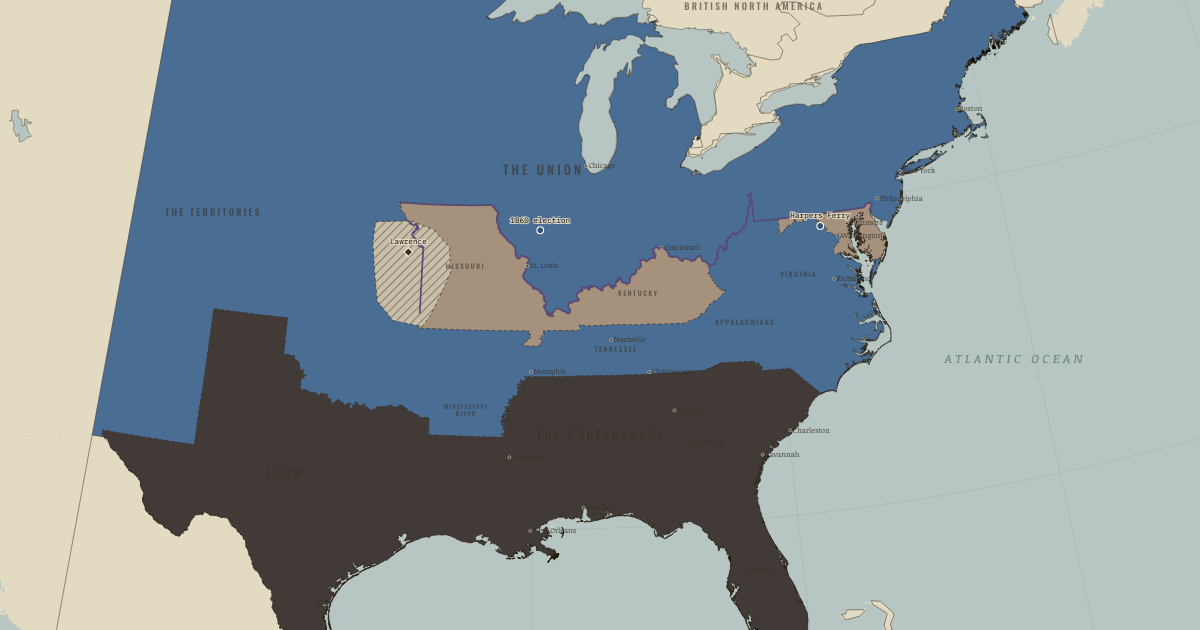
The map above is the world of The United States, April 1861 — Sumter — the house divides.
Every state on the map that year: The world in 1871 · Europe in 1871.
Part of IB History: The American Civil War →
SHORT EXPLANATION
By 1860 roughly four million enslaved people produced cotton that made up a majority of American exports. Slaveholders also counted those people as property, collectively the largest form of property in the country. Slavery was therefore a source of wealth and political power as well as a system of forced labor. A challenge to it threatened the position of those who profited from it, and made agreement over the country’s future difficult.
The western territories brought that future into dispute. New slave states could add votes in Congress and sustain demand for enslaved people; confinement to the existing South, slaveholders feared, would begin a slow decline. Kansas–Nebraska reopened the territorial question, Dred Scott denied Congress power to exclude slavery, and John Brown’s raid intensified Southern fears of violence. Lincoln’s election in 1860 showed that a coalition opposed to slavery’s expansion could win the presidency without carrying a slave state. Deep South leaders saw their national power slipping away.
The full story
A plantation produced cotton by forcing people to work. To the slaveholder, those same people also represented property that could be sold or pledged, wealth on which planters, lenders, and states depended. Enslaved labor made the cotton South one of the world’s wealthiest agricultural regions, and expansion helped sustain the system: new plantations bought people sold from the Upper South, while new slave states could defend slavery in Congress. Slaveholders feared that shutting slavery out of the territories would diminish its value and political strength. Even Kansas, where cotton was not yet grown, could appear to them a question of survival.
For a generation, political bargains had maintained a rough balance between slave and free states. But settlement kept creating territories whose future had to be decided. The Kansas–Nebraska Act left that decision to settlers, and around Lawrence the contest became an armed struggle. The Supreme Court’s Dred Scott decision went further, holding that Congress could not bar slavery from the territories and declaring that Black Americans had no rights white people were bound to respect. John Brown’s raid on Harpers Ferry added another fear: many white Southerners concluded that the North intended to destroy slavery by force. Each crisis made the ground for a further bargain less secure.
The dashed sectional line on the map also shows a division in political power. The free-state population had grown large enough to elect a president without the slave states. In 1860 Lincoln carried every free state and lost every slave state. He proposed stopping slavery’s spread, not abolishing it in the states, yet Southern leaders could see that a coalition hostile to expansion had won national power without them. Secession was partly a refusal to accept the election’s result and the prospect of lasting minority status.
The people most directly affected had no vote in the conventions deciding their future. Enslaved people nevertheless shaped the crisis through escape and resistance, and through testimony that fed abolitionism. The Union was being asked to govern a slaveholding South alongside a growing free-state majority; every decision about another territory put that arrangement under renewed pressure.
FULL EXPLANATION
Why expansion protected existing slavery
A slaveholder in the Upper South had a stake in expansion even without moving west. Buyers establishing plantations in new areas created demand for people sold from states such as Virginia. That demand supported the prices attached to human beings treated as property. Expansion also promised new slave-state votes in Congress and reassured lenders who relied on the value of that property. This helps explain why Kansas mattered to slaveholders even though cotton was not central there. Would containment actually have caused slavery to decline quickly? Historians disagree. Some stress its profitability and adaptability; others emphasize its dependence on fresh land and political power. The evidence does not show an institution about to collapse by itself. It does show why slaveholders feared a policy that left slavery legal in 1860 but altered expectations about markets, migration, and political influence. Those fears helped lead to secession.
Cause, argument, and mechanism
The seceding states left accounts of what they were trying to protect. Mississippi called slavery its greatest material interest; South Carolina emphasized Northern resistance to returning fugitives. Their constitutional arguments included states’ rights, but slave states also demanded strong federal action when it protected slavery, as the Fugitive Slave Act did. The apparent inconsistency makes sense when we look at the interest the arguments served. Economic interests belonged to that same system: wealth rested on enslaved labor and ownership. This explanation concerns the decisions of state conventions. It does not require every Confederate soldier to have had the same motive, or make disputes over tariffs and parties imaginary. Slavery was the institution at stake, its wealth gave the conflict force, and constitutional theory framed its defense.
Key places on the map
On this day
Why it happened
Slavery as capital, not merely labor. A person enslaved in Virginia could be sold to a buyer in Mississippi or another area open to slavery. Demand from such markets sustained the value slaveholders assigned to people they claimed as property. Expansion offered political protection too, through new slave states. Closing the frontier threatened both expectations, although historians differ about how quickly containment would have weakened slavery.
Two economies, two civilizations. Factories, railroads, public schools, and immigrant cities grew in the free states. The South’s highly profitable plantation economy depended on enslaved labor. Each section accused the other of betraying the Founders. Disputes over tariffs, homesteads, and railroads could thus become entangled with the future of slavery and the balance of power between the sections.
The machinery of compromise breaks. Earlier bargains had given each section something it could accept. Kansas–Nebraska removed the Missouri Compromise’s fixed boundary at 36°30′; Dred Scott then held that Congress could not exclude slavery from territories at all. The institutions needed to negotiate a new bargain were under strain as well. In 1856 Senator Charles Sumner was caned on the Senate floor, making the chamber itself a scene of violence.
The sectional math of 1860. Population growth gave the free states enough electoral strength to choose a president on their own. Lincoln’s 1860 victory demonstrated it: he carried every free state and lost every slave state. Southern leaders now faced the prospect of continuing in the Union as a political minority. Secession was partly a refusal to accept both that prospect and the immediate election result.
THE TURNING POINT
6 November 1860 — the election. Lincoln sought to bar slavery from the territories; his platform did not propose freeing enslaved people in the states. Nevertheless, his election on 6 November 1860 revealed a change in power. A coalition opposed to slavery’s expansion had won the presidency without carrying a slave state. Southern leaders had to reckon with a national government that could be elected without their support. South Carolina seceded within six weeks.
What it changed
Secession begins in the Deep South. The first state to leave was South Carolina. Six more cotton states followed between December and February, before Lincoln took office. The earliest departures came from the Deep South, where investment in slavery was especially great.
The upper South waits. Virginia, Tennessee, North Carolina, and Arkansas rejected secession in early 1861. Their men, food, and factories would be important to the Confederacy, yet Lincoln’s election alone had not persuaded them to leave. The fighting in April presented a new choice and changed their course, as the next chapter shows.
Both sides inherit a myth. Many Northerners imagined that a small planter clique had carried the Southern masses into secession. Many white Southerners, meanwhile, expected Northern shopkeepers to refuse to fight. Men in both armies went to Bull Run expecting the other side to run.
DISCUSSION QUESTION — Was the Civil War “about” slavery, states’ rights, or economics — and is that even a well-formed question?
The declarations of the seceding states tell us what their leaders said was at stake. South Carolina, Mississippi, Georgia, and Texas named threats to slavery among their reasons for leaving. Slaveholders also counted the people they owned as roughly four billion dollars in property. The economic interest was bound up with slavery itself. States’ rights supplied a constitutional argument for its protection, though slave states also demanded federal power when it served that purpose, as with the Fugitive Slave Act. These terms answer different questions. Slavery was the institution secessionists sought to protect; constitutional arguments defended it, and the wealth invested in it helps explain the urgency of that defense.
An interesting fact
In 1852 Harriet Beecher Stowe’s Uncle Tom’s Cabin sold some 300,000 American copies in its first year, a scale no novel had matched. Stage adaptations carried Eliza’s flight across the ice to people who might never read abolitionist argument. A familiar story has Lincoln greeting Stowe as “the little woman who wrote the book that started this great war.” It appears only decades later in family tradition, without a contemporary record, and is almost certainly embroidery. The book’s documented reach is striking enough: its story brought enslaved mothers and children before millions of Northerners while political compromises were failing.
Related
THE FREE PRINTABLE STUDY GUIDE
Get the printable study guide for The American Civil War free. I’ll send you a few short letters, then one when a new atlas opens. That’s all. — Paul
NO TRACKING · YOUR ADDRESS IS USED FOR THE DISPATCH AND NOTHING ELSE · UNSUBSCRIBE ANYTIME