Mongol Empire · 1279
Why did Song China fall when Japan and Vietnam did not?
The seminar question: “Why did the wealthy Song fall when Yuan invasions of Japan and Vietnam failed?”
Southern Song China held out for decades because its rivers, rice fields and fortified cities cancelled the advantages of cavalry. Khubilai’s Yuan dynasty turned to fleets and siege specialists: the siege of Xiangyang (1268–1273) opened the Yangzi, Hangzhou surrendered in 1276 and the last Song fleet was lost at Yamen in 1279.
Chapter 10 is included with every paid plan. WW2 is free in full, and chapter 1 of every atlas is free. A free account opens 3 more chapters a day. Starter, at $9 a month, opens all 21 with no daily limit — see the plans.
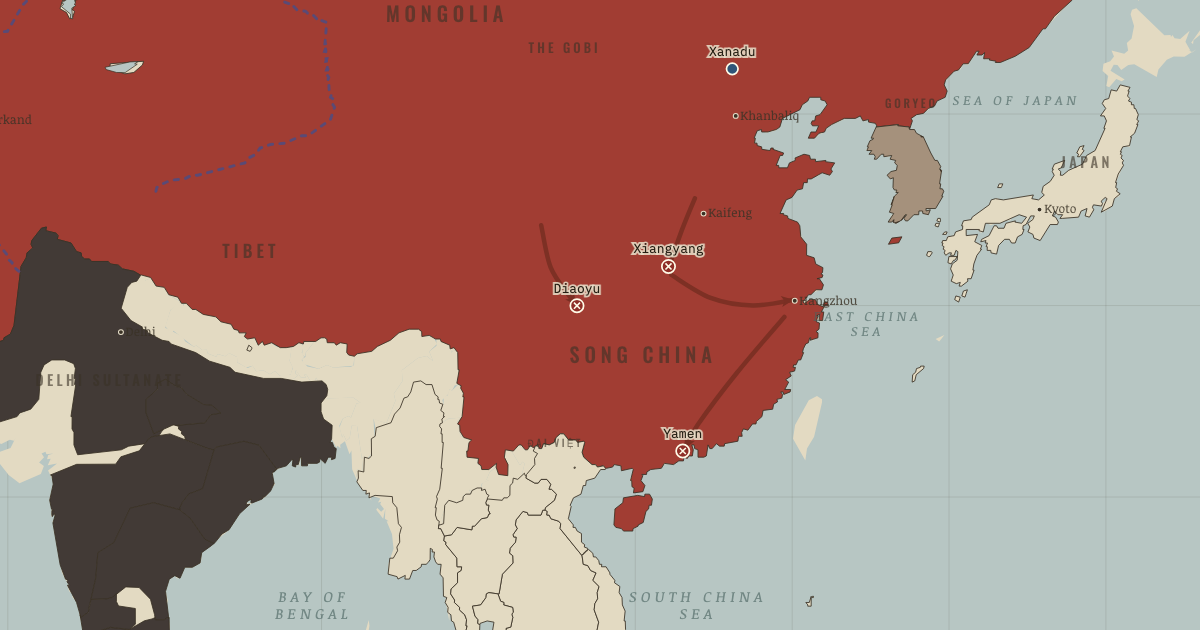
For decades the Southern Song could resist a method of war that had served the Mongols elsewhere. Its fortified cities received supplies by river, while wet rice fields and limited pasture restricted the movement and feeding of horses. A cavalry victory might defeat an army in the field without cutting a city off from the water routes that kept it alive.
The short answer
- The problem of water. A fortress supplied by river could survive the passage of a mounted army nearby. The Song had many such defenses, set among wet fields where pasture was scarce. To maintain pressure, the Mongols needed control of waterways, siege equipment and ways to feed troops on rice. They acquired and built these capabilities over decades. The roughly 45-year war shows the effort needed to overcome a wealthy state whose defenses were tied to its rivers. Japan, across the open sea, would pose a different problem.
- Song resources and divisions. Commerce gave the Song money to pay armies and replace losses; defenders also used gunpowder weapons. These resources had to be directed through a court divided by politics. Chancellor Jia Sidao has been accused of concealing the state of the war, and commanders who joined the Yuan carried useful knowledge to the other side, including naval expertise. In the final years supporters of child emperors continued resistance from the coast. Song wealth sustained a long defense, but it could not ensure that the dynasty’s resources and talents would all serve it effectively.
- A claim to rule China. Military pressure could induce a commander to consider surrender. Khubilai’s Yuan title and Chinese forms of government gave him a further reason to do so: there might be a place for him in the new administration. Hangzhou was surrendered, occupied and taxed rather than stormed. Compare it with Merv. The two cases show different means available to Mongol rulers, and the value of retaining an administrative center that could continue to work.
- Expertise across long distances. The family wars placed demands on Mongol resources, including through Kaidu’s revolt (Ch. 9), yet expertise still traveled between distant regions. Engineers associated with the Ilkhanate contributed counterweight trebuchets at Xiangyang. Korean and Chinese shipbuilding and naval skills served Yuan campaigns, while Central Asian financiers worked in the empire. Khubilai could bring these different kinds of knowledge to bear against the Song despite division among Mongol rulers.
THE TURNING POINT
Xiangyang and Fancheng, 1268–1273. For five years Yuan forces worked to take Xiangyang and Fancheng. Because the two cities could receive supplies by river, bombardment alone was not enough: the besiegers also had to isolate them and fight for control of the water. Counterweight engines added power to the attack, while the blockade sustained pressure on the defenders. Their fall opened the Han route toward the Yangzi. The siege also shows the reach of Mongol connections, along which engineers and weapons traveled as traders and scholars did.
What it changed
A reunited China under the Yuan. The Yuan brought much of China under one dynasty after centuries of political division, with its capital at Beijing. Its authority also encompassed Yunnan, formerly the Dali kingdom, and extended into Tibet through distinctive arrangements. Later Chinese dynastic histories counted the Yuan among the legitimate dynasties. The Ming and Qing inherited parts of this political geography, although both institutions and borders changed.
A capital nearer the Chinese tax base. A court at Beijing was well placed to draw on north China’s population, officials and taxes. It was also farther from Karakorum and the politics of the steppe. Khubilai still had to contend with rivals there, including Kaidu and his long resistance. When the Yuan lost Beijing in 1368, Mongol rulers continued to govern on the steppe (Ch. 12). The location of the capital helped the dynasty use one source of power while leaving another set of relationships to manage.
Fleets for further campaigns. The Song war left the Yuan with fleets and sailors drawn from Chinese and Korean resources. Khubilai sent expeditions against Japan, Vietnam and Java, but possession of ships did not settle how each campaign would be supplied. The first invasion of Japan preceded Yamen; another followed in 1281. Chapter 11 follows the Yuan into these different settings and the difficulties they encountered there.
The full answer, argued
The Song’s wealth paid for prolonged resistance, while giving the Yuan a valuable prize to pursue. Geography made sustained pressure possible: the states shared a land frontier, and after the Yuan built fleets and took Xiangyang, connected rivers offered routes into the south. Japan required a dangerous sea crossing. In Vietnam, distance, heat, disease and supply difficulties constrained the invaders. The outcome depended on the routes and resources needed to sustain an invasion as well as on the defenders’ wealth.
An interesting fact
Shangdu was Khubilai’s summer capital and the place where he was acclaimed in 1260. Marco Polo described its palace; his account appeared in Samuel Purchas’s travel anthology of 1613. Samuel Taylor Coleridge later said that he fell asleep after reading Purchas and composed “Kubla Khan” on waking: In Xanadu did Kubla Khan / A stately pleasure-dome decree. The archaeological site in Inner Mongolia became a World Heritage Site in 2012.
This is the study layer of Mongol conquest of the Song dynasty, chapter 10 of The Mongol Empire, 1206–1294; the full index of the atlas is here.
Related questions
THE FREE PRINTABLE STUDY GUIDE
Get the printable study guide for The Mongol Empire free. I’ll send you a few short letters, then one when a new atlas opens. That’s all. — Paul
NO TRACKING · YOUR ADDRESS IS USED FOR THE DISPATCH AND NOTHING ELSE · UNSUBSCRIBE ANYTIME