Mongol Empire · 1241
Did the death of Ögedei save Europe from the Mongols?
The seminar question: “Did Ögedei’s death save Europe? What evidence supports each answer?”
From 1236 Batu and Subötai led a full Mongol campaign west: Volga Bulgaria fell, winter campaigns over frozen rivers took the Rus principalities, and Kiev was stormed in December 1240. In April 1241 Mongol armies won at Legnica and Mohi within days, devastating Hungary, but withdrew in 1242 after Great Khan Ögedei died.
Chapter 6 is included with every paid plan. WW2 is free in full, and chapter 1 of every atlas is free. A free account opens 3 more chapters a day. Starter, at $9 a month, opens all 21 with no daily limit — see the plans.
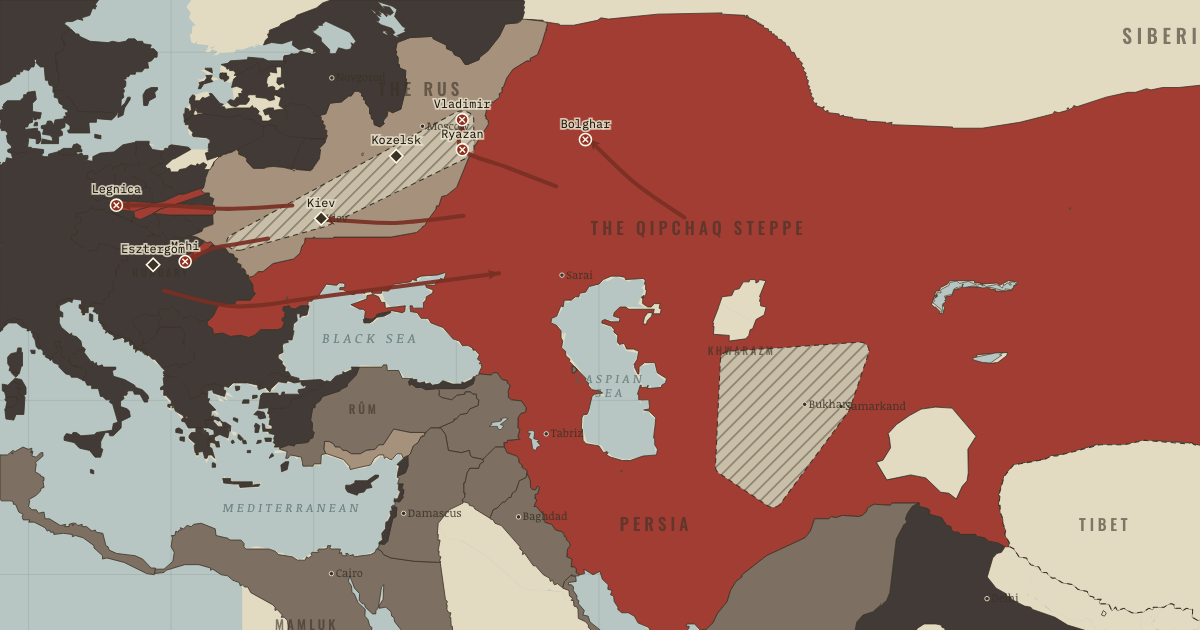
The force that struck Volga Bulgaria in 1236 was sent to conquer, with resources far greater than those of the earlier raid. From Bulgaria the Mongol armies entered the Rus lands. Their rulers faced the invasion as separate principalities, and the season did not give them the protection they might have expected. Frozen rivers offered routes toward settlements, although uncertain ice, snow and the need to feed horses made winter a burden as well.
The short answer
- The resources of a dynasty. The expedition that reached the Kalka in 1223 had roughly 20,000 riders. In 1236 Batu led a campaign backed by a kurultai decision and princes from all four family lines. Subötai brought experience of the earlier journey. A raid could expose routes and opponents; this time the dynasty committed resources for a conquest on a much larger scale.
- Winter made usable. Winter offered opportunities to an army prepared for its hardships. Frozen rivers led toward cities, hard ground could help movement, and horses could dig through snow for grass. Stores gathered after harvest offered another resource. The cold remained difficult for men and animals, but Mongol forces could campaign while opponents struggled to assemble across separate principalities.
- Opponents divided. The invasion encountered rival Rus rulers and a Poland divided among Piast dukes. Béla also sought help farther west, where Emperor Frederick II and the pope were in conflict with each other. Batu cited Hungary’s shelter of Qipchaq refugees in his ultimatum. These divisions made a common response hard to organize; no relief army reached Hungary.
- Refugees and the Hungarian defense. Qipchaqs fleeing the Mongols found refuge in Hungary. Batu treated them as subjects who had escaped Mongol authority and invoked their shelter in his demand to Béla. Inside Hungary, rumors turned people against the newcomers. Their khan Köten was murdered in Pest, and his followers departed, burning and fighting as they went. Shortly before Mohi, Hungary had lost experienced steppe cavalry that might have helped defend the kingdom.
THE TURNING POINT
Legnica and Mohi, 9–11 April 1241. Legnica and Mohi fell two days apart, on 9 and 11 April 1241. Separate Mongol forces had won battles hundreds of kilometers apart while their opponents failed to join in time. At Mohi, troops forced the Sajó crossing under bombardment as the Hungarian army came under pressure. Coordination and engineering helped bring the attack together. Letters from Hungary to the papal court conveyed the shock. The victories decided these campaigns, though they cannot tell us that every later European defense would have failed.
What it changed
Rus under the Horde. The Rus principalities retained their princes and faiths, but the Horde required tribute, censuses and the khan’s approval for rule. This relationship endured in changing forms for roughly 240 years. Moscow, a small town on the map, later gained power partly by collecting tribute. Historians continue to debate how much Muscovite autocracy owed to Horde rule.
The withdrawal and its explanations. Ögedei died on 11 December 1241, leaving leading princes to consider their place in the succession. Batu’s rivalry with Güyük makes the political stakes plain, yet Batu did not attend the eventual kurultai. Another explanation begins in Hungary, where pasture and supplies had been damaged and large herds were difficult to feed. Succession may help explain when the armies left; environmental and strategic costs also help explain the limits of further campaigning. The evidence does not assign a certain share to either cause.
Europeans travel east. After the shock of 1241, Europeans sent travelers east to learn about the Mongols. Carpini went in 1245 and Rubruck in 1253, returning with accounts of Asia and its rulers; their route appears in Chapter 7. Later Horde raids struck borderlands, but an army on the same scale did not return. Succession struggles, the Berke–Hülegü war and Hungary’s new stone castles all belonged to the later setting. Survivors had reason to feel relief, even though historians still dispute why the invaders withdrew.
The full answer, argued
The timing favors a connection: withdrawal followed news of Ögedei’s death, when princes had reason to consider the succession. Campaigning also changed after Möngke died in 1259. Yet Batu did not hurry to the election, and his army faced damaged forage and, beyond the Hungarian plain, forests and fortifications. Succession may have influenced the decision in 1242; ecological and strategic costs give reasons both to stop and to avoid returning at the same scale. The evidence does not establish one decisive cause.
An interesting fact
Fear of the Tatars could travel farther than their armies. Matthew Paris, the St Albans chronicler, wrote that in 1238 merchants from Gotland and Frisia stayed away from the herring fair at Yarmouth because they were afraid. Fish crowded the English market, he reported, and forty or fifty herring sold for a piece of silver. His account and price deserve caution, but they show how he understood rumors from the east to affect trade three years before Legnica.
This is the study layer of Mongol invasion of Europe, chapter 6 of The Mongol Empire, 1206–1294; the full index of the atlas is here.
Related questions
THE FREE PRINTABLE STUDY GUIDE
Get the printable study guide for The Mongol Empire free. I’ll send you a few short letters, then one when a new atlas opens. That’s all. — Paul
NO TRACKING · YOUR ADDRESS IS USED FOR THE DISPATCH AND NOTHING ELSE · UNSUBSCRIBE ANYTIME