WWI · APR 1918
Why didn’t Brest-Litovsk save Germany from defeat?
The seminar question: “Why did the gains at Brest-Litovsk fail to save Germany?”
The Bolsheviks tried to leave the war without accepting Germany’s terms, but Germany resumed its advance, and Lenin forced his party to accept the Treaty of Brest-Litovsk on 3 March 1918. Russia lost Poland, the Baltic lands and Ukraine, yet occupying them tied down German troops and yielded far less grain than expected.
Chapter 11 is included with every paid plan. WW2 is free in full, and chapter 1 of every atlas is free. A free account opens 3 more chapters a day. Starter, at $9 a month, opens all 21 with no daily limit — see the plans.
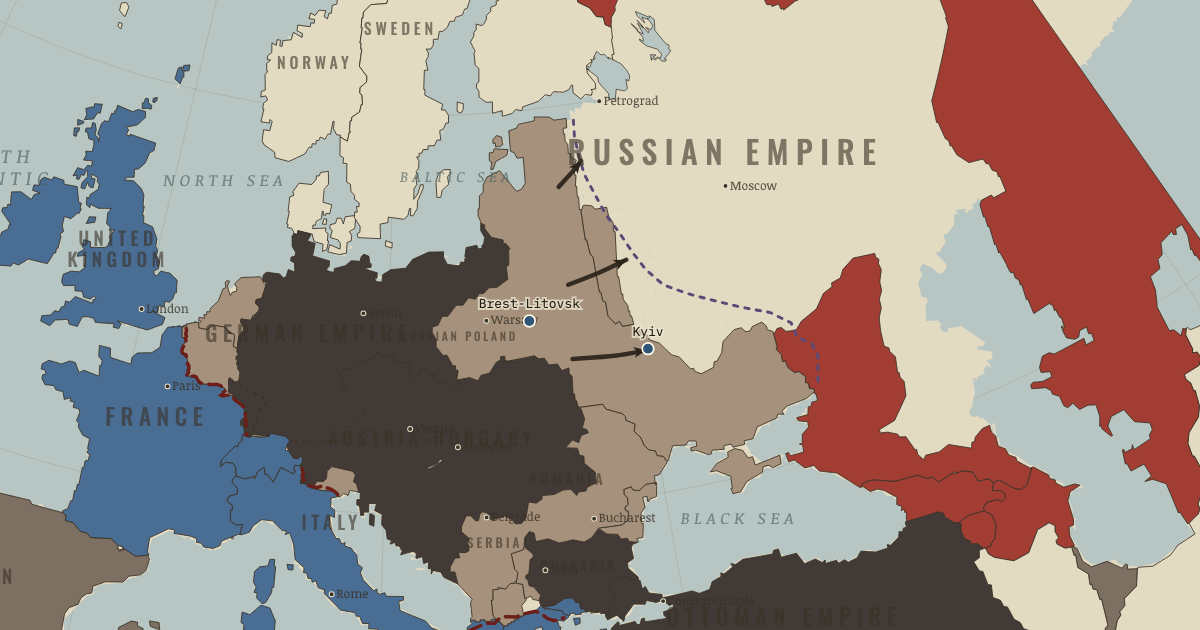
The Bolsheviks had taken power promising to end Russia’s war. Peace, however, came with German demands for territory that Trotsky was unwilling to concede. At Brest-Litovsk he offered “no war, no peace”: Russia would stop fighting, but would sign no treaty. This left the outcome in German hands. When Germany launched Operation Faustschlag, its troops advanced against almost no organized resistance. Lenin pressed a fiercely divided Bolshevik leadership to accept the terms, and the treaty was signed on 3 March 1918.
The short answer
- Lenin’s cold arithmetic. The Central Committee faced three proposals. Bukharin wanted revolutionary war; Trotsky sought neither war nor a signed peace; Lenin urged acceptance of the “obscene peace.” Lenin’s reason was that the revolution lacked an army capable of holding the territory. Ground surrendered now might be recovered, whereas a government destroyed by renewed fighting could recover nothing. The regime survived, and Soviet power returned to much of the lost territory within five years of Germany’s defeat, through further conflict.
- Germany’s eastern ideology. The settlement gave substance to ambitions older than the negotiations. German war-aims programs since 1914 had envisaged a German-dominated Mitteleuropa and a border strip. Under Ludendorff’s military leadership, Baltic client kingdoms and an economically dependent Ukraine became part of the projected order. Some historians trace a continuity between these imperial plans and later German projects in the east: the ambition to dominate came before the ideology that made the later project genocidal.
- The garrison paradox. The new eastern order required soldiers to guard railways, requisition grain and support client regimes from Finland to Georgia. Around a million German and Austro-Hungarian men remained in the east for such work and were unavailable for western battles, including the Marne in July. Conquest enlarged Germany’s apparent strength while imposing a substantial cost in troops. How many could have been withdrawn, and at what cost to the occupation, remains a further question.
THE TURNING POINT
The treaty signed, 3 March 1918. On 3 March the signature secured Germany’s eastern settlement and sharpened the race in the west. Germany needed troops both to hold its gains and to fight before American arrivals changed the balance. Allied governments could point to the terms as evidence of what Germany demanded from a defeated state; propagandists used them too, and compromise became harder. Chapter 12 follows the attempt to win in time.
What it changed
The last race. About 48 divisions moved west, and Germany prepared the five-hour bombardment for Michael, scheduled for 21 March. Against that temporary reinforcement stood the growing flow of American troops. The outcome depended on what the German army could achieve before those arrivals changed the balance.
Russia’s agony continues. Russia’s exit from the world war was followed by civil war. Reds and Whites fought across the former empire, Allied forces intervened at ports, and the Czechoslovak Legion fought along the Trans-Siberian railway. Estimates for deaths from war, terror and famine through 1922 range from seven to twelve million, exceeding Russia’s losses in the world war.
The precedent everyone cites. Brest-Litovsk became part of the dispute over Versailles. When Germans protested against the 1919 terms, Allies could answer by recalling what Germany had imposed on a defeated Russia; Allied leaders also invoked security in framing their settlement. The earlier treaty supplied a precedent in the argument, although Versailles had causes of its own.
The full answer, argued
The eastern victory released divisions for the west and promised food and other resources. But Germany had to hold its new position: roughly a million German and Austro-Hungarian troops remained east, while Ukrainian grain arrived in disappointing quantities. Romanian oil offered another potential resource, although Romania’s settlement was separate from Brest-Litovsk. The treaty also gave the Allies further reason to resist German terms. Timing brought these gains and costs together. The transferred divisions could fight that spring; fuller returns from the east would take longer, and American arrivals were strengthening the Allies. Germany needed a quick victory from its temporary advantage, and its offensives failed to deliver one.
An interesting fact
The first Soviet delegation at Brest-Litovsk placed representatives of the revolution alongside its diplomats: a worker, a soldier, a sailor, a woman and a peasant. The woman, Anastasia Bitsenko, was a Socialist-Revolutionary recently amnestied from Siberian imprisonment for assassinating a tsarist general. The peasant, Roman Stashkov, had been recruited from the street at the last moment. Wheeler-Bennett recounts a dinner where a German prince asked Stashkov whether he preferred red or white wine. “Whichever is stronger,” he replied. The delegation’s speeches were also addressed beyond the German representatives, to the workers of Europe.
This is the study layer of Treaty of Brest-Litovsk and WWI, chapter 11 of The Great War, 1871–1923; the full index of the atlas is here.
Related questions
THE FREE PRINTABLE STUDY GUIDE
Get the printable study guide for WWI free. I’ll send you a few short letters, then one when a new atlas opens. That’s all. — Paul
NO TRACKING · YOUR ADDRESS IS USED FOR THE DISPATCH AND NOTHING ELSE · UNSUBSCRIBE ANYTIME