WWI · NOV 1917
Why did Russia’s army collapse in 1917 but not France’s?
The seminar question: “Why did Russia’s army dissolve while France’s recovered, despite exhaustion in both?”
By 1917 the war was breaking the societies that fought it. In Russia food shortages and strikes toppled the Tsar, and in November the Bolsheviks seized power promising peace, land and bread. France suffered mutinies after the failed Nivelle Offensive but recovered under Pétain, and Italy nearly collapsed at Caporetto.
Chapter 10 is included with every paid plan. WW2 is free in full, and chapter 1 of every atlas is free. A free account opens 3 more chapters a day. Starter, at $9 a month, opens all 21 with no daily limit — see the plans.
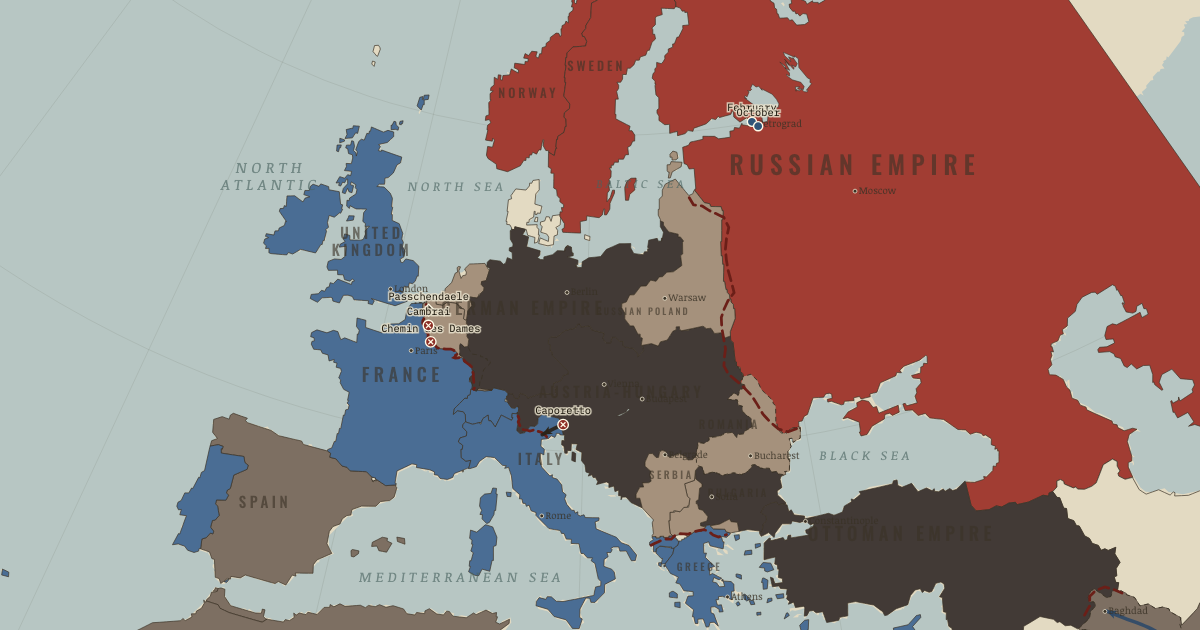
In Petrograd, the struggle to find food brought people into the streets. Strikes spread, and the garrison soldiers sent to suppress the crowds refused to fire. The Tsar abdicated. Russia now had a new government, but it still faced the war that had helped destroy the old one.
The short answer
- Russia’s collapsing authority. By taking personal command of the army in 1915, the Tsar tied his authority to its fortunes. Military failures damaged him directly, while court politics, Rasputin and a German-born Tsarina encouraged rumors of treason. Inflation and failing railways made food harder to obtain. A regime demanding total-war sacrifices could not reliably supply its cities. When strikes spread and soldiers refused to suppress them, the monarchy lacked the authority to survive.
- Why the government continued the war. The Provisional Government inherited commitments as well as a war. It depended on Entente credit, had treaties and alliance obligations, and hoped for territorial gains including Constantinople. Its leaders also believed a free Russia might fight better. These reasons explain the decision to continue, but they did not make an exhausted army accept another defeat. The Bolshevik promise of “Peace, land, bread” addressed needs the government had not satisfied, and fighting on made that alternative more compelling.
- What French soldiers refused. Many French soldiers drew a line between defending their country and taking part in another offensive. They held trenches, asked for leave, rest and better tactics, and some sang the Internationale. Pétain could respond to these demands while keeping France in the war. In Russia, similar complaints arose amid a collapsed monarchy and a contest between the Provisional Government and the soviets. The state behind an army affected both what soldiers could ask for and whom they could trust to answer.
- Two ways through the line. At Caporetto, infiltration troops followed the barrage, bypassed strongpoints and gave junior leaders initiative to move through the defenses. At Cambrai, tanks crushed wire and crossed trenches without the prolonged bombardment that would alert defenders. Both methods made openings. Both also exposed the difficulty of exploiting them: infantry and unreliable machines could outrun the guns and supplies needed to sustain an advance. The campaigns of 1918 would test how far armies could carry and defend such gains.
THE TURNING POINT
The October Revolution, 7 November 1917. The Bolsheviks seized power in Petrograd on 7 November with relatively little bloodshed. The new government sought peace and agreed an armistice within weeks. As Russia left the war, Germany could move forces west; the Bolsheviks also published secret Allied agreements and established a regime that would shape international politics for decades. Revolutionary red spreads on the map, but control of the capital did not settle the whole country. Further fighting accompanied the change in power.
What it changed
Germany’s opportunity. Russia’s exit released some fifty German divisions for transfer west. Germany thus gained a narrow opportunity to attack before American armies arrived in force. Chapter 11 follows its gains in the east; Chapter 12 follows its gamble in the west.
American resources. American entry gave the Allies credit, expanded shipping and the prospect of millions of troops. Loans eased their financial crisis, and shipbuilding helped replace losses to U-boats. Waiting could therefore strengthen the Allied position. Pétain’s “wait for the Americans and the tanks” expressed a strategy for holding out until that help arrived.
Rival visions of peace. The rival governments offered different answers to what peace should bring. Wilson’s Fourteen Points of January 1918 called for open covenants and self-determination; Lenin’s Decree on Peace called for immediate peace and revolutionary change. These programs raised expectations among peoples affected by settlements from Brest-Litovsk to Versailles, who could measure the terms imposed on them against those promises.
The full answer, argued
Both armies had suffered failed attacks and heavy losses, and their soldiers wanted food and leave. In France, however, the republic, railway supplies and Allied support remained in place. Pétain could improve conditions and suspend great offensives while soldiers continued to defend. Russia’s autocracy had fallen, the capital faced shortages, and the Provisional Government had tied its authority to fighting on. Russian soldiers could look to soviets and a party promising peace and land, or leave to pursue land at home. France could hold until conditions improved. In Russia, another failed offensive intensified the dispute over who should govern and whether the war should continue. The soldiers’ grievances were similar; the institutions and alternatives available to them were not.
An interesting fact
Among the Caporetto infiltrators was Erwin Rommel, a 25-year-old Württemberg mountain lieutenant. With a detachment of a few hundred men, he took Monte Matajur after roughly fifty hours of climbing and bluff; by his own count, he claimed 9,000 prisoners for a handful of casualties. Another officer initially received the Pour le Mérite, but Rommel pressed his claim and obtained it. His memoir Infantry Attacks (1937) became an influential account of tactics studied between the wars, including by soldiers who later fought with tanks.
This is the study layer of WWI in 1917, the year of crisis, chapter 10 of The Great War, 1871–1923; the full index of the atlas is here.
Related questions
THE FREE PRINTABLE STUDY GUIDE
Get the printable study guide for WWI free. I’ll send you a few short letters, then one when a new atlas opens. That’s all. — Paul
NO TRACKING · YOUR ADDRESS IS USED FOR THE DISPATCH AND NOTHING ELSE · UNSUBSCRIBE ANYTIME