Chinese Revolution · 1949
Why did Mao win and Chiang lose the Chinese Civil War?
The seminar question: “Why did Mao win and Chiang lose, and was Communist victory inevitable after Japan surrendered?”
In April 1949 Communist forces crossed the Yangtze and took Nanjing, and on 1 October Mao proclaimed the People’s Republic of China in Peking. The Nationalist government withdrew to Taiwan with soldiers, refugees, gold and cultural collections, leaving the civil war unfinished across the Taiwan Strait.
Chapter 12 is included with every paid plan. WW2 is free in full, and chapter 1 of every atlas is free. A free account opens 3 more chapters a day. Starter, at $9 a month, opens all 21 with no daily limit — see the plans.
Free printable Chinese Revolution study guide, sent by email ↓
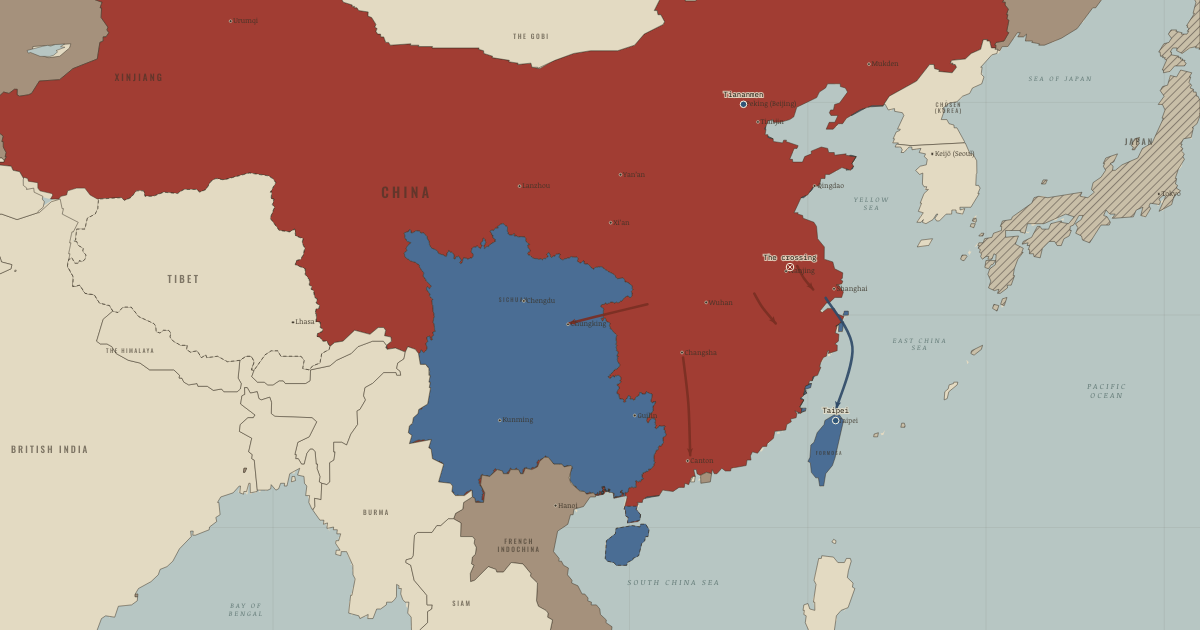
The Yangtze was the Nationalists’ next line of defense, but the armies that might have held it had been broken in the three campaigns. After peace terms lapsed, roughly a million Communist troops crossed on junks and sampans along a front of some 500 kilometers. The crossing began on the night of 20–21 April 1949 (the ✕) and met little resistance. Nanjing fell on 23 April. Its government had left, and soldiers photographed one another sitting in the presidential chair.
The short answer
- The war against Japan. In 1937 the CCP had about 40,000 survivors in the loess hills. By 1945 it claimed a million troops and some 90 million people under some form of administration. Japanese occupation had damaged the Nationalist army, tax base and urban legitimacy, while leaving space in which Communist organizers could work. Historians disagree over what made that opportunity fruitful. Chalmers Johnson emphasized nationalism, Mark Selden social policy, and others the organization that connected the two.
- Land and the army. Land policy gave peasants a stake in the struggle. The party moved from rent reduction toward redistribution, and at Huaihai the barrows showed what rural mobilization could supply to an army. Redistribution also involved coercion. The Nationalists, tied to landed and urban elites, had not effectively implemented their 1930 land-reform law on the mainland. After 1949 the KMT carried out sweeping reform on Taiwan under different political conditions. The comparison shows how a change in relationships and circumstances allowed the same party to pursue a different policy.
- Money and confidence. Wartime decline of the fabi gave way to postwar hyperinflation. The 1948 gold-yuan exchange then took citizens’ assets for notes that quickly lost value. Officials, officers, teachers and shopkeepers were among those who suffered. The government needed these people to administer the country and sustain its forces; the destruction of their savings weakened confidence before the defeats and defections of 1948–49.
- Rival party-states. Chapter 4 describes the Leninist organizations both contenders built. Each sought authority over China, while neither offered much institutional room for a loyal opposition. That shared structure made a durable settlement harder, though it cannot account for every military decision. The People’s Republic and the government on Taiwan carried this inheritance into different subsequent histories.
THE TURNING POINT
Tiananmen, 1 October 1949. The ceremony at Tiananmen gave a visible form to a transfer of power won through years of conflict. At the old gate on 1 October 1949, the new flag and the words “the Chinese people have stood up” helped establish the state’s founding story. The government claimed succession to Chinese state authority and a reach growing from Kashgar toward the coast. Taiwan remained under its rival, however, and other frontiers were contested. The proclamation marked a new government; it did not finish the territorial settlement.
What it changed
Governing after victory. After victory came the work of governing. In the following years the new state unified currency, suppressed inflation and pursued land reform on a large scale. Violence against landlords accompanied reform, and estimates of the dead remain disputed. China also fought United Nations forces in Korea until the armistice. Administrative capacities developed in base areas now operated across a much larger population, with coercion as well as organization.
Two governments endure. The Taipei government retained China’s United Nations seat until 1971 and its American alliance beyond that date. The strait became an enduring Cold War frontier. Crises in 1954, 1958 and 1996 were among the later consequences of the unresolved dispute.
Revolutionary methods abroad. Other revolutionary movements drew on the Chinese experience of peasant warfare, base areas, united fronts and close ties between party and army. Vietnam was especially important: its war against France was already under way as this chapter closes. These methods traveled across continents, where movements adapted them to their own conditions.
The full answer, argued
Japanese occupation generated nationalism that the CCP could organize, according to Chalmers Johnson. His argument helps explain north China, though it is less complete for areas less directly affected by occupation. Mark Selden and later scholars place greater weight on the “Yenan Way”: land policy, taxation and participatory institutions. Chen Yung-fa’s work adds an important qualification, showing that coercion also operated in the base areas. Lloyd Eastman and other historians emphasize the Nationalists’ inflation, factionalism and command failures. Those failures mattered, but they do not explain how Communist forces conquered Manchuria. Odd Arne Westad’s archival account brings decisions into view, including Soviet policy in Manchuria and Chiang’s 1946 choice to fight there. The Nationalists still had possibilities in 1945; by late 1948 their position had deteriorated dramatically. Victory was made through choices as well as conditions. For an essay on conditions, methods and consolidation, the Japanese invasion belongs among the conditions and years of institutional development among the methods. The Nationalists’ coalition with landed interests constrained their policies. Invasion and government weakness gave the Communists opportunities; their party still had to recruit, govern and win campaigns.
An interesting fact
The new air force had only seventeen serviceable aircraft for the founding ceremony on 1 October 1949. Its captured or defected machines included P-51s, Mosquitos and trainers. To enlarge the display, nine leading fighters circled back over Tiananmen, producing twenty-six passes. Two flew armed: the war continued offshore, and Nationalist aircraft based at Zhoushan would bomb Shanghai the following February. The flypast displayed a confident new state whose air force was small and whose war was unfinished.
This is the study layer of Communist victory in China (1949), chapter 12 of China in Revolution, 1911–1949; the full index of the atlas is here.
Related questions
THE FREE PRINTABLE STUDY GUIDE
Get the printable study guide for China in Revolution free. I’ll send you a few short letters, then one when a new atlas opens. That’s all. — Paul
NO TRACKING · YOUR ADDRESS IS USED FOR THE DISPATCH AND NOTHING ELSE · UNSUBSCRIBE ANYTIME