Chinese Revolution · 1915
Was Yuan Shikai the republic’s betrayer or its only hope?
The seminar question: “Was Yuan Shikai the republic’s betrayer, or a leader overwhelmed by an impossible task?”
Yuan Shikai dominated China’s early republic through the Beiyang Army, which was loyal to him personally. He crushed the Nationalists, dissolved parliament and faced Japan’s Twenty-One Demands in 1915, but his attempt to restore the monarchy provoked the National Protection War, and he died in 1916.
WW2 is free in full, and chapter 1 of every atlas is free. A free account opens 3 more chapters a day. Starter, at $9 a month, opens all 21 with no daily limit — see the plans.
Free printable Chinese Revolution study guide, sent by email ↓
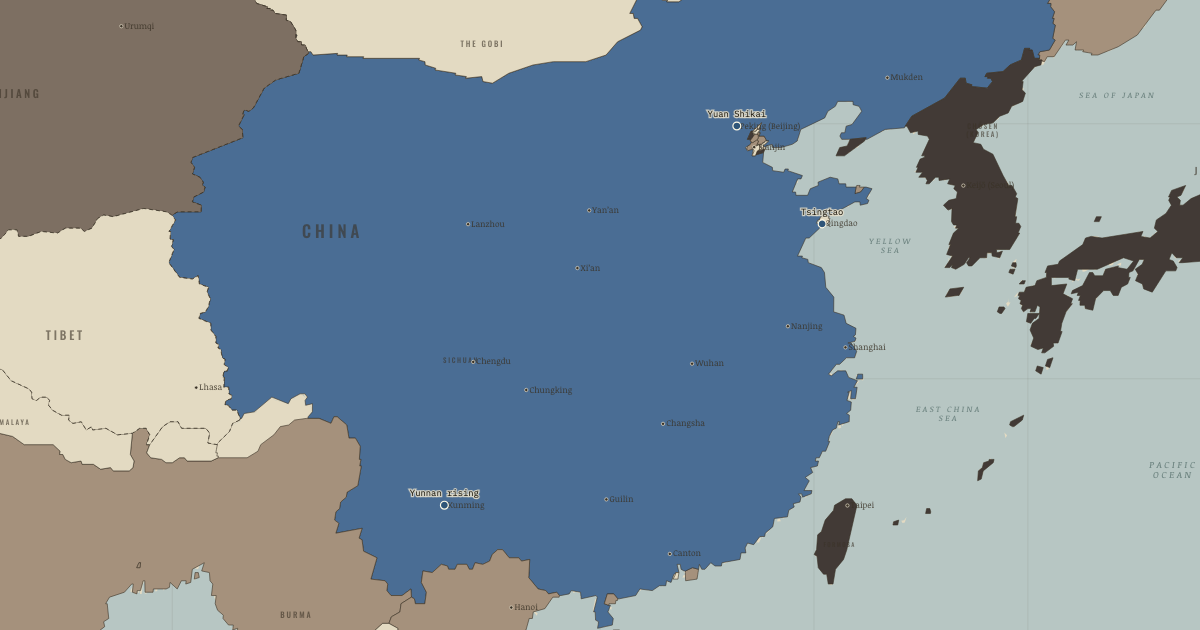
Yuan Shikai's republic appears on the map as one blue expanse. To understand how precarious that unity was, look at the force on which the president depended. Yuan (the ● at Peking) commanded the Beiyang Army, whose officers owed their positions and advancement largely to him. The republic needed the army, but its commander could use those personal loyalties against the institutions meant to restrain him.
The short answer
- The Beiyang network. Yuan built the Qing's modern Beiyang Army in the 1890s and 1900s. Its commanders' careers depended on his patronage: he promoted and paid them, and marriages and other connections joined them to his circle. These ties made the army a powerful instrument for the republic, but they did not give the constitution an independent hold over its officers. After Yuan's death, Beiyang commanders and provincial imitators could use their own military networks to pursue power.
- A fragile constitutional settlement. The 1912 settlement had been negotiated among elites. About 40 million men were nominally enfranchised for the 1912–13 elections, but the representatives they chose lacked an effective means of enforcing constitutional rules against the army's commander. Song's murder and Yuan's dissolution of parliament showed how little protection those rules afforded. In 1915–16 provincial armies would show that they could resist him by force.
- The opportunity for Japan. The European war gave Japan room to act in China. Britain needed the Japanese navy, Russia was absorbed by the war in Europe, and Germany was Japan's enemy. Japan seized the German position in Shandong and presented its demands while the European powers were preoccupied. Although the most intrusive clauses were withdrawn, Japan kept important advantages in Shandong. Another opportunity for Japanese expansion would arise in 1931.
- The monarchy miscalculation. Some of Yuan's advisers believed a throne could give his government lasting legitimacy. The American constitutional scholar Frank Goodnow wrote a memorandum on monarchy that supporters quoted beyond its intended scope. But the Qing's fall had ended the old imperial claim to the Mandate of Heaven, and Yuan's own bid failed to secure the backing he needed. Provincial leaders and men in his military network opposed him, combining republican objections with concern for provincial power. Their resistance showed that regional commanders could check the center.
THE TURNING POINT
The National Protection War, 25 December 1915. Cai E and the Yunnan leaders raised armies against Yuan's monarchy on 25 December 1915. As other provinces joined them, Yuan's own commanders withheld support, and the monarchy fell. The result revealed a difference between parliamentary opposition and military resistance: Yuan had subdued the former, but provincial armies could bring down his imperial project. The next chapter's rival cliques would work with the regional strength this conflict had exposed.
What it changed
Military rivalry after Yuan. After Yuan's death, Duan Qirui, Feng Guozhang, and Cao Kun were among the commanders who inherited parts of his Beiyang network. They and their allies fought for the Peking government, whose international recognition and access to customs revenue made it a valuable prize. The grey-tan plates in the next snapshot show the division that followed.
A grievance carried forward. Japan's seizure of Shandong and its Twenty-One Demands gave Chinese nationalism a concrete grievance. The dispute continued after Yuan's death. In 1919 the Versailles settlement awarded Japan Germany's former rights in Shandong, prompting the student marches described in Chapter 3.
Sun seeks another route. Sun Yat-sen's defeat and exile sent him searching for support to build a political movement with military power behind it. Western governments did not provide what he sought. In 1923 he found a partner in Moscow, beginning an arrangement that would shape the party and army in Chapters 4 and 5.
The full answer, argued
Yuan faced formidable problems. The state was bankrupt, provinces had recently demonstrated that they could secede, and Japan was ready to exploit weakness. He had an instrument of national power, and his efforts to centralize revenue and administration addressed real needs. It is understandable that someone might have looked to him to hold the republic together. Yet the charge of betrayal also has force. Song Jiaoren was murdered, Yuan dissolved parliament, and he sought to become emperor. The difficulties he inherited explain the appeal of strong rule; they do not excuse the destruction of parliamentary opposition. Nor did his personal system solve succession. Yuan died of natural causes at fifty-six, leaving military leaders without a comparable authority to hold them together. His career shows both the attraction of a strongman's promise of order and the fragility of an order dependent on one man.
An interesting fact
Yuan's intended reign was called Hongxian, “Constitutional Abundance.” Its official era ran for 83 days, from 1 January to 22 March 1916, and no coronation took place. Preparations had nevertheless produced the objects of a monarchy: coins were struck, stamps printed, and a porcelain works at Jingdezhen made wares bearing the Hongxian mark. The objects outlasted the empire and became collectors' items.
This is the study layer of Yuan Shikai and the early republic, chapter 2 of China in Revolution, 1911–1949; the full index of the atlas is here.
Related questions
THE FREE PRINTABLE STUDY GUIDE
Get the printable study guide for China in Revolution free. I’ll send you a few short letters, then one when a new atlas opens. That’s all. — Paul
NO TRACKING · YOUR ADDRESS IS USED FOR THE DISPATCH AND NOTHING ELSE · UNSUBSCRIBE ANYTIME