Meiji Japan and post-Soviet Russia · 1991
Did the nations or Russia itself destroy the Soviet Union?
The seminar question: “Was the Soviet Union destroyed more by the nations on its edges or by Russia at its centre?”
In 1989–91 the Soviet republics turned their paper rights into real power. The Baltic Way chain of August 1989 and the opening of the Berlin Wall came before Lithuania declared independence in March 1990, and after the failed coup of August 1991 the Union broke into fifteen states.
Chapter 9 is included with every paid plan. WW2 is free in full, and chapter 1 of every atlas is free. A free account opens 3 more chapters a day. Starter, at $9 a month, opens all 21 with no daily limit — see the plans.
Free printable Meiji Japan and post-Soviet Russia study guide, sent by email ↓
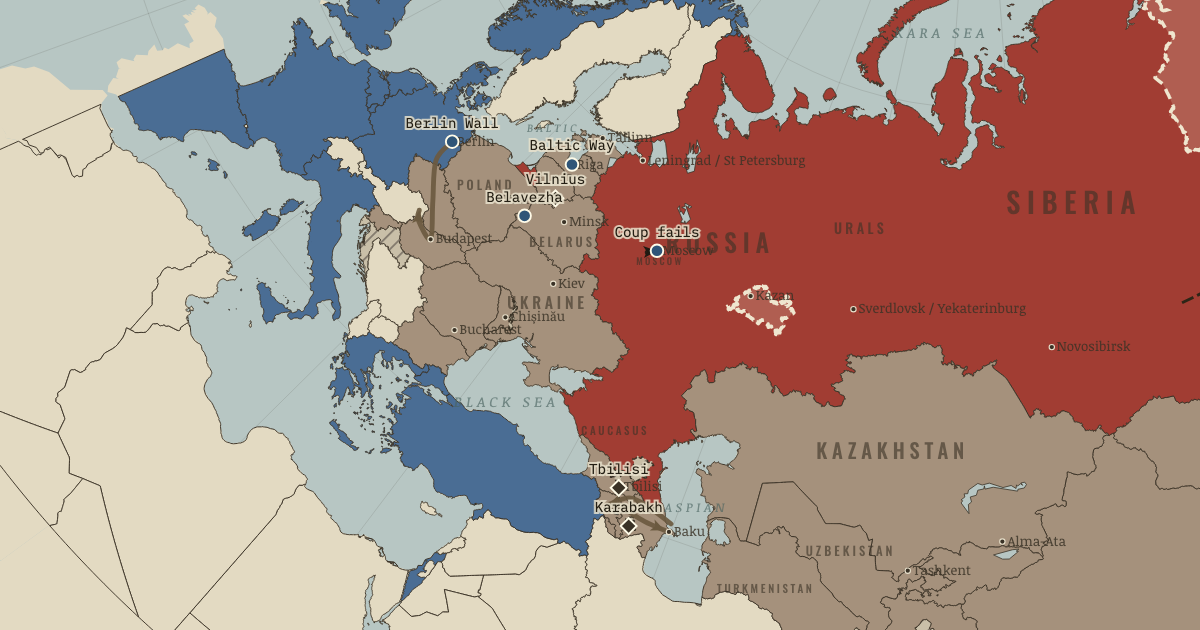
The communist governments of Eastern Europe had reason to fear opposition at home, but their opponents had reason to fear Soviet tanks. In 1989 Gorbachev removed that last assurance of rescue. His spokesman joked that the new policy was the “Sinatra doctrine”: each country could do it “my way”. Poland’s Solidarity, an independent trade union turned national movement, defeated the communists in semi-free elections in June. Hungary opened its Austrian border, allowing thousands of East Germans to travel west along the route shown by the arrow. Protests grew in East Germany itself, and on 9 November the Berlin Wall opened. Within weeks communist rule also ended in Czechoslovakia, Bulgaria and Romania. The former bloc states turn tan on the December 1989 map; Germany reunited in October 1990. Once Moscow would no longer defend these governments, they fell within months.
The short answer
- Glasnost and elections gave nations a voice. Glasnost made public discussion of deportations, annexations and suppressed languages possible for Balts, Georgians, Armenians and others. The 1989–90 elections gave those grievances a political route: movements could win parliaments and govern through them. Gorbachev hoped openness would renew loyalty; in several republics elected leaders used it to demand departure.
- Moscow renounced force in Eastern Europe. Gorbachev announced cuts to Soviet forces in Europe at the United Nations in December 1988. The following year, communist governments fell from Warsaw to Bucharest without Soviet intervention. People inside the Union saw that Moscow could let allied governments go; restraint abroad made a threat of repression at home less convincing.
- The economic crisis destroyed the centre’s case. Shortages, rationing and broken supply chains by 1990–91 made prosperity a difficult argument for keeping the Union. Republics hoarded food and fuel and withheld taxes, issuing coupons and later currencies of their own. Departure could appear a way out of the crisis, while the center had too little money to purchase loyalty.
- Russia’s leaders wanted Moscow’s power for themselves. After his expulsion from the Politburo in 1987, Yeltsin rebuilt his career in the Russian republic. Its parliament, presidency and treasury gave him a base from which to contest the Union government. Russian nationalists and democrats both argued that their republic subsidized the others. As the center weakened, its elected rivals had a reason and the means to take its place.
THE TURNING POINT
The White House, 19–21 August 1991. The plotters hoped to preserve the Union, but their defeat discredited three of its central pillars: the KGB, army leadership and Communist Party. Yeltsin’s stand on a tank gave him the initiative. Leaders who had hesitated now had reason to fear that hard-liners could again seize a government in Moscow. Within days Yeltsin suspended party activity in Russia, the Baltic states gained recognition and most remaining republics declared independence. The attempt to hold the Union together hastened its end.
What it changed
Fifteen states with inherited borders. The lines between Soviet republics became borders between states. About 25 million ethnic Russians now lived outside Russia, and other minorities found themselves in new states that did not want them. Crimea, transferred to Ukraine in 1954, was part of independent Ukraine. Citizenship, language and military bases would trouble relations among successor states for decades.
Frozen conflicts on the edges. As Soviet authority weakened, wars began over Karabakh, Abkhazia, South Ossetia and Transnistria, hatched on the map. They continued after dissolution, with Russian troops and arms involved in most. Ceasefires in 1992–94 stopped fighting while leaving breakaway regions beyond the control of the states to which they legally belonged. The unresolved disputes became known as “frozen” conflicts.
Russia inherited the Union’s seat, weapons and debts. Russia assumed the Soviet Union’s United Nations Security Council seat, its embassies and most of its foreign debt. By 1996 all Soviet nuclear warheads had been moved to Russian territory. The new government also inherited the economic crisis while promising its people a rapid transition to a market economy.
The full answer, argued
The borderlands made secession a public question. Baltic popular fronts, the Karabakh crisis and Georgian protests opened the crisis; Lithuania declared independence first, and Ukraine’s vote of more than 90% made a Union without it impossible. Mark Beissinger shows how mobilizations encouraged later ones. But the Union also needed its core. Russia asserted sovereignty and withheld taxes; Yeltsin defeated the coup and took the initiative at Belavezha. Serhii Plokhy emphasizes Russia and Ukraine’s choices together, while many Central Asian leaders received independence they had scarcely sought. The borderlands began the crisis, but the core decided its outcome. Russia’s leaders saw more to gain by leaving than by sustaining the Union, illustrating how an empire can end when its core judges the periphery too costly to hold.
An interesting fact
At a hunting lodge in the Białowieża forest on 8 December 1991, the leaders of Russia, Ukraine and Belarus signed the agreement dissolving the Union. Boris Yeltsin then called US President George Bush while Belarusian leader Stanislav Shushkevich tried to reach Gorbachev. Yeltsin got through first, and Gorbachev was angry that Washington already knew. Shushkevich later insisted the calls were almost simultaneous. In either account, a foreign president learned of the decision as quickly as the man who still nominally governed the Union.
This is the study layer of Collapse of the Soviet Union, chapter 9 of Remaking the State: Meiji Japan 1600–1912 and Post-Soviet Russia 1964–2000; the full index of the atlas is here.
Related questions
THE FREE PRINTABLE STUDY GUIDE
Get the printable study guide for Remaking the State free. I’ll send you a few short letters, then one when a new atlas opens. That’s all. — Paul
NO TRACKING · YOUR ADDRESS IS USED FOR THE DISPATCH AND NOTHING ELSE · UNSUBSCRIBE ANYTIME