Crusades · 1204
Was the sack of Constantinople a plot or an accident?
The seminar question: “Was the sack of Constantinople a Venetian conspiracy or a chain of accidents?”
The Fourth Crusade ordered a Venetian fleet for twice the army that gathered and, unable to pay, stormed the Catholic city of Zara for Venice in 1202. A deposed Byzantine prince then promised money for his restoration; when he could not deliver, the crusaders sacked Constantinople in April 1204.
Chapter 8 is included with every paid plan. WW2 is free in full, and chapter 1 of every atlas is free. A free account opens 3 more chapters a day. Starter, at $9 a month, opens all 21 with no daily limit — see the plans.
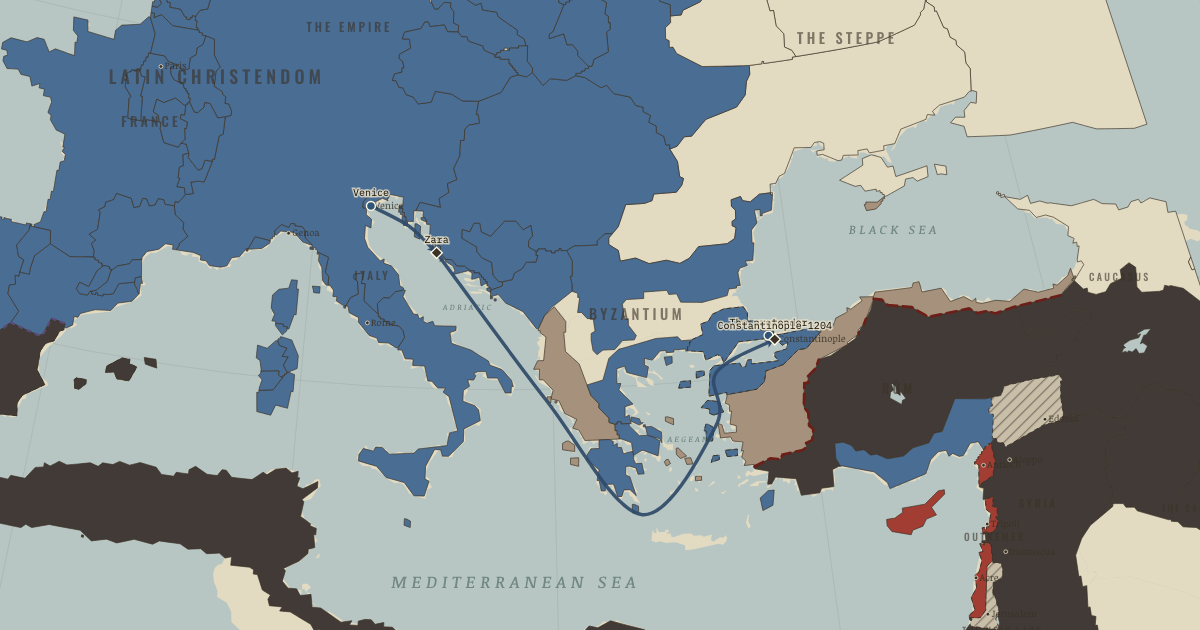
The Fourth Crusade was supposed to strike Egypt. Saladin had drawn on its resources, and Richard had identified it as a key to securing Jerusalem. To reach it, the leaders made a contract at Venice in 1201 for a fleet large enough to carry far more men than eventually assembled. Venice built the ships and suspended much of its ordinary commerce for the undertaking. When the smaller army arrived, it could not pay the agreed price; without the fleet, it could not sail. Venice had both a substantial claim and power over the expedition’s next move.
The short answer
- The Venetian debt. The leaders contracted for a fleet larger than the crusade that assembled could afford. They needed Venice’s ships but could not pay the agreed price. Service against Zara reduced the debt and allowed the expedition to proceed; the same financial mistake shaped later choices without making those choices inevitable.
- A Byzantine succession crisis. A feud within the Angelos dynasty offered the indebted crusaders a role in Byzantine politics. Alexios promised money and military help if they put him on the throne. For leaders trying to satisfy Venice and reach Egypt, the bargain appeared to solve several problems together.
- A century of Latin contempt for the Greeks. Relations between Latin and Greek Christians had deteriorated during the First and Second Crusades, including disputes over Antioch. By 1204, contempt for Greeks called “schismatic” made an attack on fellow Christians easier to contemplate and defend. Those earlier disputes did not by themselves cause the sack, but they supplied a language in which it could be rationalized.
THE TURNING POINT
The pretender’s bargain, 1203. The leaders accepted Alexios’s offer in 1203 and sent the fleet toward Constantinople. His promised money, troops and church union made the diversion seem useful to the crusade. When his position collapsed without those promises being fulfilled, the expedition faced a confrontation it had not resolved by installing him. The later assault still required a further decision.
What it changed
Byzantium fatally weakened. The map shows the Byzantines recovering Constantinople in 1261. They returned to a fragmented and weakened empire, however. The losses of 1204 became part of a longer decline; many forces contributed to the eventual Ottoman conquest in 1453.
A fragile Latin Empire. The Latin Empire was fragile and lasted less than two generations. Its conquest left a divided landscape of Latin, Greek and Bulgarian powers. The brief blue over Byzantium on the map marks a new regime around Constantinople, not the completion of the campaign against Egypt.
The schism made permanent. The bargain with Alexios had promised church union. The sack instead added a lasting memory of violence to the older doctrinal disputes between Catholic and Orthodox Christians. Eight centuries later that memory remains part of relations between the churches and has made reconciliation harder.
The full answer, argued
A chain of choices under changing pressures explains the sack better than a Venetian plan for it from the outset. The proposed “Venetian plot” holds that the doge meant to direct the expedition against a commercial rival. But the oversized fleet, the debt, the attack on Zara and the arrival of Alexios each changed the leaders’ circumstances; their sequence does not itself show that the doge planned it in advance. Debt gave the crusaders a reason to attack Zara. Alexios then appeared to offer payment and a route back to the campaign in Egypt. After his failure, they faced a hostile city. At each stage they still made choices, including the decisions to attack Zara and Constantinople. Long-standing Latin contempt for Greeks helped make the latter violence easier to justify. Improvisation and self-interest explain the route without removing responsibility for the sack.
An interesting fact
Doge Enrico Dandolo, the Venetian leader, was blind and very old; the original account describes him as in his nineties. Geoffrey of Villehardouin, a crusade leader and partisan eyewitness, describes him armed at the prow of his galley beneath the banner of St Mark, demanding to be put ashore first beneath Constantinople’s sea walls. Dandolo died in 1205 and was buried in Hagia Sophia, the great church his crusade had plundered. A marker in its gallery floor still bears his name, long after the Latin Empire disappeared.
This is the study layer of Fourth Crusade, chapter 8 of The Crusades, 1095–1291; the full index of the atlas is here.
Related questions
THE FREE PRINTABLE STUDY GUIDE
Get the printable study guide for The Crusades free. I’ll send you a few short letters, then one when a new atlas opens. That’s all. — Paul
NO TRACKING · YOUR ADDRESS IS USED FOR THE DISPATCH AND NOTHING ELSE · UNSUBSCRIBE ANYTIME