Indian independence · JUL 1857
Was 1857 a mutiny, peasants’ war or war of independence?
The seminar question: “Was the rising of 1857 a mutiny, a peasants’ war or a war of independence?”
In May 1857 sepoys of the East India Company’s army mutinied at Meerut and rode to Delhi, where they placed themselves under the Mughal emperor. Annexations under the Doctrine of Lapse, the seizure of Awadh and a rumour about greased rifle cartridges drove the rising, after which the British Crown replaced the Company.
WW2 is free in full, and chapter 1 of every atlas is free. A free account opens 3 more chapters a day. Starter, at $9 a month, opens all 21 with no daily limit — see the plans.
Free printable Indian independence study guide, sent by email ↓
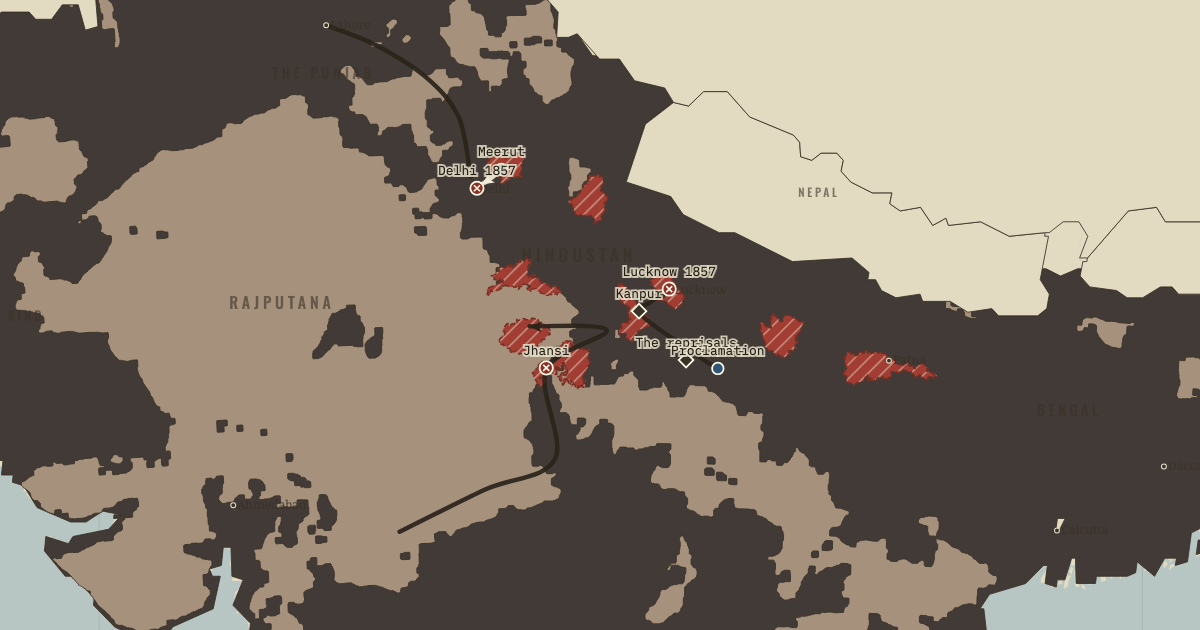
The hatched lands on the January 1857 map show where recent Company expansion had disturbed established interests. Lord Dalhousie, the Governor-General and the Company's chief executive in India, had taken Satara, Jhansi and Nagpur under the Doctrine of Lapse. When a dependent ruler died without a natural son, the Company claimed his state even if he had adopted an heir. In 1856 Dalhousie also annexed Awadh (Oudh). There new revenue settlements assessed village ownership and tax obligations, depriving great landholders, the talukdars, of villages their families had held for generations. Many Bengal Army sepoys came from Awadh, so a change in government reached into the families of the Company's own soldiers. Their standing was threatened in another way: caste, the inherited rank governing whom a Hindu could marry or eat with, made overseas service dangerous to their place at home. Cartridges said to contain the fat of cows sacred to Hindus or pigs forbidden to Muslims raised fears of religious pollution.
The short answer
- Dalhousie’s annexations and the Doctrine of Lapse. Between 1848 and 1856 Dalhousie added more territory to British India than any previous governor. Some came by conquest: Punjab in 1849 and Lower Burma in 1852. The Doctrine of Lapse provided another means. A dependent ruler without a natural son could adopt an heir, but the Company refused to recognize that succession and took Satara, Jhansi and Nagpur. Other rulers could see what might happen to their own states. Among those who lost a throne or pension were the Rani of Jhansi and Nana Sahib, who went on to lead the rising.
- Awadh: an annexation that reached the barracks. The Company annexed Awadh in February 1856 on grounds of misgovernment and sent King Wajid Ali Shah into exile in Calcutta. Its new summary revenue settlement deprived the talukdars, the province's great landholders, of thousands of villages. The consequences reached the barracks because many Bengal Army sepoys came from Awadh. Soldiers, landholders and peasants thus had connected reasons to resist the new rule; in Awadh their participation made the rebellion a popular war.
- An army that no longer trusted its masters. Pay and standing helped bind the Bengal Army to the Company. Both were under strain in the 1850s. Allowances for service in newly annexed provinces were cut, while the General Service Enlistment Act of July 1856 required new recruits to serve overseas. Many high-caste Hindus believed that crossing the sea would break caste. Missionary preaching and reforms, including the 1856 law permitting Hindu widows to remarry, encouraged fears that the Company intended forced conversion. Soldiers could therefore read a new order in the light of an existing distrust.
- The cartridge: a rumour as trigger. The Enfield rifle issued in 1857 required a soldier to bite open a paper cartridge. Reports from Dum Dum and Barrackpore said its grease contained cow and pig fat, polluting to Hindus and Muslims alike. The army ordered ungreased cartridges and changed the drill, but the rumor persisted because it fitted fears already present in the ranks. At Barrackpore Mangal Pandey attacked his officers on 29 March. On 9 May at Meerut, 85 troopers who had refused the cartridges were shackled on parade; their comrades rose the following evening. A shared suspicion had become a shared act of defiance.
THE TURNING POINT
Delhi, 11 May 1857. The Meerut troopers arrived at Delhi on 11 May 1857 and persuaded the reluctant Bahadur Shah Zafar, then eighty-one, to accept their allegiance. Their choice gave a cantonment mutiny a sovereign, a court and a capital: princes and landholders could now join a cause with a claim to political legitimacy. Regiments rose across northern India in the following weeks and marched to Delhi, which remained the center for four months. But restoring the Mughals offered little to Sikhs in Punjab or educated people in Calcutta. When British troops stormed Delhi in September, the rebellion lost its center and continued as a number of local wars.
What it changed
The Crown replaces the Company. The Government of India Act of 2 August 1858 transferred authority from the Company to the Crown. In London a Secretary of State and his council took charge; in Calcutta Lord Canning became the first Viceroy. Officials' daily work changed little at first, but they now governed on behalf of the British state. Later demands in this atlas would be directed to that state and to the promises it made in 1858.
The princes become the Raj’s allies. Under the Company, princes had reason to fear annexation; under the Crown, their continued rule became part of the settlement. Victoria's proclamation of 1 November 1858 promised no further annexations and respect for their rights and dignity. Hyderabad, Gwalior and Patiala were among the rulers rewarded for supporting Britain in 1857. In the early 1860s leading princes received sanads, charters securing their right to adopt heirs. The tan patchwork remained on the map until the accessions of 1947.
A rebuilt army and a more distant Raj. The British sought an army less capable of turning against them. In 1859 the Peel Commission recommended one British soldier for every two Indians in the Bengal army, and one for every three in Madras and Bombay. Artillery remained almost entirely in British hands. Recruitment shifted from Awadh and Bihar toward Punjab, Nepal and the north-west, whose men had remained loyal. Officials also believed that attempts to change Indian customs had helped cause the rebellion. They abandoned most social reform, and the Raj became more cautious and racially aloof.
Two memories of one war. British and nationalist accounts remembered different aspects of the same war. For British opinion, the Mutiny meant Kanpur and the siege of Lucknow, a story that helped sustain suspicion and distance between rulers and ruled. Later nationalists saw a first war of independence, evidence of Indians fighting foreign rule together. Savarkar's book of 1909, written in London and banned in India, brought that interpretation into revolutionary circles during the Swadeshi campaign of 1905–11. Both memories served political purposes for a century; each selected the dead it would remember.
The full answer, argued
Each name identifies something that happened, but none describes the whole rising equally well. It began with soldiers refusing orders, killing officers and marching on Delhi: that was a mutiny. In Awadh and the upper Doab, talukdars and peasants joined a struggle over annexation, revenue and lost land. Stokes and Mukherjee show how intense the rebellion became where those grievances were sharpest. Independence is a question of definition. Rebels at Delhi, Lucknow and Jhansi sought to end Company rule and restore an Indian sovereign. A national movement, however, would require a wider common cause: Punjab, Bengal, the south and most princes stood aside, and educated classes opposed the rising. It was the last great attempt to restore the old political order, and it frightened Britain into changing its government of India. The map lets us test each name against the people and regions it includes.
An interesting fact
The last Mughal emperor, Bahadur Shah Zafar, was also a respected Urdu poet. He studied under the master Zauq, and Ghalib, the greatest poet of the age, belonged to his court. After Delhi fell, a British military commission tried him for treason in the Red Fort's Diwan-i-Khas in early 1858. He was convicted and exiled to Rangoon, where he died on 7 November 1862. The British buried him in an unmarked grave to prevent it becoming a shrine, and its location was forgotten. Workmen digging at his memorial in Rangoon found the brick-lined grave in 1991. Pilgrims now visit it from across South Asia.
This is the study layer of Indian Rebellion of 1857, chapter 1 of Indian Independence & Partition, 1857–1964; the full index of the atlas is here.
Related questions
THE FREE PRINTABLE STUDY GUIDE
Get the printable study guide for Indian Independence & Partition free. I’ll send you a few short letters, then one when a new atlas opens. That’s all. — Paul
NO TRACKING · YOUR ADDRESS IS USED FOR THE DISPATCH AND NOTHING ELSE · UNSUBSCRIBE ANYTIME