Indian independence · DEC 1920
Was Gandhi right to call off Non-Cooperation in 1922?
The seminar question: “Was Gandhi right to halt Non-Cooperation after Chauri Chaura?”
From 1920 Congress pursued swaraj, or self-rule, through non-cooperation: students left government colleges and lawyers left the courts. Joined to the Khilafat movement, it was the broadest Hindu–Muslim mobilization of the struggle, until Gandhi halted it after the violence at Chauri Chaura in February 1922.
Chapter 7 is included with every paid plan. WW2 is free in full, and chapter 1 of every atlas is free. A free account opens 3 more chapters a day. Starter, at $9 a month, opens all 21 with no daily limit — see the plans.
Free printable Indian independence study guide, sent by email ↓
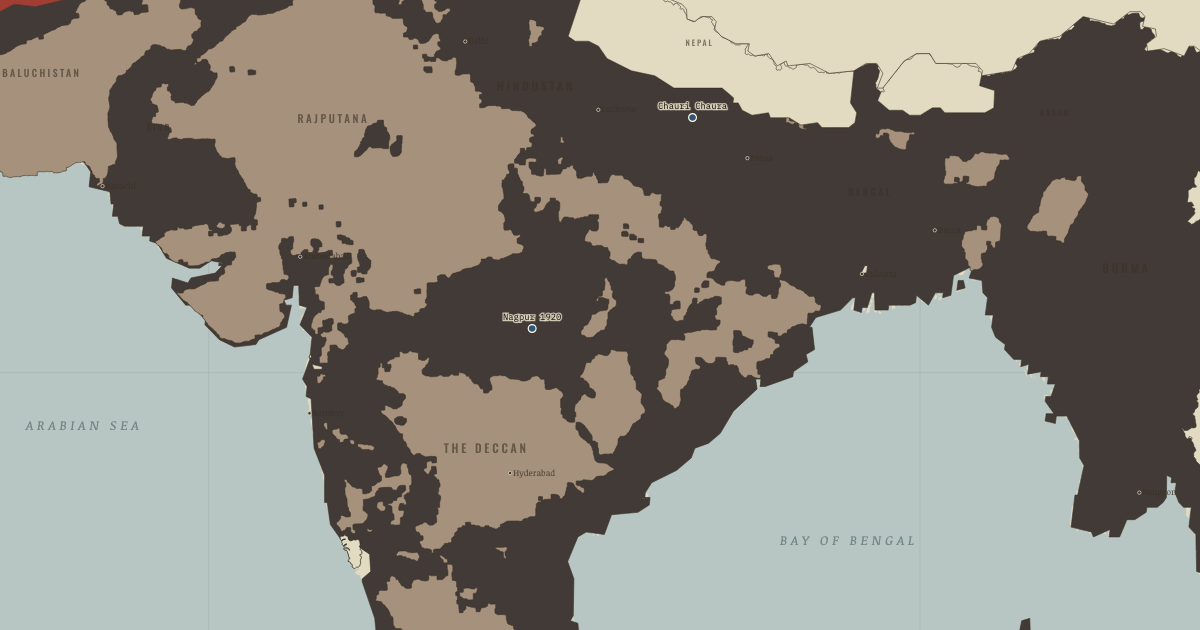
At Nagpur in December 1920, Congress reorganized itself for a struggle in which ordinary participation would become a source of power. Its goal was swaraj, self-rule; its method was non-violent non-cooperation. Membership cost four annas, within a peasant’s reach, and Congress would work in each province’s own language. Gandhi promised swaraj within a year if the program held. The reasoning was straightforward: a government needs people to use its institutions and buy its goods. If enough people refused, its machinery would be much harder to operate.
The short answer
- Amritsar plus Khilafat: two griefs, one front. Amritsar’s wound in Punjab and Muslim anger over the Caliphate were different grievances, but Gandhi brought their supporters into one campaign. A Mahatma championing a Caliph made an awkward theological alliance; Gandhi thought Hindu–Muslim unity worth it. For two years the alliance drew Muslims into all-India politics on an unmatched scale. Critics then and historians since have also seen a cost. Religion had helped unite the movement, but its use gave religious identity a recognized place in political mobilization, a language put to different purposes in the 1930s.
- Gandhi’s wager on discipline. Gandhi’s discipline required people under attack to accept violence without returning it. That was a strategic calculation as well as a moral demand: violence could justify repression, divide the movement and alienate audiences in Britain and the wider world. The difficulty was preparing a subcontinent to exercise that restraint in months. Chauri Chaura showed that the preparation was incomplete; whether it justified pausing the campaign remains disputed.
- The boycott’s real economics. The boycott changed measurable behavior. Cloth imports halved between 1920 and 1922, and the departure of lawyers and students deprived institutions of participants. By staying away from the councils, voters also withheld legitimacy from dyarchy at its birth. This was chapter 3’s arithmetic put to work: the Raj relied on cooperation that Indians could refuse. The machinery slowed rather than stopped, though, and boycott fatigue had appeared even before the halt.
- Swaraj undefined — deliberately. “Swaraj in one year” gave people a common destination without settling what they would find there. A peasant might hope for land, a merchant for tariffs, and a Khilafat supporter for the Caliph’s restoration. That openness helped build the coalition. It also left different expectations to be answered separately when the year passed without self-rule.
THE TURNING POINT
Chauri Chaura, 4 February 1922. The killing of twenty-two policemen at Chauri Chaura brought Gandhi to a decision almost every Congress leader protested in writing: he stopped the national campaign. Critics hold that its momentum never returned in the same measure. The Raj recovered, Khilafat unity dissolved during the pause, and swaraj was postponed a generation. Gandhi’s defense asks what sort of movement would have continued after excusing the burning. It would have surrendered the discipline on which its claim to non-violence rested, giving the Raj an opening to use force and the world reason to dismiss it. The leaderless violence of 1942 offers a later example of what violence achieved. The decision put Gandhi’s conviction that means shape ends to a costly test.
What it changed
The ebb turns communal. The campaign had given Hindus and Muslims a common purpose; it had not removed the divisions between them. As the struggle ebbed, the mid-1920s brought waves of riots and opposing shuddhi and tanzeem mobilizations. Unity had been an achievement requiring active work, and the consequences of its breakdown would endure.
Constructive work and the long game. Gandhi used the quieter years for spinning, work against untouchability and village sanitation. Critics called this “constructive programme” a retreat; he regarded it as preparation. Khadi and the charkha gave millions a daily way to practice the boycott, and cadres in the movement that rose in 1930 included people trained during the ebb.
The Swarajists re-enter the councils. Motilal Nehru and C. R. Das instead entered the legislatures “to wreck dyarchy from within”. Even partial office brought pressures and possibilities of its own. Their choice began a pattern in which Congress moved between mass struggle and council work, each feeding the other. The 1937 ministries brought the Swarajist approach to a much larger scale.
The full answer, argued
The movement had put the Raj under severe pressure. Its own officials later admitted how stretched it had been, and the halt gave it a reprieve. Millions were demobilized without returning in the same numbers, and Khilafat unity dissolved in the pause. These are serious reasons to criticize Gandhi’s decision. His answer concerns the means by which the pressure had been built. Non-violence made repression costly, kept a moral audience and avoided a war the movement would have to lose against the best army in Asia. Excusing Chauri Chaura could license further mob violence and let the Raj fight on military rather than moral ground. Disciplined mass movements may gain legitimacy at the cost of momentum. Yet the criticism also assumes that swaraj was available in 1922; almost certainly it was not. The halt sacrificed less than its critics claimed, while teaching the movement more.
An interesting fact
In September 1921 at Madurai, Gandhi permanently adopted the loincloth of the poorest peasant, explicitly so that no Indian could be worse-dressed than he was. The spinning wheel he made a daily discipline appeared on the Congress flag that year; transformed into Ashoka’s wheel of law, it remains on India’s tricolour. Winston Churchill later sneered at “a seditious Middle Temple lawyer, now posing as a fakir”. The London-trained barrister had made the clothing of India’s poor an image seen around the world.
This is the study layer of Non-cooperation movement, chapter 7 of Indian Independence & Partition, 1857–1964; the full index of the atlas is here.
Related questions
THE FREE PRINTABLE STUDY GUIDE
Get the printable study guide for Indian Independence & Partition free. I’ll send you a few short letters, then one when a new atlas opens. That’s all. — Paul
NO TRACKING · YOUR ADDRESS IS USED FOR THE DISPATCH AND NOTHING ELSE · UNSUBSCRIBE ANYTIME