Indian independence · APR 1919
Why was Dyer’s punishment after Amritsar worse than none?
The seminar question: “The Hunter Commission censured Dyer and he was retired from active command. Why was that punishment worse than none at all?”
The Rowlatt Act of 1919 made detention without trial permanent for political cases, and Gandhi called the first all-India protest. On 13 April 1919 General Dyer ordered troops to fire without warning on a crowd at Jallianwala Bagh in Amritsar; the official death toll was 379, while Indian estimates ran far higher.
Chapter 6 is included with every paid plan. WW2 is free in full, and chapter 1 of every atlas is free. A free account opens 3 more chapters a day. Starter, at $9 a month, opens all 21 with no daily limit — see the plans.
Free printable Indian independence study guide, sent by email ↓
India had helped Britain fight a war presented as a defence of liberty. Peace brought an unsettling answer to those who expected that service to earn greater freedom. The Rowlatt Act carried wartime emergency powers into peacetime, permitting detention without trial and trial without jury in political cases. Gandhi called the first all-India satyagraha, a general strike known as a hartal. Cities from Lahore to Madras shut down. The protest brought the subcontinent into common action on a scale it had not seen before.
The short answer
- Rowlatt: the insult of permanence. No one was ever prosecuted under the Rowlatt Act, but Indians did not have to wait for its application to see what it meant. After a war said to have been fought for liberty, the machinery of a police state would remain available in peacetime. Every Indian member of the Imperial Legislative Council voted against the measure; it passed nonetheless. The episode exposed the limits of consultation, and Jinnah resigned his seat in protest. Constitutionalists, too, were radicalized.
- The Punjab under pressure. Punjab had supplied three-fifths of the army’s men and endured recruitment quotas, requisition and influenza. Lieutenant-governor Michael O’Dwyer governed it like a barracks and regarded educated politics as sedition. The hartal recalled the uprising of 1857 to him. He deported local leaders, setting off riots, and endorsed Dyer’s response. The officer’s decision grew out of a provincial regime’s settled ideas about rule.
- Dyer’s theory of exemplary terror. Dyer did not merely want the crowd to disperse. As he put it, “I was going to punish them.” The intended lesson reached beyond those in the garden: others would hear what defiance could bring. A frontier doctrine of collective punishment had been applied in a city of British India. His testimony made plain a question the Raj had blurred: was India governed by law, or did law cover rule by force? His words gave Indians reason to believe the latter.
- A promise already discounted. The Montagu–Chelmsford reforms arrived in the same season, offering real, if grudging, steps toward reform. Rowlatt and Amritsar changed how those steps could be understood. Concessions offered alongside repression could look like management of dissent rather than partnership. Historians debate whether a generous settlement in 1919 might have kept India on a dominion path; after Amritsar, moderates who might have advocated it had lost ground for their argument.
THE TURNING POINT
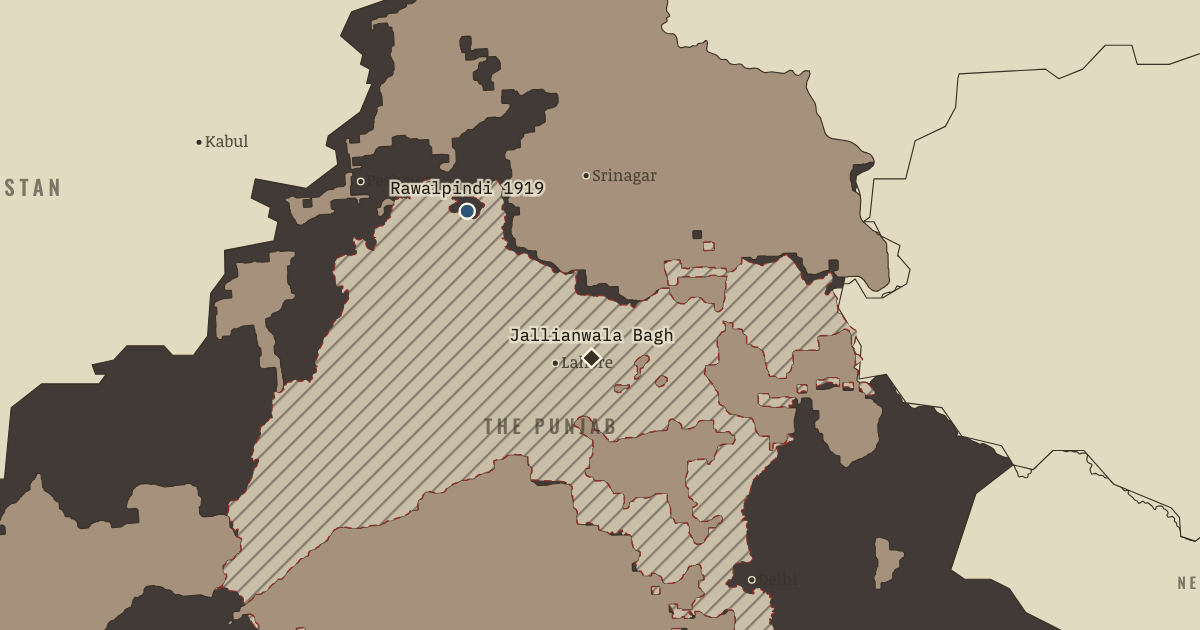
Jallianwala Bagh, 13 April 1919. At Jallianwala Bagh, ten minutes of fire into a walled garden became a test of Britain’s claim to rule by law. The Raj might conceivably have survived had the massacre been disowned as an atrocity. Instead Dyer defended his intended “moral effect” under oath, the Lords passed a motion in his favour and members of the public raised him a purse. Enough people in Britain endorsed exemplary terror to destroy the sixty-year argument for lawful rule. The atlas marks the site as a memorial: 379 were officially counted dead, perhaps a thousand died, and names are still being recovered. The change in belief cannot be drawn on the map, but it shaped what followed.
What it changed
Gandhi captures the national movement. Gandhi could now make a moral as well as a strategic case for non-cooperation. If the Raj was force presented as law, Indians who cooperated helped sustain its rule; withdrawing cooperation could become a duty and a means of resistance. Within eighteen months the man who had recruited soldiers for the Raj led a movement to boycott everything it touched.
Afghanistan slips the leash. While Punjab was in turmoil, the new Afghan amir attacked British India. A month’s desultory war ended with the Rawalpindi treaty in August 1919, under which Britain conceded Afghan control of its own foreign policy. The north-west corner of the map turns red. As consent weakened within British India, Afghanistan became the first sovereignty shown here to escape British tutelage; Britain could no longer afford even its buffers.
The Khilafat bridge. Another grievance helped bring Indian Muslims into common action with Congress. The victors were dismembering Ottoman Turkey, whose sultan was Caliph. In 1920 the Khilafat movement’s outrage joined Congress’s anger after Amritsar, producing the broadest Hindu–Muslim front of the freedom struggle. Its eventual collapse left a bitter communal ebb.
The full answer, argued
The official response censured Dyer without treating his action as a crime. He faced no court and kept his pension. The Lords voted in his favour, and the British public presented him with a fortune in a purse and a jewelled sword inscribed “Saviour of the Punjab”. O’Dwyer, who had ratified the massacre, was entirely exonerated. Indians could see formal disapproval beside evidence that the killing was valued as a service. A hanging would have been justice; full exoneration would at least have been candid. The half-measure neither punished terror nor honestly acknowledged its use, undermining the government’s claim to rule by law. From 1920 the argument in India shifted from whether British rule was legitimate to how and when it would end.
An interesting fact
The Rowlatt Act helped bring on the crisis even though its preventive-detention machinery was never used against anyone. It remained on the statute book for three years before repeal in 1922; protest against its existence had already reshaped the subcontinent. Its political meaning reached far beyond its actual use. Udham Singh, an orphan of Amritsar, watched the aftermath closely. Twenty-one years later, in 1940, he shot Michael O’Dwyer dead in a London lecture hall. Indian memory has treated that coda less as a question of terrorism or justice than as part of Amritsar’s story.
This is the study layer of Amritsar massacre, chapter 6 of Indian Independence & Partition, 1857–1964; the full index of the atlas is here.
Related questions
THE FREE PRINTABLE STUDY GUIDE
Get the printable study guide for Indian Independence & Partition free. I’ll send you a few short letters, then one when a new atlas opens. That’s all. — Paul
NO TRACKING · YOUR ADDRESS IS USED FOR THE DISPATCH AND NOTHING ELSE · UNSUBSCRIBE ANYTIME