Meiji Japan and post-Soviet Russia · 2000
Did the Meiji transition succeed where Russia’s failed?
The seminar question: “To what extent did the Meiji transition succeed where the post-Soviet transition failed?”
Russia’s decade of transition ended with a return to strong central power. Vladimir Putin, made prime minister in August 1999, led a second war in Chechnya, became acting president when Yeltsin resigned on 31 December 1999 and won the March 2000 election with 52.9%, setting up a comparison with Meiji Japan.
Chapter 12 is included with every paid plan. WW2 is free in full, and chapter 1 of every atlas is free. A free account opens 3 more chapters a day. Starter, at $9 a month, opens all 21 with no daily limit — see the plans.
Free printable Meiji Japan and post-Soviet Russia study guide, sent by email ↓
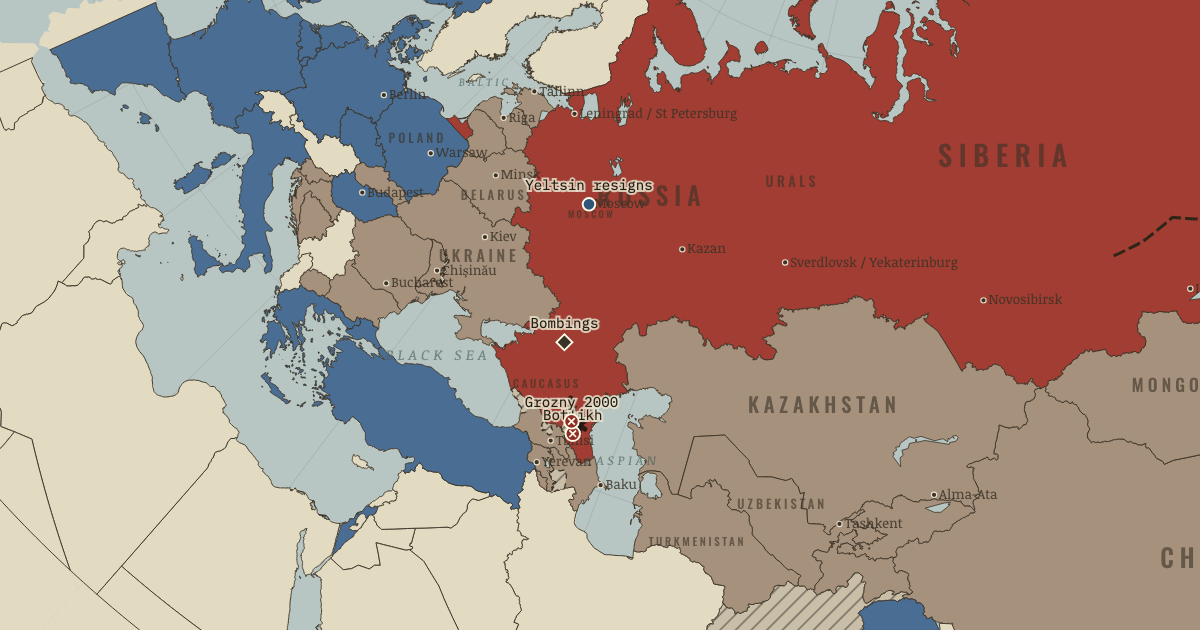
On 9 August 1999 Yeltsin appointed Vladimir Putin prime minister. Two days earlier fighters led by Shamil Basayev had crossed from Chechnya into Dagestan, along the arrows on the map. Putin had headed the FSB, the KGB’s successor as Russia’s security service, since 1998. Within weeks the country faced a terrifying series of attacks: between 4 and 16 September bombs destroyed apartment blocks in Buynaksk, Moscow and Volgodonsk, killing about 300 people. The government blamed Chechen militants.
The short answer
- Chechnya’s interwar chaos and the Dagestan raid. Khasavyurt ended the first war without giving Chechnya’s elected president Aslan Maskhadov control over field commanders such as Shamil Basayev. Kidnapping for ransom became an industry. In August 1999 Basayev and Khattab led fighters into Dagestan in support of a local Islamist rising. Moscow could cite the raid as a reason for another war and present that war as defense against terrorism.
- Yeltsin needed a successor who would protect him. Yeltsin’s circle needed a successor who could win and protect him. By 1999 he was ill and deeply unpopular, while corruption investigations threatened family and associates. Putin appeared to fit the requirement: loyal, disciplined and unknown to the public. As acting president, his first decree granted Yeltsin immunity.
- The 1998 crisis discredited the reformers and the oligarchs. The 1998 default destroyed savings for the second time in a decade. Governments that had promised a quick transition to Western prosperity lost credibility, and many Russians associated democracy and markets with chaos, theft and humiliation. Promises of order spoke to that experience; curbs on oligarchs and independent media were popular with much of the public.
- Oil prices rose again. Oil gave the government resources to rebuild. Its price had fallen to around ten dollars a barrel in late 1998, then roughly tripled by 2000. Revenue returned, wages and pensions were paid on time, and growth resumed. As in the 1970s, Moscow received resources that did not depend on reform; this windfall helped finance central power.
THE TURNING POINT
Yeltsin resigns, 31 December 1999. By resigning six months early on 31 December 1999, Yeltsin made Putin acting president and advanced the election. Putin could campaign as an incumbent while the Chechen war was popular. The ruling circle arranged the transfer, and voters approved it afterward. Open, chaotic politics gave way to a priority on restoring state power over political competition. Russia’s transition ended, as Japan’s had begun, with authority concentrated at the center.
What it changed
The centre reclaimed the regions. The separate bargains regions had made with Moscow in the 1990s gave way to federal districts under presidential envoys, control over parliament’s upper house and a requirement that regional laws match federal ones. From 2005 governors were appointed rather than elected. Japan’s abolition of domains in 1871 offers a softer parallel: both centers took power from regions. The difference is that the Kremlin reclaimed powers lost in 1990–91, while Japan’s new government took powers no earlier Japanese center had held.
The war in Chechnya became a long insurgency. Taking Grozny did not end the war. Fighting continued in the mountains for years, with terrorist attacks inside Russia. Moscow governed Chechnya through loyal Chechen leaders, Akhmad Kadyrov and later his son Ramzan. The counter-terrorist operation officially ended only in 2009, and human rights groups documented disappearances and killings on a large scale throughout.
Two transitions, two strong states. The institutions left by each transition shaped what later leaders could do. Meiji Japan’s emperor-centered constitution and powerful military allowed the army to escape civilian control; its empire expanded into China in the 1930s. Russia’s restored “vertical of power” narrowed elections, media and courts in the decades after 2000. Both states survived, while limits on democracy offered opportunities for later leaders to exploit.
The full answer, argued
By their leaders’ chosen goals, the Meiji reformers succeeded more clearly: within forty years Japan ended the unequal treaties, built industry, schools and a constitution, and defeated two great powers. By 2000 Russia had lost an empire, output had fallen about 40%, and millions of excess deaths had occurred. But the comparison changes when we ask what people gained and lost. Russia created a market economy and private property, held competitive elections for a decade and grew quickly after 1999. Japan’s achievements rested on authoritarian institutions, cheap labor and colonial conquest, and its state slid into militarism. Carol Gluck and Stephen Kotkin warn against judging transitions only by their end points. A strong answer names its criteria, compares leadership, sequencing and the international setting, and gives weight to the people, minorities and neighbors who bore the costs.
An interesting fact
In June 1996 Putin lost his job as deputy mayor of St Petersburg when his patron, the reformist mayor Anatoly Sobchak, lost re-election. He moved to the Kremlin property department, which managed presidential buildings and resorts. In July 1998 he became head of the FSB security service; in August 1999 he became prime minister, and on 31 December acting president. Less than four years separated unemployment from the presidency, one of the fastest rises of any modern head of state. He had never stood in an election before March 2000.
This is the study layer of Meiji and post-Soviet Russia compared, chapter 12 of Remaking the State: Meiji Japan 1600–1912 and Post-Soviet Russia 1964–2000; the full index of the atlas is here.
Related questions
THE FREE PRINTABLE STUDY GUIDE
Get the printable study guide for Remaking the State free. I’ll send you a few short letters, then one when a new atlas opens. That’s all. — Paul
NO TRACKING · YOUR ADDRESS IS USED FOR THE DISPATCH AND NOTHING ELSE · UNSUBSCRIBE ANYTIME