Chinese Revolution · 1946
Could 1945–46 mediation have produced a coalition China?
The seminar question: “The “lost chance” debate: could the 1945–46 mediation have produced a coalition China, or was civil war inevitable?”
Japan’s surrender in 1945 set off a race for Manchuria: Soviet forces overran Manchukuo and let captured weapons reach the Communists, while the United States moved Nationalist armies north. American mediation produced agreements but no trust, and Nationalist gains, including Yan’an in 1947, hid overextension.
Chapter 10 is included with every paid plan. WW2 is free in full, and chapter 1 of every atlas is free. A free account opens 3 more chapters a day. Starter, at $9 a month, opens all 21 with no daily limit — see the plans.
Free printable Chinese Revolution study guide, sent by email ↓
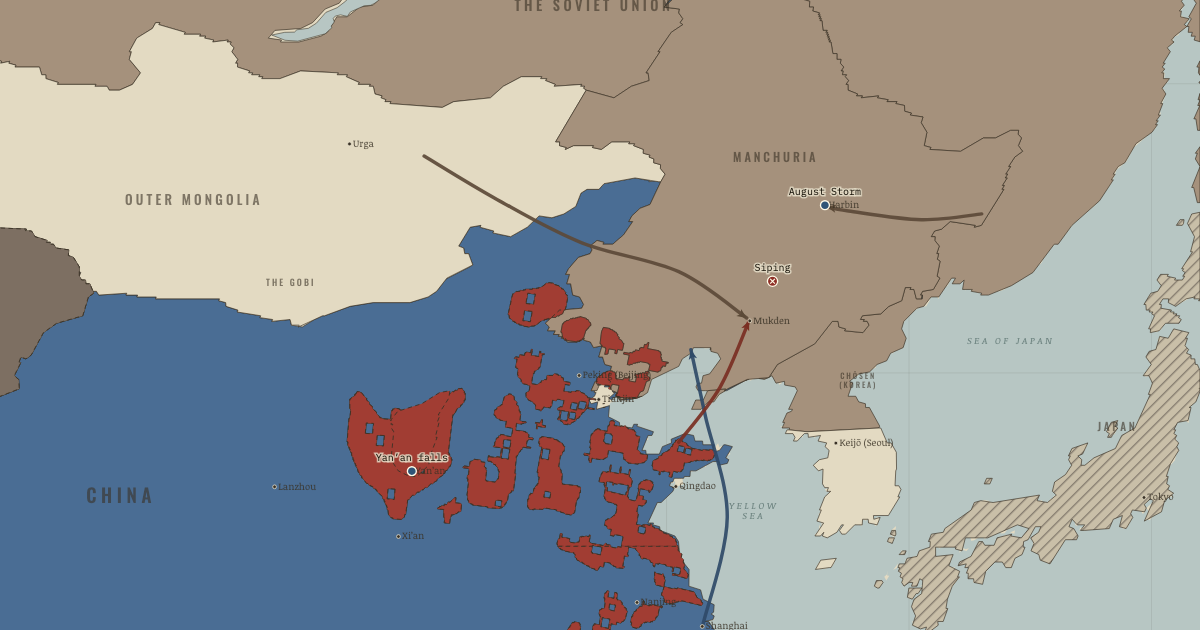
Japan’s surrender left a question that neither Chinese party could afford to leave to its rival: who would occupy the territory and receive the Japanese surrender? Manchuria was especially valuable. Its factories, ports and railways offered resources with which to fight a Chinese war, and the hatching on the map shows the region contested from the outset.
The short answer
- Why Manchuria mattered. Manchuria offered the industrial complex, ports, railways and grain with which an army might sustain a long campaign, as well as a border with the Soviet Union. Mao sent his best cadres and about 100,000 troops from other theaters in autumn 1945 under the direction “develop the north, defend the south”. Chiang also had a powerful reason to recover the northeast: its loss in 1931 had damaged his legitimacy. Wedemeyer and Marshall warned that supplying his armies there would be difficult. Both leaders understood the prize; holding it would test the resources each could bring to the region.
- Stalin's two policies. Stalin made a formal agreement with Chiang while leaving opportunities open to the Communists. The August 1945 friendship treaty secured concessions associated with Yalta concerning Port Arthur and the railways, as well as recognition of Mongolia’s independence. Soviet forces removed machinery, but as they withdrew in spring 1946 Communist troops gained access to Japanese stocks and positions near vacated cities. Moscow sought advantage in a weak, divided China and did not expect a Communist victory outright.
- Why mediation was difficult. A coalition required the two parties to place their armies within a common state. For each, that meant risking the one protection it had against the other. The 1927 purge described in Chapter 5 had given both reason to remember what a broken alliance could mean. They used truces to reposition: Nationalist historians have argued that the 1946 ceasefires helped Lin Biao recover after Siping, while Chiang’s victories strengthened his belief in force. Marshall could obtain signatures and pause the fighting. He could not provide the security each side demanded before surrendering control of its army.
- The return to the coast. The return to the coast gave the Nationalists an opportunity to turn victory into public support. Instead, corrupt takeover officials seized assets, currency conversion harmed people holding puppet-issued money, and former collaborationist industry went to favored hands. Hyperinflation added to urban hardship. In villages the government recovered, landlords returned with it. The manner of recovery weakened the support the state would need for the war ahead.
THE TURNING POINT
August Storm, 9–20 August 1945. The Soviet advance of 9–20 August 1945 opened Manchuria to a new contest in eleven days. It left Japanese arsenals within Communist reach, removed industrial equipment and placed a Soviet border sanctuary near the struggle. Chiang had strong reasons to recover the region, yet his garrisons would have to be supplied over great distances. In the 1948 Liaoshen campaign they faced siege, a sealed rail gate and supply lines extending some 1,800 kilometers. August Storm helped establish that arena and its initial positions; the later fighting determined the outcome.
What it changed
Land and the war in the countryside. From May 1946, Communist policy in northern base areas moved beyond wartime rent reduction to outright redistribution. The process was sweeping and often violent. It also gave millions of families land they had reason to fear losing if the Nationalists returned. Land reform helped mobilize recruits and support; at Huaihai in 1948 civilian porters pushed barrows to supply the armies whose victory mattered to the land they held.
An army rebuilt after Siping. Lin Biao’s retreat across the Sungari was not the end of his army. North of the river he rebuilt it as the Northeast Field Army, using Japanese equipment, absorbed puppet troops and conscripts from villages affected by land reform. Winter offensives wore down Nationalist garrisons. By 1948 the force outnumbered and outgunned the government’s best troops, an unprecedented material advantage for a Communist army in this period.
The end of Marshall's mission. Marshall left in January 1947 and blamed both parties for the failure of mediation. Aid to Nanjing continued: it tied Washington to the Nationalist cause without securing the government’s survival. Already, Americans were beginning to ask “who lost China”. That question assumes a power over China’s future that deserves examination.
The full answer, argued
The agreements themselves give the case for a lost chance some force. Both parties signed the October 1945 communiqué and the January 1946 ceasefire, and China was weary of war. An enforced standstill might have kept the Communists out of Manchuria’s cities and arguably limited their ambitions. The difficulty was deciding who could enforce such a settlement and reassure the parties that it would last. Archives opened since the 1990s, examined by Odd Arne Westad, Chen Jian and others, show Mao treating negotiation as a phase of struggle (“talk, talk, fight, fight”). Chiang’s diaries reveal corresponding distrust and reliance on force. Both Leninist party-armies remembered 1927 and feared disarmament under a state the other might control. Marshall could suspend the shooting, but he could not guarantee either side against its rival’s victory. The skeptical reading is more persuasive: both found coalition useful to discuss, yet neither accepted the security arrangements needed to sustain it. A signed agreement matters, and so does the means of enforcing it.
An interesting fact
In 1946 the Pauley reparations mission toured Manchuria and estimated the value of Soviet removals—generators, machine tools, locomotives and whole factory lines—at roughly 858 million US dollars, or about 2 billion including deterioration. Moscow called the equipment “war booty” taken from Japan. Photographs of concrete floors bolted for machines that had vanished circulated worldwide. The region remained a prize, but its stripped factories made grain, recruits and porters all the more important to the armies competing for it.
This is the study layer of Chinese Civil War (1945–47), chapter 10 of China in Revolution, 1911–1949; the full index of the atlas is here.
Related questions
THE FREE PRINTABLE STUDY GUIDE
Get the printable study guide for China in Revolution free. I’ll send you a few short letters, then one when a new atlas opens. That’s all. — Paul
NO TRACKING · YOUR ADDRESS IS USED FOR THE DISPATCH AND NOTHING ELSE · UNSUBSCRIBE ANYTIME