Indian independence · MAR 1940
Was the Lahore Resolution a bargaining position?
The seminar question: “The Lahore Resolution never mentions “Pakistan” and calls for “independent states,” plural, of ambiguous sovereignty. Does the ambiguity support the view that Partition was a bargaining position rather than a goal?”
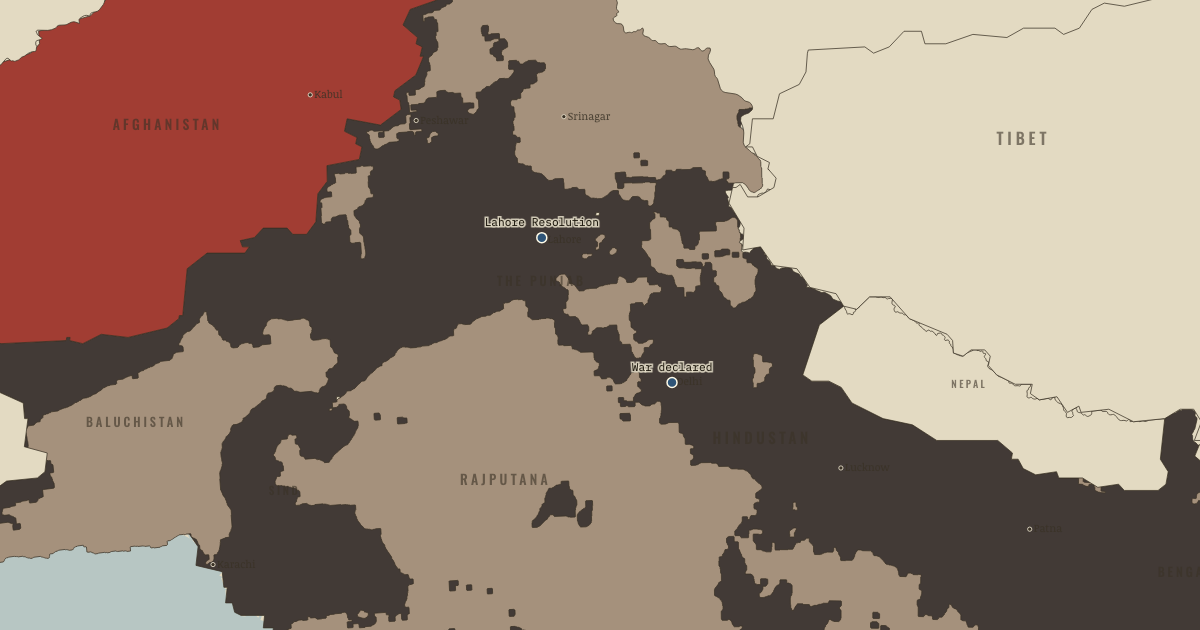
In September 1939 the Viceroy declared India at war with Germany without consulting elected Indian leaders, and the Congress provincial ministries resigned in protest. On 23 March 1940 the Muslim League’s Lahore Resolution demanded autonomous Muslim-majority units in the north-west and north-east, leaving their final form vague.
Chapter 10 is included with every paid plan. WW2 is free in full, and chapter 1 of every atlas is free. A free account opens 3 more chapters a day. Starter, at $9 a month, opens all 21 with no daily limit — see the plans.
Free printable Indian independence study guide, sent by email ↓
Britain entered the war against Germany on 3 September 1939. On the same day Viceroy Linlithgow declared India at war too, without consulting an Indian. He needed no one’s agreement under the constitution. The contrast was hard to miss: Britain was invoking freedom while the people of India had no say in a decision that committed them to war.
The short answer
- One signature, four hundred million people. Linlithgow’s signature placed four hundred million people at war. He had the legal authority to act, but the elected provincial governments had no power to decide the question for the people they governed. Even friends of the Raj winced. Congress’s resignations exposed the contradiction between wartime language about freedom and a system that could commit India without its consent.
- Congress’s impossible position. Congress opposed fascism as well as imperialism. Supporting Britain without conditions would have affirmed the Raj; outright opposition risked an association with fascism. Its proposed exchange—cooperation for freedom—addressed both concerns, but London refused. Resignation protected Congress’s position at a cost: it gave up office and influence over the war state, leaving room for the League. Congress chose conscience and lost leverage.
- The Raj discovers the League’s uses. Britain needed recruits and political quiet during the war, and the League offered a counterweight to Congress. The army grew tenfold to two million, the largest volunteer force in history and disproportionately Punjabi Muslim. As the League helped the Raj meet its needs, Jinnah gained recognition. The 1940 “August Offer” promised that no future constitution would be imposed against the will of “large elements” of Indian life. Such a promise carried the beginnings of a communal veto. Without having won an election, the League had become a co-author of India’s future.
- From minority to nation: the doctrine assembled. The claim to Muslim nationhood drew on older ideas: Sir Syed’s anxieties, Iqbal’s 1930 address outlining a Muslim north-west, and Rahmat Ali’s 1933 pamphlet coining “Pakistan”. Between 1937 and 1940 these ideas acquired new political force. A mass League could organize around fears of majority rule, while wartime Britain needed Muslim support. At Lahore they came together in a claim that changed the arithmetic: if Muslims were a nation, a majority could not simply outvote their claim.
THE TURNING POINT
Lahore, 23 March 1940. Lahore made a new question unavoidable without making Partition certain. Jalal’s interpretation of the demand as a bargaining counter remains powerful, and Jinnah accepted a united-India scheme as late as June 1946. Yet a settlement after Lahore had to address sovereignty for Muslim-majority zones. The Cripps offer’s provincial opt-out, the Cabinet Mission’s grouping and Mountbatten’s partition each offered an answer. Whether Jinnah wanted the answer he eventually received remains one of the era’s great historical puzzles.
What it changed
The map of the demand precedes the map of the state. The 1937 snapshot already shows much of the geography named at Lahore: blue coalition provinces in Punjab, Bengal and Sind, together with the red NWFP. This was not yet a mandate for the League. The Unionists and Huq, who governed those provinces, resisted its claim to speak for them. War, the decline of their parties and the election of 1946 would deliver their voters to the League. The demand’s map preceded the state’s boundary.
Deadlock becomes policy. Congress had left office while the League had entered the wartime political arrangement. The Raj could now weigh each move toward one party against the other, and proposals such as Cripps in 1942 had to reckon with the veto implied by Lahore. Deadlock suited London during the war. Its accumulated costs came due in 1946–47.
Bose walks out of the frame. Twice president of Congress, Subhas Chandra Bose had lost faith in Gandhi’s method and in Britain’s good faith. He escaped house arrest in 1941 and raised the Indian National Army under Japanese patronage. It reached 40,000 and included a women’s regiment named for the Rani of Jhansi. The INA failed militarily at Kohima, but the 1945 trials of its soldiers united Indian opinion, and mutinies followed in a way no Congress campaign quite had. Its political afterlife was much larger than its military success.
The full answer, argued
The wording gives Jalal’s bargaining interpretation substantial support. Jinnah left Pakistan undefined for years, accepted the Cabinet Mission’s united-India scheme in June 1946, and could use a large demand to seek parity from Congress and Britain. Yet the plural “states” also admits a more maximalist reading; ambiguity alone cannot tell us which outcome he wanted. Nor would a bargaining purpose settle what the campaign would produce. A decade of mobilization around a holy destination made the demand difficult for its author to withdraw, and Direct Action Day showed how events could escape control. The synthesis most historians now accept holds that the demand’s content remained open until remarkably late, while electoral, communal and escalating mobilization progressively closed alternatives to the literal outcome. A demand used as leverage could create a constituency determined to see it fulfilled.
An interesting fact
The name “Pakistan” did not originate at Lahore. In January 1933 Choudhry Rahmat Ali, a graduate student in a Cambridge boarding house, published Now or Never. His name combined Punjab, Afghania (the NWFP), Kashmir, Sind and Baluchistan, and also meant “land of the pure” in Persian-Urdu. It had no letter for Bengal, home to most of the future state’s population. League delegates dismissed his scheme as a student fantasy in 1933. Rahmat Ali later denounced the Pakistan of 1947 as a betrayal, was expelled from the country he had named, and died in Cambridge in 1951 with his rent unpaid.
This is the study layer of Lahore Resolution and World War II, chapter 10 of Indian Independence & Partition, 1857–1964; the full index of the atlas is here.
Related questions
THE FREE PRINTABLE STUDY GUIDE
Get the printable study guide for Indian Independence & Partition free. I’ll send you a few short letters, then one when a new atlas opens. That’s all. — Paul
NO TRACKING · YOUR ADDRESS IS USED FOR THE DISPATCH AND NOTHING ELSE · UNSUBSCRIBE ANYTIME