Meiji Japan and post-Soviet Russia · 1988
Did Gorbachev fail, or end the Soviet system without war?
The seminar question: “Should Gorbachev be judged a failure for losing the system he set out to save, or credited for ending it without a major war?”
Mikhail Gorbachev, chosen Soviet leader in March 1985, set out to save socialism by making it work. An anti-alcohol campaign and the oil price fall of 1985–86 emptied the budget, Chernobyl in April 1986 turned him to glasnost, and the contested elections of March 1989 gave an opposition a national stage.
Chapter 8 is included with every paid plan. WW2 is free in full, and chapter 1 of every atlas is free. A free account opens 3 more chapters a day. Starter, at $9 a month, opens all 21 with no daily limit — see the plans.
Free printable Meiji Japan and post-Soviet Russia study guide, sent by email ↓
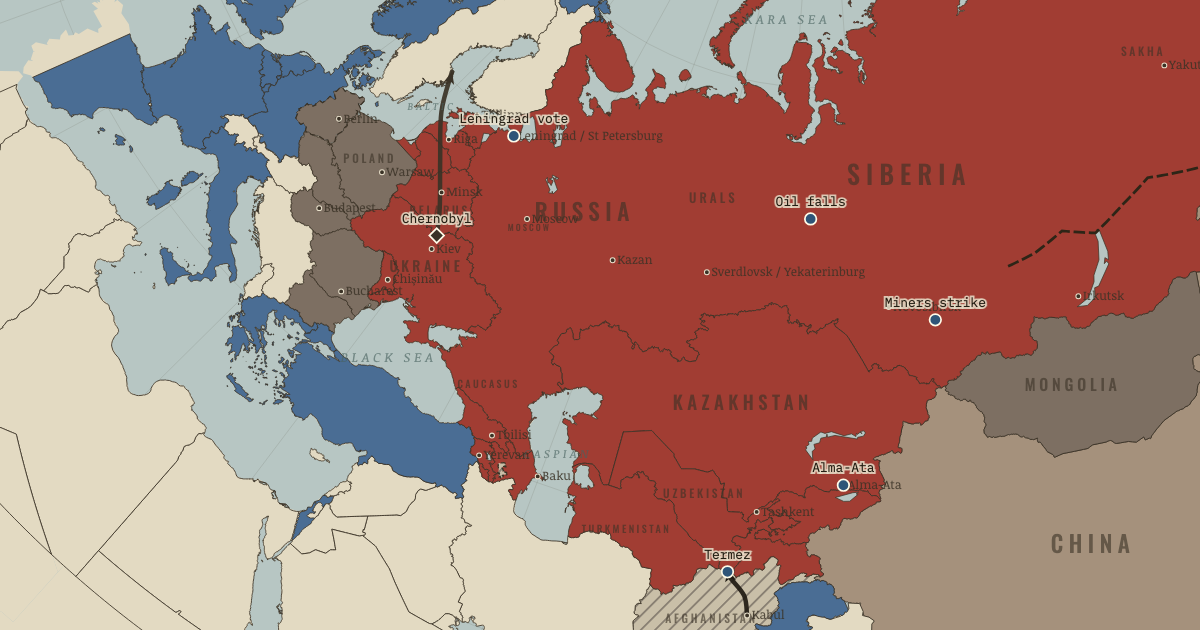
Gorbachev’s first attempt at reform did not abandon the Soviet system. It asked the system to work harder. As general secretary, and thus the country’s leader, he sought “acceleration” through investment in machine-building and tighter discipline. His campaign against drinking, launched in May 1985, reduced vodka production and raised its price. It also removed tens of billions of roubles from the budget over three years, because alcohol taxes were one of the state’s largest sources of income. Many drinkers turned to moonshine in place of state vodka.
The short answer
- A generational change at the top. Three general secretaries died in office between November 1982 and March 1985. Their deaths opened the leadership to a younger man whose career had taken him through regional party work in Stavropol and agriculture. Gorbachev and allies including Alexander Yakovlev and Eduard Shevardnadze had seen the West and believed Soviet renewal was possible. The decline described in chapter 7 created the demand for change; the passing of the old guard gave them an opportunity to attempt it.
- Falling oil prices and the vodka campaign emptied the budget. The government depended on alcohol taxes at home and oil and gas sales abroad, its two largest sources of income apart from enterprise profits. Gorbachev’s temperance campaign reduced the first, and falling world oil prices in 1985–86 cut the second. Afghanistan, the Chernobyl clean-up and an investment drive still required funding. Printing money covered the immediate gap but added to the excess of cash over goods that undermined later reforms.
- Chernobyl discredited secrecy. At Chernobyl, failures and concealment extended from plant managers to ministries in Moscow. The accident persuaded Gorbachev that hidden problems could not be fixed and gave reformers a reason to challenge censorship. Glasnost helped him expose opponents of reform, but citizens used the same opening to criticise the party itself. The discussion soon went beyond his control.
- The apparatus resisted economic reform. Ministries and regional party bosses had built careers within the plan and controlled resources through it. They diluted measures that threatened that control. By 1988 Gorbachev believed political competition was needed to overcome them. At the 19th Party Conference in June–July 1988, contested elections to a new parliament were approved. Reform would now be fought over at the voting booth as well as inside party offices.
THE TURNING POINT
The elections of 26 March 1989. The elections of 26 March 1989 gave most voters a choice of candidates for the first time since 1917. In Leningrad and other cities they rejected senior party officials; Boris Yeltsin won almost 90% in Moscow. When the new 2,250-member Congress of People’s Deputies met in May, millions watched its televised debates, including Andrei Sakharov’s attack on the party’s monopoly. A leader could now claim authority through votes, outside the party’s appointment system. Leaders of the republics would soon make claims in the name of their own peoples.
What it changed
An elected opposition gained a national stage. The new Congress gave opponents a national platform. Yeltsin, Sakharov and several hundred allies formed the Inter-Regional Group of deputies, the first organised opposition since the 1920s. In March 1990 the Congress removed the constitutional article guaranteeing the party’s leading role. That spring, elections to republic parliaments brought nationalist and democratic movements to power in the Baltic states, Russia and elsewhere.
Shortages turned into a crisis of supply. Basic goods were no longer reliably delivered by the state in 1989–90. Rationing spread, while regions and republics kept food and raw materials for themselves. Perestroika left its successors with empty shops and a monetary overhang: too much unspent money relative to available goods. That was the starting point for price liberalisation in January 1992.
National movements found their voice. Glasnost opened space for national grievances as well as criticism of the party. In February 1988 the Armenian-majority region of Nagorno-Karabakh, hatched on the map, voted to leave Azerbaijan. That year popular fronts formed in Estonia, Latvia and Lithuania. A reform begun at the centre was enabling demands to escape its authority.
The full answer, argued
Gorbachev did not achieve what he set out to do. He sought a more productive socialism in a renewed Union; by 1991 the economy was in free fall and the Union had dissolved. His vodka campaign and enterprise law made deficits and shortages worse. Yet the outcome of his political choices deserves separate consideration. Archie Brown and William Taubman stress his acceptance of competitive elections, his role in ending the Cold War and his refusal to use mass force to retain power at home or in Eastern Europe. Violence occurred in Tbilisi in 1989 and Vilnius in 1991, showing that force was used, though it was not pursued to the end. Judgment requires attention to his aims and results, to economics and politics, and to what alternative leaders could realistically have done. Many see a failed economic reformer and a remarkable political one. His refusal to use force helped determine the character of the transition.
An interesting fact
The anti-alcohol campaign earned Gorbachev an unflattering nickname: “mineral secretary” instead of general secretary. It also brought a measurable health improvement. Deaths from heart disease, accidents and alcohol poisoning fell, and Russian male life expectancy reached about 65 years in 1987, its highest level during the Soviet period. After the campaign ended and drinking returned, life expectancy began to fall. Alcohol was among the factors considered in the severe decline of the 1990s; that collapse was partly a delayed bill for lives the campaign had briefly saved.
This is the study layer of Perestroika and glasnost, chapter 8 of Remaking the State: Meiji Japan 1600–1912 and Post-Soviet Russia 1964–2000; the full index of the atlas is here.
Related questions
THE FREE PRINTABLE STUDY GUIDE
Get the printable study guide for Remaking the State free. I’ll send you a few short letters, then one when a new atlas opens. That’s all. — Paul
NO TRACKING · YOUR ADDRESS IS USED FOR THE DISPATCH AND NOTHING ELSE · UNSUBSCRIBE ANYTIME