MAPS OF HISTORY · THE QUESTIONS · Midway is often called “incredible luck.” The…
The War Room — WW2, 1936–1945 · JUN 1942
Midway is often called “incredible luck.” The Americans called it “calculated risk.” Who’s right?
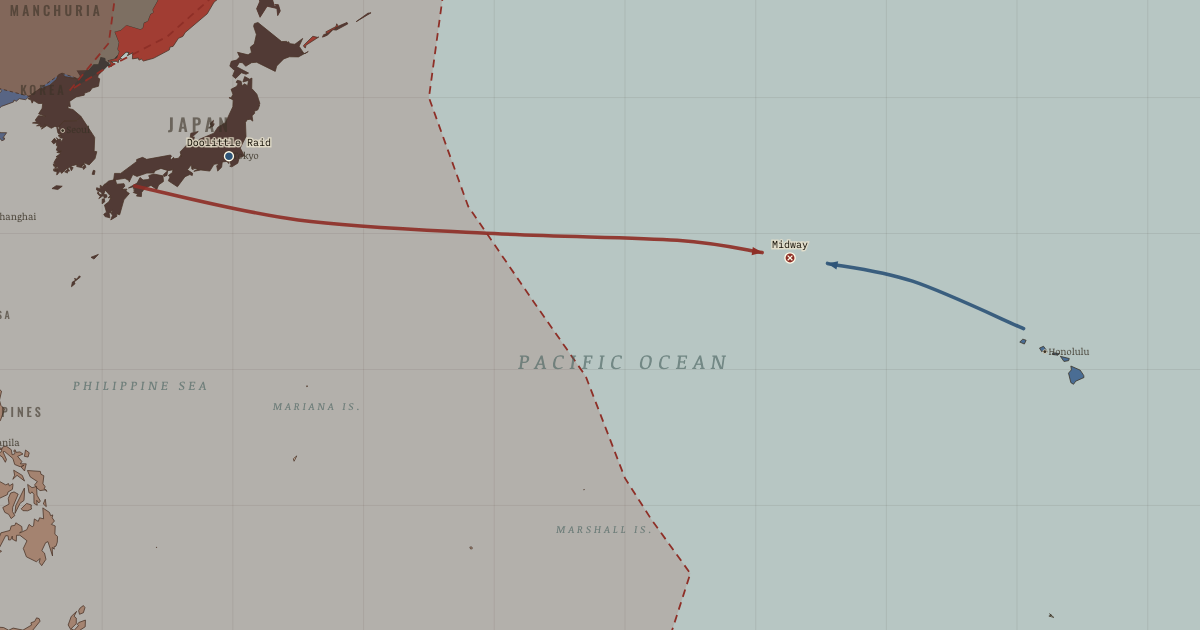
The battle began in the mind of the Japanese high command rather than on any map. In April 1942 sixteen American bombers flew off a carrier and struck Japan in the Doolittle Raid, which did little material harm but shattered the navy’s promise that the home islands were safe. To restore that promise, Japanese planners rushed forward an operation to seize Midway and draw out the American carriers for a decisive battle. The plan scattered forces across a vast area and simply assumed that the United States Navy would react exactly when and where Japan wanted.
THE SHORT ANSWER
- The Doolittle sting. Militarily trivial, psychologically decisive — the raid shamed the navy that had promised the Home Islands were untouchable, and silenced everyone in Tokyo arguing for consolidation over expansion. Emotion, not analysis, chose the next battle.
- Codebreaking: the invisible weapon. HYPO’s partial breaks into the JN-25 code — confirmed by the famous “Midway is short of water” trick — turned an ambush of America into an ambush by America. Intelligence didn’t guarantee victory; it bought the chance of one.
- Victory disease. Six months of unbroken conquest bred a plan of baroque overconfidence: forces split across half the Pacific, a pointless Aleutians feint, and no plan for the possibility that the Americans might already be waiting.
THE TURN
10:20–10:25 a.m., 4 June 1942. Three squadrons of dive-bombers, arriving by luck and stubbornness at the same instant from different errors, find the Japanese carriers with fueled planes and stacked bombs on deck. Akagi, Kaga and Sōryū are mortally hit in five minutes — the most consequential five minutes of the Pacific war.
WHAT IT CHANGED
Parity, then dominance. Japan can no longer take islands under enemy air; the perimeter stops growing. Two months later, US Marines land at Guadalcanal — the counteroffensive begins.
The attrition Japan dreaded. Carriers can be rebuilt; ten-year veteran pilots cannot — and Japan, unlike the US, had no mass training pipeline. From Midway on, Japanese air quality falls while American quality and quantity soar.
A lesson in hinge points. Note the shape of this chapter: a war’s direction reversed not by size of forces but by information, timing and luck compounding. Compare it with Stalingrad next chapter — the other 1942 hinge.
THE FULL ANSWER, ARGUED
Both. Codebreaking, deployment, and command decisions put American carriers in position. Navigation, timing, and Japanese defensive disruption created the decisive moment. Preparation did not eliminate chance; it made favorable chance usable. Without intelligence there was no ambush, and without contingent timing there may have been no decisive carrier losses.
AN INTERESTING FACT
Japan never told its own people about Midway. Radio broadcasts announced a great victory; the fleet’s wounded were brought ashore at night, isolated in guarded hospital wards as “secret patients,” and many surviving sailors were shipped straight to distant garrisons so they could not talk. Even much of the army high command was kept in the dark about the four lost carriers — a government now lying to itself about the ledger of its own war.
This is the study layer of Chapter 8 — Midway: Five Minutes That Turned an Ocean in The War Room — WW2, 1936–1945; the full index of the atlas is here.
SEE IT MOVE ON THE INTERACTIVE MAP →The WW2 atlas is free in full — no sign-up.
MORE QUESTIONS FROM WW2
THE DISPATCH
One short letter when a new atlas opens — and the printable study guide for WW2 is yours now, free.
NO TRACKING · YOUR ADDRESS IS USED FOR THE DISPATCH AND NOTHING ELSE · UNSUBSCRIBE ANYTIME