MAPS OF HISTORY · WW2 · ALL CHAPTERS · CHAPTER 8
CHAPTER 8 · APR–JUN 1942 · JUN 1942
Midway: Five Minutes That Turned an Ocean
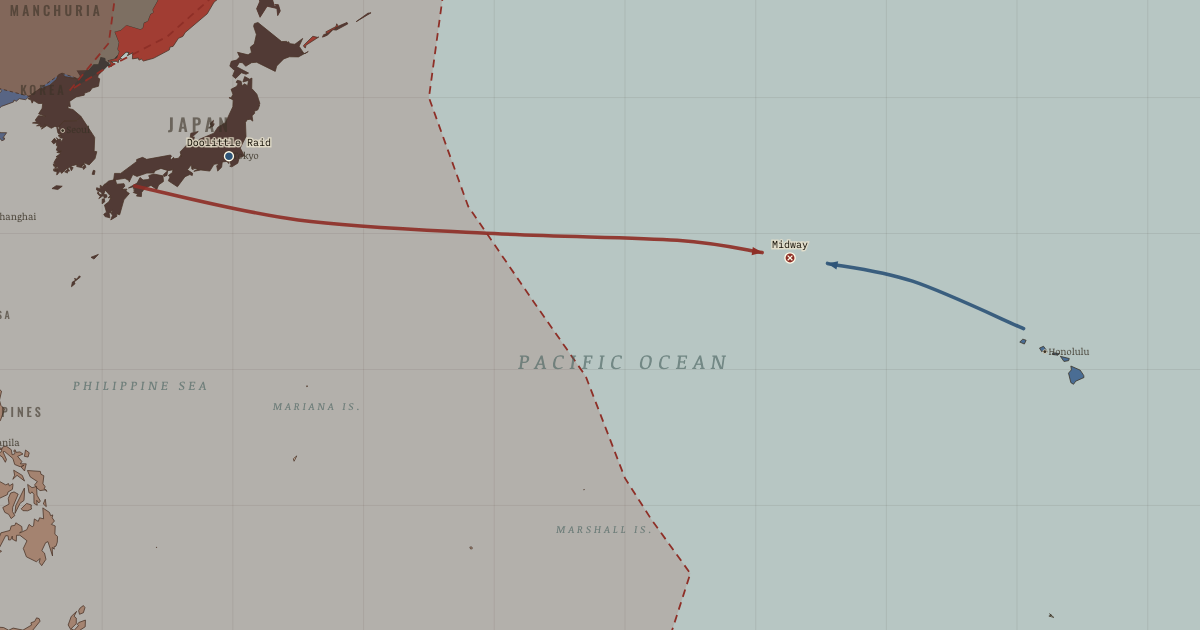
The map above is the world of MAY 1942 — The hundred days.
BRIEF EXPLANATION — THE ESSENTIAL ARGUMENT
Six months after Pearl Harbor the Pacific war turned on a single morning, and it turned because information proved more powerful than firepower. Stung by the Doolittle Raid, an American carrier strike that did little damage yet embarrassed the navy sworn to protect the home islands, Japan planned to seize the atoll of Midway and lure the surviving American carriers to their destruction. What Japan did not know was that United States codebreakers had partly read its naval code, so Admiral Nimitz learned the target and the timing in advance and set an ambush instead of walking into one.
On 4 June 1942 the trap sprang in the opposite direction. American dive-bombers found the Japanese carriers at the worst possible moment, with aircraft being refuelled and rearmed on their decks, and sank four fleet carriers in exchange for one of their own. Japan still possessed a large and dangerous navy, but it had lost irreplaceable veteran aircrews along with the initiative it had held since Pearl Harbor. From this point the Japanese perimeter stopped expanding, and the long American counteroffensive could begin.
GUIDED EXPLANATION
The battle began in the mind of the Japanese high command rather than on any map. In April 1942 sixteen American bombers flew off a carrier and struck Japan in the Doolittle Raid, which did little material harm but shattered the navy’s promise that the home islands were safe. To restore that promise, Japanese planners rushed forward an operation to seize Midway and draw out the American carriers for a decisive battle. The plan scattered forces across a vast area and simply assumed that the United States Navy would react exactly when and where Japan wanted.
The American advantage came from codebreaking, though intelligence created the chance rather than winning the battle by itself. Station HYPO had partly broken the Japanese naval code JN-25, so American commanders identified Midway as the target, estimated the date, and stationed three carriers northeast of the atoll. Chance and courage still decided the outcome. American torpedo squadrons were slaughtered almost to a man, yet their attacks pulled the Japanese fighters down to sea level, and dive-bombers then arrived over the carriers just as their decks were crowded with fuel and armed aircraft. Three carriers were mortally hit within minutes and a fourth later that day, and with them Japan lost many of its finest aviators, producing a rough carrier parity that American production would soon turn into dominance.
The result joined careful calculation to genuine chance, and honesty requires holding both together. Nimitz accepted a real risk because codebreaking placed the likely Japanese force within reach, while the Japanese plan dispersed its ships across a sprawling operation and relied on a surprise it no longer had. Search errors, weather, navigation, and the timing of separate American air groups still shaped the decisive few minutes, which is why Midway should be reduced neither to pure genius nor to pure luck. It became a turning point because the same losses meant very different things to the two sides. The United States had a growing system for training pilots and building carriers, while Japan’s smaller prewar air arm could not replace veteran crews at the same quality or speed.
DEEP EXPLANATION — EVIDENCE & INTERPRETATION
Turning information into advantage
Codebreaking mattered at Midway because commanders turned incomplete information into concrete decisions about where to place their ships. HYPO could not read every message, and the Japanese code groups still demanded interpretation, so analysts combined traffic patterns, fragments, and a clever ruse, a false report that Midway was short of fresh water, to confirm that the code designator “AF” meant Midway. Nimitz then accepted the risk of stationing his carriers in ambush despite real uncertainty about Japanese strength. Intelligence reduced the uncertainty; it did not remove chance or the need for command judgment. The Japanese plan, by contrast, dispersed its forces and leaned on surprise, and its very complexity made rapid adaptation harder once the Americans appeared early. The analytical chain runs cleanly, because intelligence changed the location, the location enabled surprise, and surprise created a brief window for carrier aircraft. Without skilled execution at the end of that chain, the information alone would have produced nothing.
Luck, preparation, and doctrine
The famous “five minutes” can make Midway look like an accident, and chance was indeed real, since search patterns, navigation errors, cloud cover, and the timing of separate squadrons all mattered. Yet preparation decided which side could exploit that chance. The American carriers were present only because of codebreaking, the pilots kept searching when their fuel ran low, and the earlier torpedo attacks, disastrous as they were, disrupted the Japanese fighter cover overhead. The most dramatic popular image, of decks simply piled with bombs, has since been revised, because aircraft handling and the disruption of Japanese defences were just as important. The larger outcome also reflected each side’s system for replacement. Japan’s prewar aviators were superbly trained but produced slowly, while the United States built a far larger pipeline of pilots, aircraft, and carriers. Midway destroyed an elite force Japan could not quickly rebuild, which is how a single battle became a lasting shift in the balance of power.
The WW2 atlas is free in full — no sign-up.
THE SITES
ON THIS DAY
WHY IT HAPPENED
The Doolittle sting. Militarily trivial, psychologically decisive — the raid shamed the navy that had promised the Home Islands were untouchable, and silenced everyone in Tokyo arguing for consolidation over expansion. Emotion, not analysis, chose the next battle.
Codebreaking: the invisible weapon. HYPO’s partial breaks into the JN-25 code — confirmed by the famous “Midway is short of water” trick — turned an ambush of America into an ambush by America. Intelligence didn’t guarantee victory; it bought the chance of one.
Victory disease. Six months of unbroken conquest bred a plan of baroque overconfidence: forces split across half the Pacific, a pointless Aleutians feint, and no plan for the possibility that the Americans might already be waiting.
THE TURN
10:20–10:25 a.m., 4 June 1942. Three squadrons of dive-bombers, arriving by luck and stubbornness at the same instant from different errors, find the Japanese carriers with fueled planes and stacked bombs on deck. Akagi, Kaga and Sōryū are mortally hit in five minutes — the most consequential five minutes of the Pacific war.
WHAT IT CHANGED
Parity, then dominance. Japan can no longer take islands under enemy air; the perimeter stops growing. Two months later, US Marines land at Guadalcanal — the counteroffensive begins.
The attrition Japan dreaded. Carriers can be rebuilt; ten-year veteran pilots cannot — and Japan, unlike the US, had no mass training pipeline. From Midway on, Japanese air quality falls while American quality and quantity soar.
A lesson in hinge points. Note the shape of this chapter: a war’s direction reversed not by size of forces but by information, timing and luck compounding. Compare it with Stalingrad next chapter — the other 1942 hinge.
FIELD QUESTION — Midway is often called “incredible luck.” The Americans called it “calculated risk.” Who’s right?
Both. Codebreaking, deployment, and command decisions put American carriers in position. Navigation, timing, and Japanese defensive disruption created the decisive moment. Preparation did not eliminate chance; it made favorable chance usable. Without intelligence there was no ambush, and without contingent timing there may have been no decisive carrier losses.
AN INTERESTING FACT
Japan never told its own people about Midway. Radio broadcasts announced a great victory; the fleet’s wounded were brought ashore at night, isolated in guarded hospital wards as “secret patients,” and many surviving sailors were shipped straight to distant garrisons so they could not talk. Even much of the army high command was kept in the dark about the four lost carriers — a government now lying to itself about the ledger of its own war.
THE DISPATCH
One short letter when a new atlas opens — and the printable study guide for WW2 is yours now, free.
NO TRACKING · YOUR ADDRESS IS USED FOR THE DISPATCH AND NOTHING ELSE · UNSUBSCRIBE ANYTIME