WWI · MAY 1917
Was WWI a European civil war with global casualties?
The seminar question: “Is “A European civil war with global casualties” a fair description of 1914–18?”
The war became global because Europe’s powers ruled empires that supplied soldiers, labourers and porters from Africa, Asia, the Pacific and the Americas. Japan seized German possessions in China and the Pacific, and Britain backed the Arab Revolt while secretly agreeing the Sykes–Picot division of the same lands with France.
Chapter 9 is included with every paid plan. WW2 is free in full, and chapter 1 of every atlas is free. A free account opens 3 more chapters a day. Starter, at $9 a month, opens all 21 with no daily limit — see the plans.
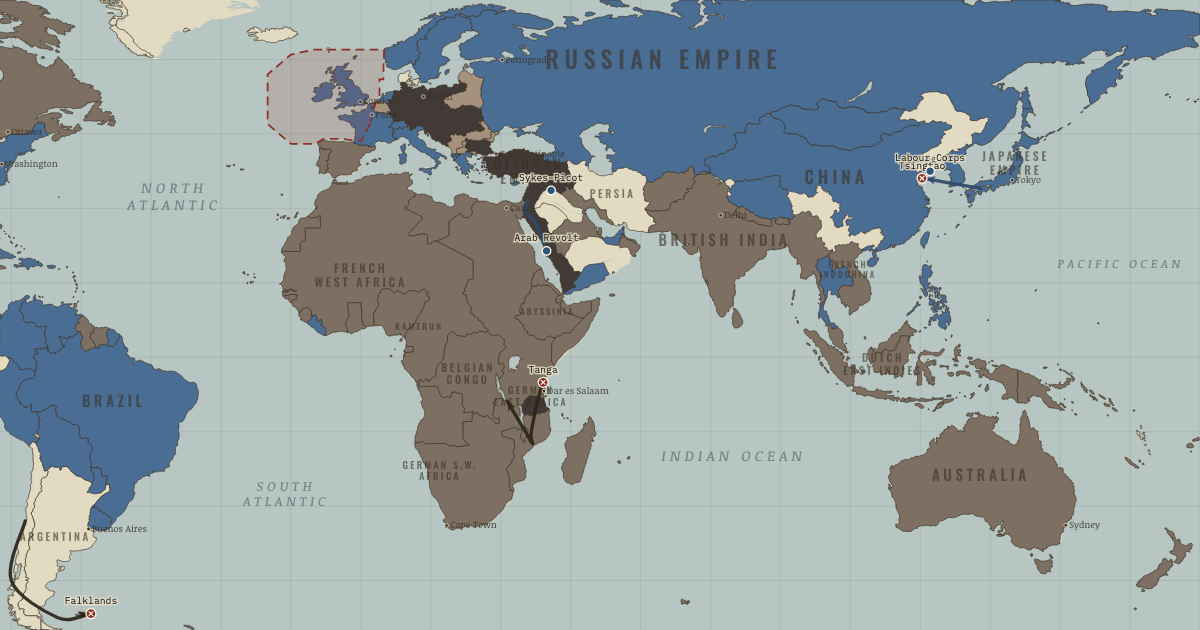
A declaration in Europe could put people on several continents to work. Most colonies became legally at war when their ruling powers entered the conflict, without a separate decision by their inhabitants. Imperial governments could then draw on shipping, bases, money, food and raw materials as well as men. India furnished a vast volunteer army; African porters carried supplies for campaigns across difficult country; and Chinese laborers dug and repaired ground behind the Western Front. Many who sustained the fighting had never chosen the quarrel.
The short answer
- Empires at war. The belligerents controlled networks that already spanned the world: shipping lanes, coaling stations, colonial armies and undersea cables. Once their governments went to war, most colonies were legally at war too; their inhabitants made no independent decision. Britain could act across those networks immediately, cutting German cables and hunting commerce raiders in the Pacific.
- Japan’s opportunity. Japan’s alliance with Britain dated from 1902, but entry into the war also offered Japan territory. After a siege of about six weeks it took Tsingtao, Germany’s Chinese port, and occupied the Marianas, Carolines and Marshalls. In 1915, while Europe was distracted, Japan presented China with the Twenty-One Demands, seeking extensive concessions and, in some demands, a position resembling a protectorate. Some islands taken in 1914 became American objectives in 1944.
- Three overlapping commitments. Britain wanted Arab help against the Ottomans, French cooperation and support for Zionism. The McMahon–Hussein letters of 1915–16 encouraged Arab independence, though their territorial exclusions remain disputed. Sykes–Picot assigned British and French spheres in May 1916; the Balfour Declaration supported a Jewish national home in Palestine in November 1917. Each addressed a wartime need. Together they gave different parties grounds to claim a voice in the future of the same region, where people already lived.
- Lettow-Vorbeck’s campaign and its cost. Lettow-Vorbeck’s small force could not defeat the British Empire, but it could keep enemy troops and resources occupied and potentially divert them from other fronts. Africans made that mobility possible and paid much of its price. Campaigns requisitioned crops and labor, villages were burned, and food supplies were devastated. Porter deaths are estimated in six figures, although precise counting is difficult. The economy of force praised in military accounts depended on costs imposed on others.
THE TURNING POINT
The wartime agreements, 1916. Britain’s agreements altered the future political problem without moving an army. In 1915–16 it encouraged Arab expectations of independence; in May 1916 it agreed with France on spheres in Ottoman lands. The correspondence’s territorial scope remains disputed, and the later Balfour Declaration added a commitment concerning Palestine. After Ottoman rule fell, the overlapping promises entered arguments over mandates, borders and self-government.
What it changed
Imperial authority challenged. Imperial subjects had seen European armies suffer and rely on their labor and loyalty. Wilson’s “self-determination” and Lenin’s anti-imperialism gave political language to experiences that could already raise questions about imperial authority. In 1919 Egypt rose; the Amritsar massacre damaged claims of liberal British rule in India; and the Versailles decision on Shandong helped spur China’s May Fourth movement. Independence would take decades, but the war sharpened demands for it and weakened claims that empire was permanent or reciprocal.
Mandates and continued rule. The victors assigned former German and Ottoman territories as League of Nations “mandates,” administered as trusteeships with reporting obligations. Look at the world map at the end: the grey-tan grows. Outside rule continued where many had sought independence, and the distance between liberation rhetoric and the settlement fed nationalist opposition from Cairo to Hanoi. Ho Chi Minh, then a young kitchen worker, petitioned at Versailles and was not received.
Remembering imperial service. The Indian Army counted 74,000 dead; French African tirailleurs fought at Verdun; Chinese laborers cleared battlefields into 1920; and many African porters died without graves. For communities outside Europe, these were central experiences of the war. Imperial memory gave them a much smaller place for most of a century.
The full answer, argued
The description captures the European origins of the crisis and the importance of the decisive European fronts. It also points to the imperial power that drew people elsewhere into the fighting. But the map shows why their experiences cannot be understood simply as casualties of someone else’s quarrel. Japan’s expansion changed the balance of power in East Asia and the Pacific. In Ottoman lands, the Arab revolt, Armenian genocide and partition of Anatolia had stakes of their own. In India, Africa and Indochina, service made imperial rule felt in lives and labor; those who contributed could ask why they lacked equal political standing. Such questions energized later challenges to empire, even though independence did not follow immediately. The war began in Europe, but its conduct and consequences reached beyond Europe.
An interesting fact
An account of payments to Lettow-Vorbeck’s former askari describes a curious test in 1964. The West German Bundestag funded unpaid wages, and a pay table was established at Mwanza on Lake Victoria. Many elderly claimants lacked papers, so, the story says, each was handed a broom and asked to perform the German manual of arms. None failed. African porters who died during the campaign were not included in such a payment.
This is the study layer of WWI outside Europe, chapter 9 of The Great War, 1871–1923; the full index of the atlas is here.
Related questions
THE FREE PRINTABLE STUDY GUIDE
Get the printable study guide for WWI free. I’ll send you a few short letters, then one when a new atlas opens. That’s all. — Paul
NO TRACKING · YOUR ADDRESS IS USED FOR THE DISPATCH AND NOTHING ELSE · UNSUBSCRIBE ANYTIME