WWI · JUL 1923
Did armies or treaties draw Europe’s borders after WWI?
The seminar question: ““In 1919–1923 armies drew the map of Europe, and treaties only signed it.” How far do you agree?”
Between 1919 and 1923 the treaties with Germany’s allies redrew Europe: Saint-Germain left a small Austrian republic, Trianon gave Transylvania, Slovakia and Croatia to Hungary’s neighbours, and Sèvres divided the Ottoman lands. Where the treaties stopped, armies took over, as Poland’s war with the Red Army in 1920 showed.
Chapter 15 is included with every paid plan. WW2 is free in full, and chapter 1 of every atlas is free. A free account opens 3 more chapters a day. Starter, at $9 a month, opens all 21 with no daily limit — see the plans.
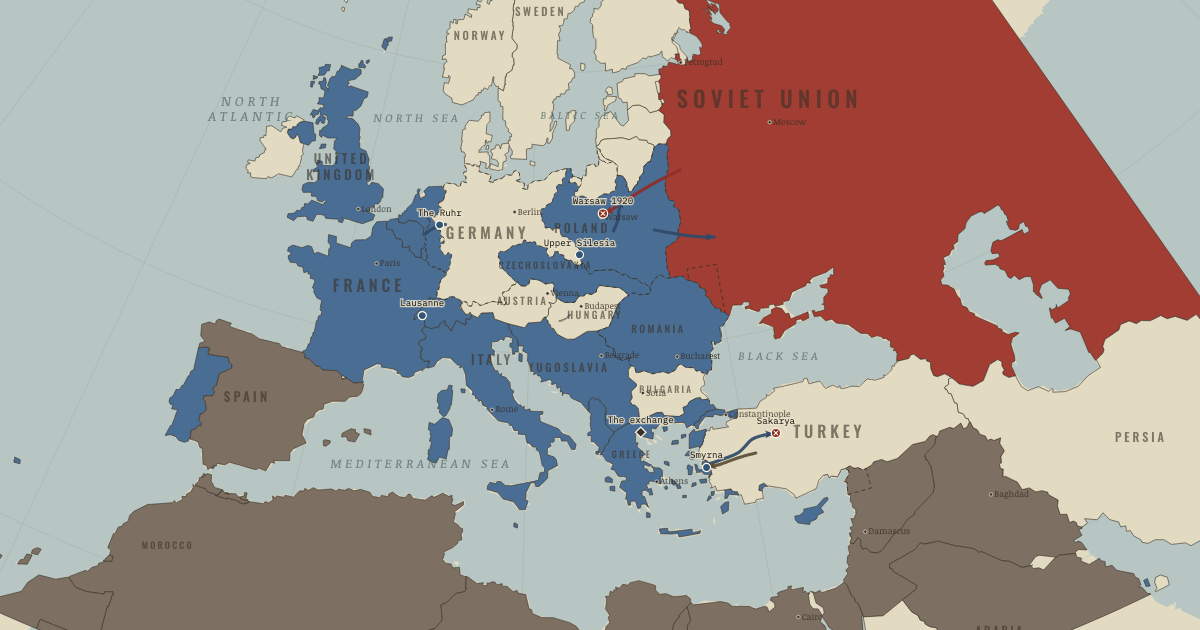
The victors said that nations should govern themselves. Yet self-determination, a principle rather like independence decided by referendum, competed with their promises to allies and their power to take land from defeated states. The treaties with Germany’s allies show the results. Saint-Germain left Austria a German-speaking republic of about six and a half million people and prohibited union with Germany. At Trianon, Transylvania went from Hungary to Romania, Slovakia to Czechoslovakia, and Croatia and the Vojvodina to the new Kingdom of the Serbs, Croats and Slovenes, later called Yugoslavia. Neuilly deprived Bulgaria of its Aegean coast. Sèvres divided lands of the Ottoman Empire, the Turkish state ruled by a sultan or emperor, among Britain, France, Italy and Greece.
The short answer
- The method Versailles set. Versailles settled Germany’s frontiers in Chapter 14 and supplied a method for the other treaties: a Covenant, or founding charter, for the League of Nations, reparations and new borders. Applying it farther east presented a different problem. The defeated states were smaller and weaker, ethnic populations were more tangled, and the victors had promised their allies territory that belonged to the losers.
- Empires that collapsed into a vacuum. The peacemakers arrived after political authority had already collapsed across much of Europe. Three empires fell in twenty months, from the Tsar’s abdication in March 1917 to the collapse of Austria-Hungary and Germany in November 1918; the Ottoman Empire, a fourth, was being dismembered. At the armistice nobody controlled the lands between Germany and Russia. National councils proclaimed new states in Prague, Zagreb, Warsaw and the Baltic capitals before the conference met. Rival claims did not wait for its decision: Poland and Lithuania, for example, contested Vilnius, and armies decided. The conference often ratified facts established on the ground.
- Promises made in wartime. The victors had made territorial promises to attract allies during the war. Under the Treaty of London of 1915, Italy was offered South Tyrol, Istria and much of Dalmatia; Romania was promised Transylvania in 1916. Britain had promised Arab independence, a Jewish national home in Palestine and a division of the Middle East with France. These commitments could conflict when peace came. The strongest claimant usually prevailed, leaving disappointed Italian nationalists and Arab leaders, as well as defeated states, to resent the settlement.
- The Bolshevik challenge. The settlement also reflected fear of revolution. Soviet Russia was excluded from the peace conference and treated as a danger to contain, while Lenin expected revolution to spread westward. Short-lived Soviet republics in Hungary and Bavaria made the danger seem immediate in 1919. The victors backed strong new states on Russia’s border, accepted Romania’s annexation of Bessarabia and tolerated Poland’s expansion eastward. They were trying to contain Moscow as well as Berlin; Moscow saw the resulting map as a hostile wall.
THE TURNING POINT
Lausanne, 24 July 1923. İsmet Pasha, Turkey’s delegate at Lausanne, refused to sign a treaty retaining the capitulations, foreign financial control or reparations. The conference dragged on for eight months before the Allies gave way. Signed on 24 July 1923, the treaty recognized the frontier Turkish armies actually held. It required no outside power to enforce that line, which has largely lasted to this day. Yet the accompanying population exchange showed what making peoples fit borders could cost. The other treaties had instead tried to protect minorities through guarantees. Lausanne’s durability exposed a weakness in the wider settlement, while its exchange revealed the human price of one way to secure a frontier.
What it changed
Guardians and revisionists. The new map gave governments different interests in its survival. France allied with Poland in 1921 and later signed treaties with the Little Entente—Czechoslovakia, Romania and Yugoslavia—to support the settlement. Germany, Hungary and Bulgaria wanted revision, and Fascist Italy, a disappointed victor, increasingly joined them. Most guardians of the settlement were new, small states with divisions of their own; among the revisionists was the strongest economy on the continent. The balance favored those seeking to redraw the map.
Minorities as pretexts. Some 25 to 30 million Europeans lived in another nation’s state. Treaties supervised by the League promised them equality before the law and schools in their own language, but a promise needed a means of enforcement. League procedures were slow, many complaints were set aside, and governments in Warsaw, Bucharest and Belgrade pressed assimilation. In the 1930s Nazi Germany used German minorities’ grievances in Czechoslovakia and Poland as pretexts to break up the settlement. Minority protection had become a weapon against the states that had undertaken it.
Hyperinflation and the radical right. By November 1923, after the Ruhr crisis drove German inflation out of control, a lifetime’s savings could not buy a loaf of bread. That month Adolf Hitler, the leader of a small Munich party, believed the republic was about to fall. He attempted to seize power in the Beer Hall Putsch, an armed coup launched from a Munich beer hall. It failed, and he went to prison. For millions of Germans, however, occupation and hyperinflation left the treaty, the republic and ruin linked in a single memory.
From Lausanne to the next war. The wars of 1919–1922 hardened the belief that stable frontiers required nations of a single people. The Lausanne exchange gave that belief international approval. In 1944 Winston Churchill cited it when defending the expulsion of Germans from lands Poland would gain; the policy was carried out in 1945, after Nazi Germany’s war of conquest and occupation. The next war had begun in 1939 over Danzig, the German port made a Free City by the peace, and the Polish Corridor, which cut East Prussia off from Germany. The settlement had drawn those fault lines years earlier.
The full answer, argued
Armies mattered most clearly in the east and south-east. Poland’s eastern frontier followed the battle line of 1920, Vilnius and Memel were seized by force, and Lausanne recognized the frontier won by Kemal’s army. Here treaties recorded results that soldiers had made possible. The claim fits the center and west less well. Versailles, Saint-Germain and Trianon drew frontiers that no army fought over in 1919, and the defeated states were too weak to resist. Diplomats did not make every decision alone there either. Plebiscites, votes in which local people chose their state much like referendums, settled Schleswig and Upper Silesia; new states had already been proclaimed in Prague and Zagreb. Drawing a border and keeping it were separate problems. Lines could be placed on paper, but those that lasted had force behind them or the consent of people living along them. The 1923 map was unstable because its borders outran the willingness to defend them—a gap governments of every era should consider before signing.
An interesting fact
Polish commanders at Warsaw had help from people listening to the enemy’s radio traffic. From 1919 a small Polish radio-intelligence unit read large numbers of Red Army messages; a young lieutenant, Jan Kowalewski, played the leading part. By August 1920 the commanders knew the positions and orders of Tukhachevsky’s armies, including the thinly held southern flank. According to one operator, a Warsaw radio station also jammed Soviet transmissions at the decisive moment by broadcasting passages from the Bible. The same Polish cipher service broke the German Enigma machine in 1932 and passed its methods to Britain and France in July 1939, five weeks before the next war began.
This is the study layer of Europe’s new borders after WWI, chapter 15 of The Great War, 1871–1923; the full index of the atlas is here.
Related questions
THE FREE PRINTABLE STUDY GUIDE
Get the printable study guide for WWI free. I’ll send you a few short letters, then one when a new atlas opens. That’s all. — Paul
NO TRACKING · YOUR ADDRESS IS USED FOR THE DISPATCH AND NOTHING ELSE · UNSUBSCRIBE ANYTIME