Chinese Revolution · 1944
Who really fought Japan: Nationalists or Communists?
The seminar question: “How did the Nationalists and Communists fight Japan, and why did their different roles matter afterward?”
From 1938 to 1944 Japan held China’s cities, railways and rivers but not the countryside between them. The Nationalists survived in the interior on the Burma Road and the Hump airlift while inflation weakened them and the Henan famine killed perhaps two million; Operation Ichigo in 1944 exposed their weakness.
Chapter 9 is included with every paid plan. WW2 is free in full, and chapter 1 of every atlas is free. A free account opens 3 more chapters a day. Starter, at $9 a month, opens all 21 with no daily limit — see the plans.
Free printable Chinese Revolution study guide, sent by email ↓
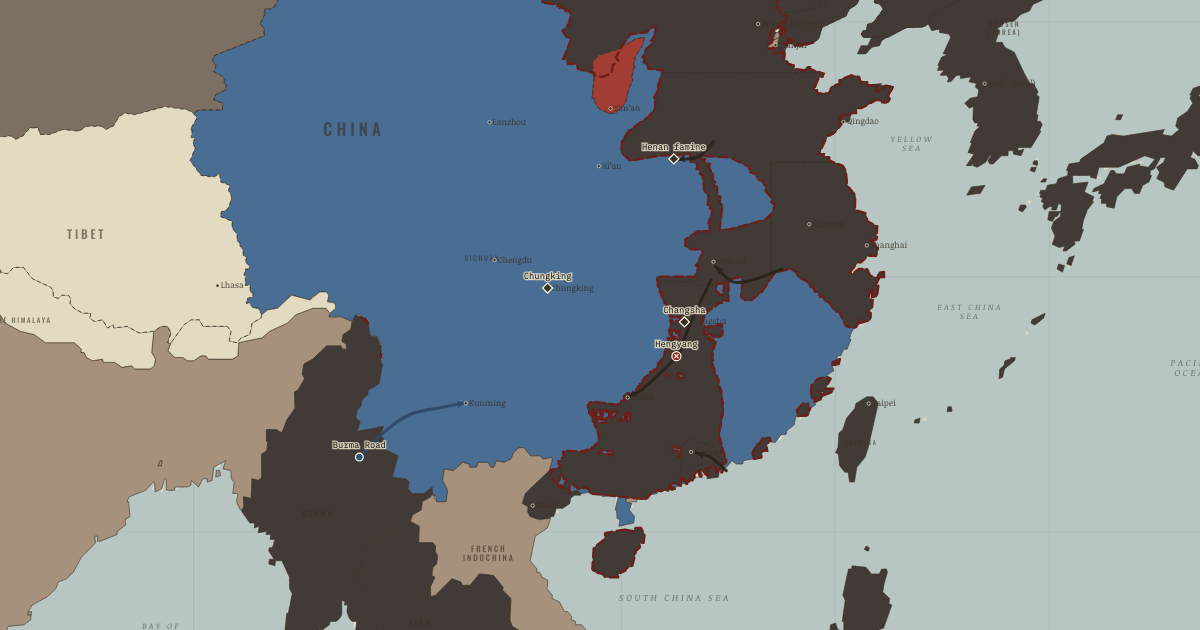
For six years after 1938, Japan occupied a network rather than the whole of China. Its garrisons held cities, railways and river valleys, but the countryside between these points and lines was much harder to govern. Communist base areas spread across the north, and government guerrillas held mountain districts. Even with about a million troops in China, Japan could guard the routes more securely than it could control the land around them.
The short answer
- Why the front froze. By late 1938, each Japanese advance created another stretch of railway to protect. Guerrillas could cut the line between garrisons, while Chinese forces avoided the decisive battle Japan wanted. Tokyo tried to wear down resistance through blockade, puppet government and terror bombing of Chungking. Wang Jingwei’s defection gave Japan a collaborationist “National Government” at Nanjing in 1940. Yet China’s size and poverty made it difficult to strangle. Japan could hold the main routes without compelling surrender; China could continue fighting without expelling Japan. That predicament kept the front largely still for six years.
- Two ways to finance a war. The Nationalists had a state and a conventional war to sustain after losing much of their tax base. Printing money and procuring supplies made resistance possible, but also brought inflation, corruption and resentment among those whose grain was taken. The Communists had a different undertaking: an insurgency sustained from occupied villages. Rent reduction, progressive levies and production drives paid for a cheaper war and helped win support. Different obligations and resources shaped the two approaches, and their consequences accumulated through 1949.
- Occupation and recruitment. Japan’s “three alls” sweeps in north China—burn, kill, loot—devastated whole belts and badly reduced Communist bases in 1941–42. The attacks also gave villagers reason to value local protection. Communist organizers stayed and fought alongside them while the old order failed to protect them. Chalmers Johnson made this connection central to his peasant-nationalism thesis. Chapter 12 considers its weight; here the point is that occupation created an opportunity for Communist organization even as it inflicted terrible losses.
- An uneasy alliance. China was promised a place among the Great Powers from 1942, but only limited supplies came over the Hump. Stilwell pressed Chiang to commit armies in Burma while Ichigo threatened his government. Allied officials judged a besieged state against expectations formed in their own unbombed, better supplied economies. In 1944 Roosevelt demanded an American commander for China’s armies, then dropped the demand. The Stilwell crisis revealed how far the allies had come apart and foreshadowed American planning for a postwar Asia less dependent on Chiang.
THE TURNING POINT
Hengyang, June–August 1944. Hengyang held for 47 days in June–August 1944. Its defenders’ courage could not prevent the city’s fall, after which Ichigo advanced essentially unchecked. Washington, Yan’an, Chinese observers and Chiang’s own commanders had reason to draw a sobering conclusion: years of siege had badly weakened the Nationalist state. Japan’s offensive, undertaken for its own purposes, revealed how poorly prepared Chiang’s government was to confront its Chinese rival after Japan’s defeat.
What it changed
The starting positions of the next war. The armies Ichigo wrecked and displaced would be needed again after Japan surrendered. Some of the Nationalists’ best remaining forces were far away in the southwest and Burma; Communist base areas, untouched by the campaign, lay closer to much of the Japanese-held north and Manchuria. A Japanese operation thus helped determine where the two rivals began their race for territory and arms.
American policy divides. The 1944 Dixie Mission sent American officers to Yan’an, while other observers witnessed Ichigo’s damage. Some concluded that the Communists would win a civil war. Washington continued to back Chiang while trying to mediate between the rivals. The tension between those aims would trouble the Marshall Mission.
The reckoning for collaboration. Wang Jingwei’s regime and other puppet governments had armies numbering hundreds of thousands. Their territory and weapons became prizes for both Chinese parties in 1945, while each side’s claim to have resisted Japan became a source of legitimacy. In the occupied east, people expecting liberation encountered corrupt takeover officials instead. That experience shaped their judgment of Nationalist rule.
The full answer, argued
The Nationalists bore the main burden of conventional battle. They fought at Shanghai and Wuhan, defended Changsha three times and faced Ichigo, suffering the overwhelming share of military casualties. One comparison counts 22 major Nationalist engagements against one large Communist offensive, the Hundred Regiments campaign of 1940. Yan’an then conserved its forces. That comparison leaves out another kind of fighting. Communist forces sabotaged and ambushed the occupiers, defended villages and endured brutal reprisals in the north. Their claim to have been the resistance exaggerates their part; the assertion that “they hid for eight years” erases it. Conventional war broke the Nationalists, while the Communists fought the occupation and built their organization. Both regimes later drew legitimacy from the war, and textbooks in Taipei and Beijing still disagree. Van de Ven, Mitter and Yang Kuisong have spent decades challenging official memories on both sides. The dispute itself has become part of the war’s history.
An interesting fact
In 1937–38, as coastal universities fled inland, Peking, Tsinghua and Nankai combined in Kunming as the National Southwestern Associated University, or Lianda. For eight years teaching continued in tin-roofed sheds amid air raids; professors carried libraries inland by the basket. Its faculty and students included many founders of modern China’s intellectual life. Two students, Yang Chen-ning and Tsung-Dao Lee, shared the 1957 Nobel Prize in Physics. Scholarship continued despite the pressures that were weakening the wartime state.
This is the study layer of Sino-Japanese War stalemate, chapter 9 of China in Revolution, 1911–1949; the full index of the atlas is here.
Related questions
THE FREE PRINTABLE STUDY GUIDE
Get the printable study guide for China in Revolution free. I’ll send you a few short letters, then one when a new atlas opens. That’s all. — Paul
NO TRACKING · YOUR ADDRESS IS USED FOR THE DISPATCH AND NOTHING ELSE · UNSUBSCRIBE ANYTIME