Crusades · 1229
Why was Frederick II condemned and Louis IX made a saint?
The seminar question: “Frederick II recovered Jerusalem by treaty and faced condemnation; Louis IX fought, failed and became a saint. What does the contrast tell us about crusading?”
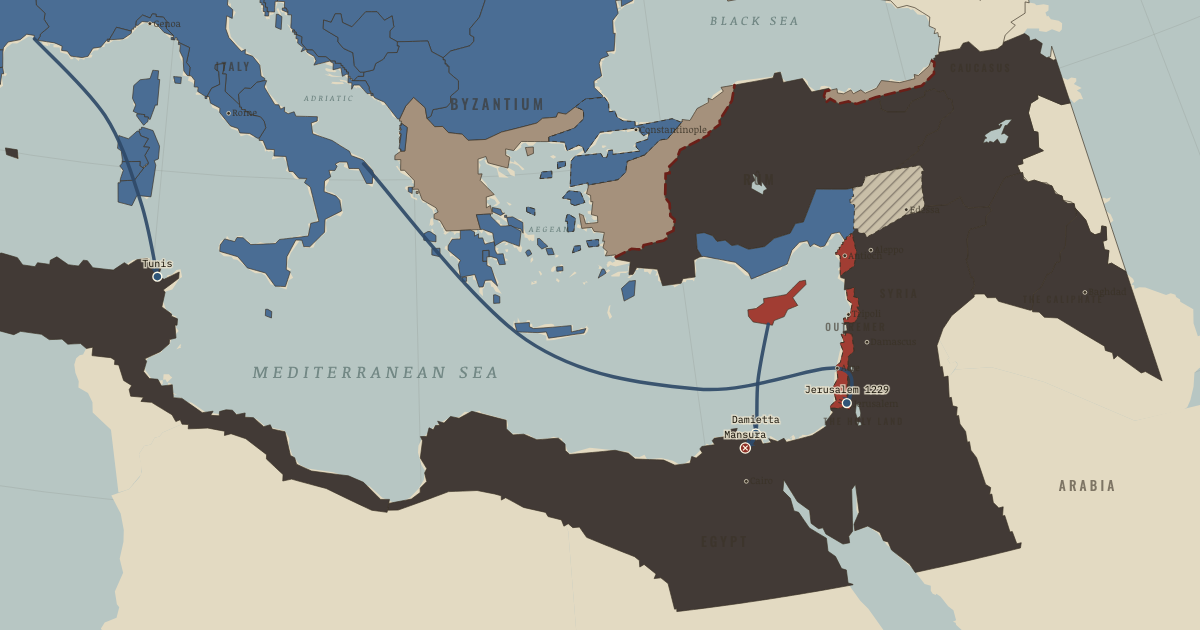
From 1218 the royal crusades targeted Egypt, whose wealth sustained Muslim power in the region. The Fifth Crusade took Damietta but was trapped by the Nile flood; the excommunicated Frederick II regained Jerusalem by treaty in 1229; and Louis IX was defeated and captured near Mansura after attacking Egypt in 1249.
Chapter 10 is included with every paid plan. WW2 is free in full, and chapter 1 of every atlas is free. A free account opens 3 more chapters a day. Starter, at $9 a month, opens all 21 with no daily limit — see the plans.
Richard’s judgment about Jerusalem shaped the campaigns that followed him. Egypt supplied regional rulers with grain, taxes and fleets; a crusade that weakened Egypt might therefore make Jerusalem more secure. This was a strategic reason to attack the Nile, even though the holy city lay elsewhere.
The short answer
- The Egypt-first doctrine. Richard’s insight (Ch. 7) led later crusade leaders to look to Egypt for a secure Jerusalem. Its resources made it a valuable target, but the flooding Nile delta also placed invaders among waterways and terrain familiar to local commanders.
- Diplomacy could do what war could not. Al-Kamil’s struggle with relatives made peace useful to him, and Frederick II had reasons to negotiate. When their interests aligned, they could agree on Jerusalem’s return to Christian control without the battle an invasion would have required.
- The gap between piety and power. Louis IX’s devotion, preparation and courage sustained his expedition. They did not provide an army with the supplies and freedom to maneuver that a campaign on the Nile required. His commitment could not by itself resolve those difficulties.
THE TURNING POINT
Jerusalem regained by treaty, 18 February 1229. Frederick II and al-Kamil agreed on 18 February 1229 to return Jerusalem to Christian control. The city had been recovered by an excommunicated emperor through negotiation, and both his dispute with the papacy and the treaty’s limits made the result controversial. The episode shows why the religious and political circumstances of a crusade mattered alongside the territory it gained.
What it changed
A treaty-held Jerusalem, then gone. The Jerusalem Frederick obtained by treaty was poorly defended and did not remain under Christian control. Khwarezmian mercenaries sacked it in 1244, and an allied army was destroyed at La Forbie. Watch the corridor vanish: Jerusalem was lost for the rest of the crusading period.
The Mamluks made. Louis IX’s defeat near Mansura was followed within weeks by a change of rulers in Egypt. Mamluk slave-soldier officers overthrew the Ayyubid dynasty; the power they established would later play a decisive part in destroying Outremer.
The centre of gravity moves to kings — and then away. Royal expeditions came to prominence after the earlier baronial campaigns, but kings also had kingdoms to govern. Once major expeditions stopped arriving, the crusader states had less prospect of relief from them. Acre fell in 1291, after the royal effort had been exhausted.
The full answer, argued
Frederick’s treaty and Louis’s campaigns were judged in a movement that valued religious conduct as well as territory. Frederick obtained Christian control of Jerusalem while excommunicated and in conflict with the papacy; the terms he accepted were disputed too. Louis failed in his campaigns, but his devotion, conduct and suffering contributed to his later canonization. The contrast does not make territorial results irrelevant. Frederick’s gain was real, though fragile, and Louis’s defeat left the eastern states’ practical problem unresolved. It shows that crusading was also a religious and penitential undertaking, in which a leader’s standing and methods affected the judgment of his actions.
An interesting fact
The Damascene chronicler Ibn Wasil recounts an exchange during Frederick’s stay in Jerusalem in March 1229. As a courtesy to the emperor, the qadi of Nablus had suspended the muezzins’ call to prayer. Frederick noticed the silence and objected: he said that hearing the call was chiefly why he had spent the night in the city. The story places the excommunicated ruler who had negotiated Jerusalem’s return in an encounter with its Muslim practice.
This is the study layer of Fifth to Eighth Crusades, chapter 10 of The Crusades, 1095–1291; the full index of the atlas is here.
Related questions
THE FREE PRINTABLE STUDY GUIDE
Get the printable study guide for The Crusades free. I’ll send you a few short letters, then one when a new atlas opens. That’s all. — Paul
NO TRACKING · YOUR ADDRESS IS USED FOR THE DISPATCH AND NOTHING ELSE · UNSUBSCRIBE ANYTIME