Chinese Revolution · 1948
Was 1948–49 a Communist victory or a Nationalist collapse?
The seminar question: “Did Communist skill or Nationalist collapse decide the three campaigns, and how far can we separate them?”
In 1948–49 three Communist campaigns decided China’s civil war. Liaoshen took Jinzhou in October 1948 and trapped the Nationalist armies in Manchuria, Huaihai destroyed Nationalist groups pocket by pocket, and Pingjin ended with Beiping’s surrender, removing about 1.5 million government troops in all.
Chapter 11 is included with every paid plan. WW2 is free in full, and chapter 1 of every atlas is free. A free account opens 3 more chapters a day. Starter, at $9 a month, opens all 21 with no daily limit — see the plans.
Free printable Chinese Revolution study guide, sent by email ↓
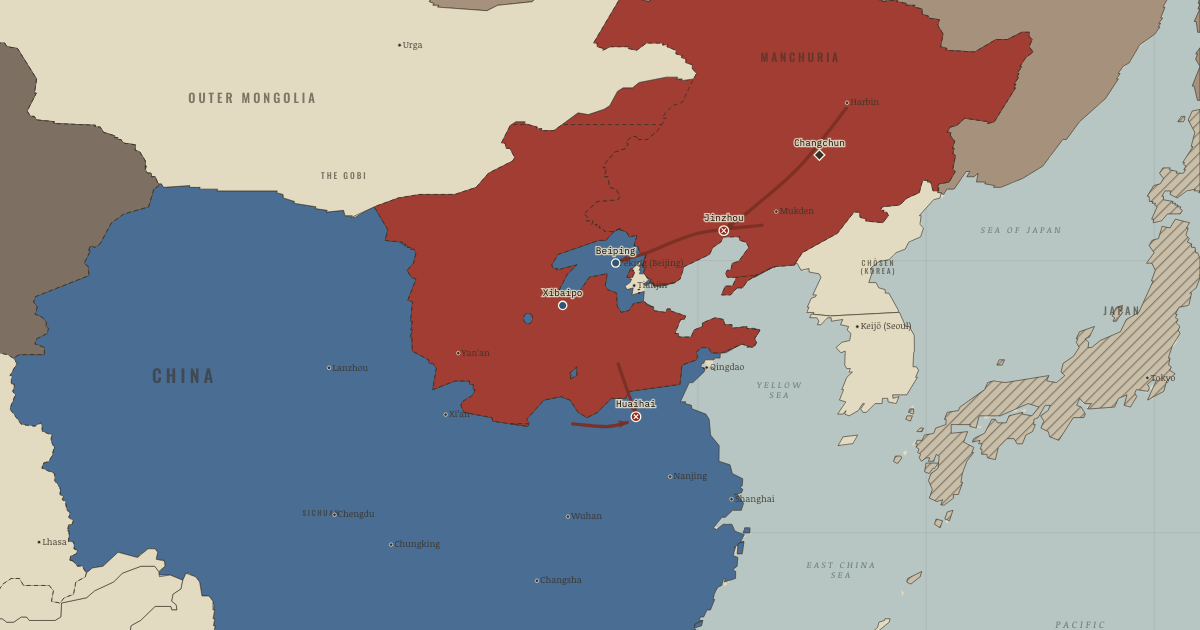
In the autumn of 1948 the Nationalist armies in Manchuria faced a choice about their escape route. The railway through Jinzhou (the ✕) connected the northeast with China proper. Communist commanders made that junction the object of the Liaoshen campaign, rather than attacking every opposing force in turn. Jinzhou fell in thirty-one hours in October, leaving roughly half a million government troops cut off. Within weeks the trapped armies surrendered or defected, and Manchuria, contested since 1945, turned red. Twenty-one years after Nanchang, the Communists had the larger and better-equipped army.
The short answer
- How encirclement worked. Lin Biao, Su Yu and Liu Bocheng had spent years fighting a stronger opponent. They learned to move their forces and choose where to fight. At Jinzhou, that experience served a larger design: take the transport gateway, isolate the armies behind it, and deal with garrisons and relief forces separately. This linking of battles to a common purpose is operational art. By 1948 the commanders had the resources to apply skills learned under constraint on a far larger scale.
- Land reform and the supply line. An army on the plains needed food and ammunition brought forward continuously. The official Huaihai count lists 5.4 million civilian laborers helping to do that work. Villages that had received land had reason to fear a Nationalist victory and the return of landlords; they sent men, grain and barrows. Nationalist troops also drew on the countryside, sometimes requisitioning at gunpoint. The relationship each army had built with villagers mattered to its ability to sustain the campaign.
- Command and withdrawal. Chiang directed operations by telephone from Nanjing and overrode theater commanders. In Manchuria, the delay in permitting withdrawal made escape increasingly difficult and left whole armies exposed. Communist fronts were assigned to committees that reviewed results. The command problem raised at Zunyi in Chapter 7 had acquired much greater consequences: decisions at the center could now trap army groups, while the opposing system could adjust its operations.
- The decision to change sides. Nationalist soldiers and officers had reasons to doubt the government beyond the battlefield. Hyperinflation impoverished officers’ families, and the August 1948 gold-yuan reform took urban assets in exchange for notes that rapidly lost value. Communist forces put surrendered troops to use, offering units an alternative to fighting on. Fu Zuoyi’s daughter, a Communist agent, provided one connection across the lines during negotiations over Beiping. Her role belongs to a wider story of the government’s declining support.
THE TURNING POINT
Jinzhou, October 1948. The railway through Jinzhou was the route between Manchuria and China proper. Communist forces took the junction in thirty-one hours in October 1948, cutting off roughly half a million Nationalist troops. The subsequent surrender or defection of the northeastern armies strengthened the victors for the campaigns still ahead. The importance of Jinzhou lay in what control of its railway made possible elsewhere.
What it changed
The Yangtze line. The Yangtze remained between the Communist armies and the south, and troops and negotiations still stood in the way of a crossing. Yet the government had lost the strategic reserve needed for a durable defense. Chapter 12 follows the crossing.
Taking over the cities. Beiping’s negotiated surrender preserved its infrastructure, universities and administration. At Xibaipo, Communist cadres attended seminars to prepare for governing cities. A party that had once lost those cities was planning their administration, in contrast to practices associated with the Nationalist return in 1945.
The government moves east. During the winter of 1948–49, the government moved treasury bullion, Palace Museum crates, and naval and air assets toward Taiwan. These resources would help sustain it after its retreat. The island became the seat of the Republic of China after defeat on the mainland.
The full answer, argued
Nationalist weakness is plain in the record. Inflation and the gold-yuan exchange damaged the government’s urban base, command interference exposed its armies, and defections transferred troops and American-made equipment to the PLA. But weakness in one army does not by itself explain how its opponent organized millions of porters or took Jinzhou in thirty-one hours. Communist commanders designed encirclements, mobilized supplies and incorporated surrendered forces. Each defection could weaken the government and strengthen its enemy at once. Odd Arne Westad gives weight both to the Nationalists’ political losses and to the military capacity of the force that defeated them. The two explanations identify different causes, yet the campaigns show them working together.
An interesting fact
Huaihai’s official count records 5.43 million civilian laborers supporting 600,000 soldiers, roughly nine laborers for each soldier. In winter they hauled grain, carried wounded men and pushed supplies across the plains in wheelbarrows. Chen Yi, a campaign commander, later said the victory “was pushed across in wheelbarrows.” Chinese farmers had used the single-wheeled barrow for centuries; here it helped sustain an army on a vast scale despite Nationalist air power.
This is the study layer of Liaoshen, Huaihai and Pingjin campaigns, chapter 11 of China in Revolution, 1911–1949; the full index of the atlas is here.
Related questions
THE FREE PRINTABLE STUDY GUIDE
Get the printable study guide for China in Revolution free. I’ll send you a few short letters, then one when a new atlas opens. That’s all. — Paul
NO TRACKING · YOUR ADDRESS IS USED FOR THE DISPATCH AND NOTHING ELSE · UNSUBSCRIBE ANYTIME