Indian independence · MAY 1964
Did Indian independence deliver its promises by 1964?
The seminar question: “By 1964, had independence delivered what the national movement had promised?”
India’s constitution, drafted under B. R. Ambedkar, came into force on 26 January 1950, giving every adult the vote and abolishing untouchability. In the first general election of 1951–52 about 173 million voters were registered and Congress won 364 of 489 seats, while language movements pressed for new states.
Chapter 15 is included with every paid plan. WW2 is free in full, and chapter 1 of every atlas is free. A free account opens 3 more chapters a day. Starter, at $9 a month, opens all 21 with no daily limit — see the plans.
Free printable Indian independence study guide, sent by email ↓
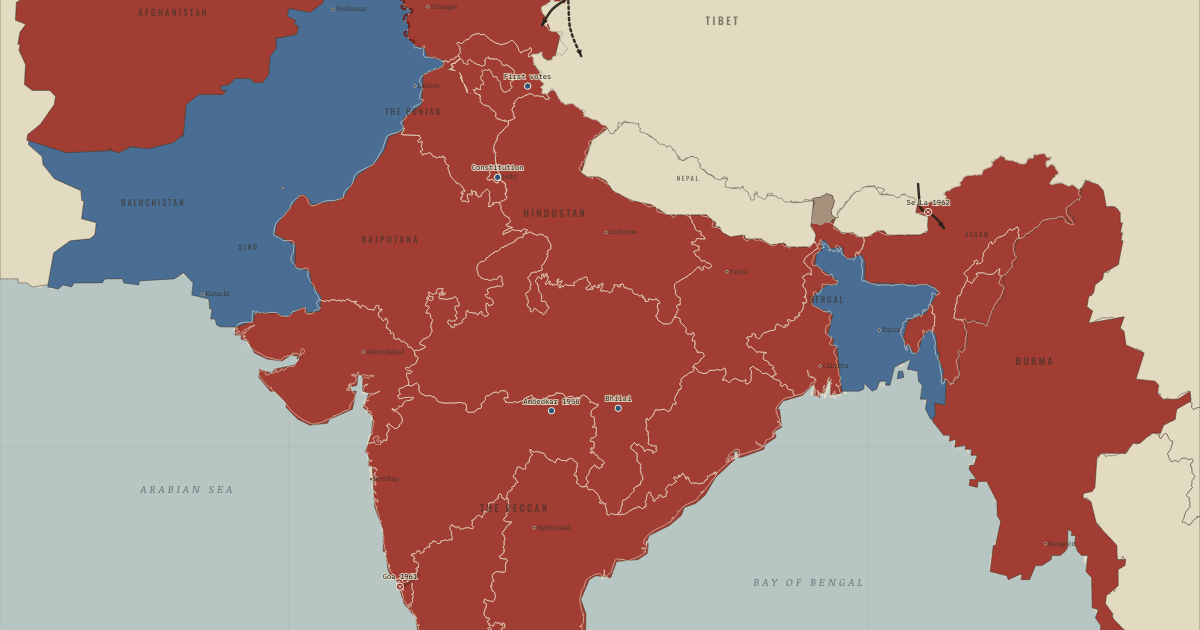
The leaders of independent India had claimed to speak for a whole people. The constitution that took effect on 26 January 1950 put that claim to a demanding test: it gave every adult over twenty-one a vote, although most Indians could not read. Its drafting committee was chaired by B. R. Ambedkar, a Dalit from a caste Hindu custom had branded “untouchable”. The constitution made India a republic of citizens, established rights enforceable in court, abolished untouchability in Article 17, and reserved parliamentary seats for the lowest castes and tribal peoples, much like a modern quota. As the country’s supreme law, it set both the powers of government and the claims citizens could make against it.
The short answer
- Partition’s legacy: a state that feared its own divisions. Partition shaped the constitution’s balance of power. The founders had seen political mobilization around identity help break the country in 1947, and feared another fragmentation. They gave the central government authority to redraw states and take over a state government in an emergency. A strong centre had already demonstrated its reach: Vallabhbhai Patel and V. P. Menon integrated more than 550 princely states by 1949. The republic would be a federation, but one whose national government had substantial means to hold it together.
- Universal suffrage as a deliberate gamble. The change in the electorate was as striking as the change in government. The Act of 1935, under which Congress first governed in 1937, gave the vote to about 35 million people selected by property and education. The Constituent Assembly rejected such tests and enfranchised every adult at once. A movement that claimed to represent all Indians had reason to let all of them choose their government. This made India the first large and poor country to attempt democracy on such a scale before literacy or prosperity had arrived.
- The language movements. Congress had promised linguistic provinces since 1920, and the demand did not disappear with independence. Telugu, Marathi, Kannada and Malayalam speakers lived across boundaries inherited from old provinces and princely states; Telugu districts, for example, were divided between Madras and Hyderabad. Their speakers pressed for the promised states through petitions and elections, and eventually through Potti Sriramulu’s fast. The central government wanted to postpone the question, but its own earlier promise and the strength of the movements kept it alive.
- Cold War choices and the border with China. Nehru’s ambition to remain independent of both Cold War blocs depended in part on friendly relations with China. The Panchsheel agreement of April 1954 set out five principles of peaceful coexistence and accepted Tibet as part of China. India left the boundary unraised, assuming that the 1914 McMahon Line in the east and its own maps in the west would stand. That assumption came under pressure when Indian patrols found China’s road across Aksai Chin in 1957–58, the Dalai Lama fled to India in 1959, and India’s Forward Policy placed small army posts in disputed territory in 1961. Each government regarded the land as its own, so each could see the other’s movements as aggression.
THE TURNING POINT
Madras, 15 December 1952. Nehru had delayed linguistic states for five years when Potti Sriramulu, a former follower of Gandhi, used a fast unto death to press for Andhra. Sriramulu’s death brought riots, and within four days Nehru conceded the demand. Within four years the wider internal map had been redrawn. The decision mattered beyond Andhra: the republic had accepted that a regional identity could be accommodated within India rather than treated simply as a threat to it. That choice shaped Indian federalism and is the main reason the language boundaries on this map have mostly held.
What it changed
A democracy that held. Elections had to become a habit before the first one could count as the beginning of a durable democracy. India held its second and third general elections on time in 1957 and 1962, and power passed peacefully to Lal Bahadur Shastri after Nehru’s death. Kerala tested another aspect of the system. In 1957 it elected a Communist government, among the first anywhere to take office through a free election. The centre accepted it until dismissing it in 1959, revealing the reach of Delhi’s constitutional powers. As many other newly decolonized states moved toward one-party or military rule, India’s democratic survival became its most cited achievement.
The unfinished revolution of caste and gender. The republic could change the law more quickly than it changed social relations. The constitution abolished untouchability, while the Hindu Code laws of 1955–56 gave Hindu women rights to divorce and inherit. Ambedkar had resigned from Nehru’s cabinet in 1951 when the Hindu Code Bill stalled. In October 1956 he left Hinduism and converted to Buddhism at Nagpur with several hundred thousand followers. His warning remained a challenge to the republic’s achievement: political democracy needed social democracy beneath it if it was to survive.
A planned economy and its limits. The planners gave India steel mills, dams and research institutes, and industry grew quickly from a low base. These were foundations for an industrial state, but they did not feed the country at the same pace. National income grew only about 3.5 to 4 per cent a year and farming lagged behind. By the early 1960s India depended on American wheat supplied under PL-480, a United States law selling surplus grain to poorer countries. The droughts of 1965–66 would make food an emergency for the next government. Most Indians lived in villages, where change was much slower than the growth of the industrial base.
Borders still in dispute. The internal reorganization left India with a more settled map inside the union than at its edges. China held Aksai Chin after the 1962 war, about 38,000 square kilometres claimed by India; the boundary has never been agreed. Kashmir remained divided along the 1949 ceasefire line, and India and Pakistan fought again little more than a year after Nehru’s death. The contrast with 1857 is striking: then the edges were secure while the interior was in revolt; the map Nehru left in 1964 had a settled interior and disputed frontiers.
The full answer, argued
The movement made more than one promise, and by 1964 their fortunes had diverged. Self-government had taken substantial form: India had a constitution, universal suffrage, an independent judiciary and three general elections held on time. Its federation had absorbed the princely states and redrawn its internal boundaries by language without breaking. Foreign rule had also receded from the subcontinent: by 1961 the French and Portuguese enclaves were gone. Other promises were harder to fulfill. Mass poverty persisted, incomes rose slowly and food shortages threatened in the 1960s; literacy reached only 28 per cent by 1961. Social equality had a place in law that it did not yet have in daily life, a gap made visible by Ambedkar’s conversion in 1956. The hope of secure surroundings also went unfulfilled: Kashmir remained disputed and China defeated India in 1962. Historians weigh the record differently. There is a strong case for calling democracy the rarer achievement, since prosperity could still come later while lost freedoms are seldom recovered. Independence gave Indians a state through which to pursue the remaining promises; their fulfillment would demand work over the following decades.
An interesting fact
The violet mark on an Indian voter’s finger has a practical purpose: it helps prevent a second vote. Chemists at the National Physical Laboratory in Delhi developed the ink, first used in the general election of 1962. Its silver nitrate darkens on contact with skin and light and resists washing for days. Mysore Paints and Varnish has been its sole manufacturer ever since. The Maharaja of Mysore founded the company in 1937 as a lac and paint works; it now supplies millions of small bottles for each national election and has supplied elections in many other countries.
This is the study layer of India under Nehru, chapter 15 of Indian Independence & Partition, 1857–1964; the full index of the atlas is here.
Related questions
THE FREE PRINTABLE STUDY GUIDE
Get the printable study guide for Indian Independence & Partition free. I’ll send you a few short letters, then one when a new atlas opens. That’s all. — Paul
NO TRACKING · YOUR ADDRESS IS USED FOR THE DISPATCH AND NOTHING ELSE · UNSUBSCRIBE ANYTIME