Mongol Empire · 1260
Did Ain Jalut save Islam, or is it overrated?
The seminar question: “Ain Jalut is often called the battle that saved Islam, and often called overrated because Hülegü had already left with the main army. How should we weigh both claims?”
Möngke sent his brother Hülegü west against the Nizari Ismaili fortresses, the Abbasid caliph and Syria: Alamut surrendered in 1256 and Baghdad fell in February 1258, ending the Abbasid caliphate there. After Möngke’s death drew Hülegü east, the Mamluks of Egypt defeated Kitbuqa’s smaller force at Ain Jalut on 3 September 1260.
Chapter 8 is included with every paid plan. WW2 is free in full, and chapter 1 of every atlas is free. A free account opens 3 more chapters a day. Starter, at $9 a month, opens all 21 with no daily limit — see the plans.
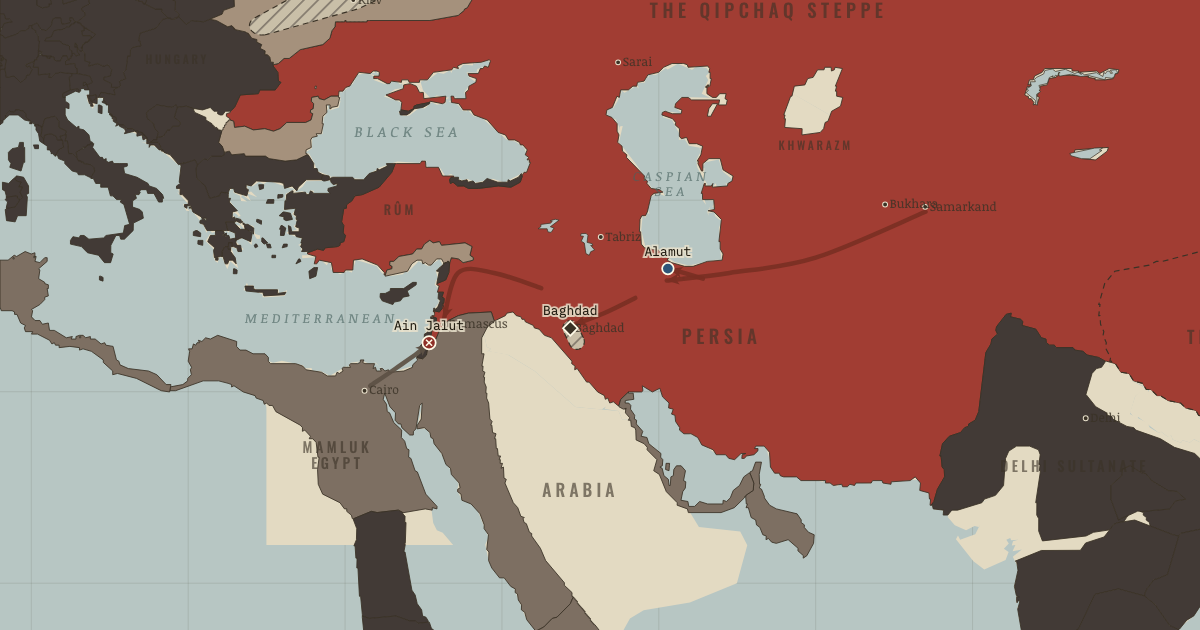
Möngke's western campaign first confronted the Nizari Ismailis, known as the Assassins in hostile sources. Their strongholds could resist from fortified positions, but Mongol engineers reduced the castles, and Alamut surrendered in 1256. Hülegü then turned to Baghdad and demanded submission from the Abbasid caliph, al-Musta‘sim. The caliph refused without preparing an effective defense. Baghdad fell in February 1258.
The short answer
- The western campaign. At Möngke's kurultai in 1251, the Mongols planned campaigns against two powers whose claims stood alongside their own: the Song in China and the caliphate in the west. Hülegü received the western assignment, while another brother fought the Song. The caliph's spiritual authority could be accepted under the khan, but not as an equal universal claim. The assault on the Nizari fortresses and the demand for Baghdad's submission belonged to that wider design.
- Baghdad’s weakness. The caliphate's standing and its military position were very different things. Abbasid caliphs had depended on military rulers for centuries; in Baghdad, the treasury and army were at odds, and Sunni–Shia riots divided the city. Al-Musta‘sim neither submitted in time nor paid for an effective defense. One hostile description dismissed him as “a falconer.” Nasir al-Din Tusi, the Shia scholar and adviser taken from Alamut, reportedly assured Hülegü that killing the caliph would bring no cosmic punishment. The reported assurance gives a sense of the office's spiritual weight, even as its holder lacked the means to protect it.
- Egypt’s Mamluk army. Egypt's rulers had themselves been trained for war. Many Mamluks were born on the steppe, brought into military slavery and drilled as professional cavalry before the Mamluks became Egypt's rulers. Centrally barracked, supplied from Egypt's resources and operating near their base, they brought mounted skills comparable to those of their opponents. Feudal hosts and city militias had broken before Mongol armies; Kitbuqa now met a force with a different preparation and resources behind it.
- A divided theatre. The battlefield in Syria was shaped by events far beyond it. Hülegü had taken most of his army east, and summer pasture and water constrained the horses Kitbuqa retained. The Crusaders of Acre stayed neutral but let the Mamluks pass and use their markets, even though some popes had considered alliance with the Mongols. Meanwhile Berke, the Muslim ruler of the Golden Horde, was hostile to Hülegü; the caliph's death added to the conflict and to the threat at Hülegü's rear. The Mamluks' passage north and the resources available to each side depended on these political and environmental conditions.
THE TURNING POINT
Ain Jalut, 3 September 1260. The Mamluk victory at Ain Jalut, a spring in Galilee, came on 3 September 1260. Estimates vary, with accounts putting tens of thousands on each side; Kitbuqa's army was only part of Hülegü's force. Even so, its defeat gave the Mamluks a claim to defend the region after Baghdad's fall. Cairo became home to a refugee Abbasid caliphate, while the Euphrates region became a contested boundary through roughly sixty years of Ilkhan–Mamluk war. The expectation of an unstoppable Mongol advance had suffered a lasting defeat.
What it changed
Cairo and the caliphate. After Baghdad's fall, the Mamluks installed a refugee Abbasid as caliph in Cairo. The office lent religious standing to their rule, and Egypt remained under Mamluk government for roughly 250 years, until the Ottoman conquest. Baghdad was still inhabited under the Ilkhanate, but it had lost its position as Abbasid capital and its regional role diminished for centuries. The caliphate now had its home in Cairo.
The Ilkhanate takes shape. Hülegü held Persia and Iraq, along with overlordship in Anatolia; these territories formed the Ilkhanate. Mamluk resistance to the southwest and Berke's hostility soon constrained it. A generation later its rulers converted to Islam. They patronized mosques and Persian painting, and supported Rashid al-Din's world chronicle. The dynasty responsible for ending the Baghdad caliphate had become a patron of Islamic institutions.
A frontier contested. The victory did not end Ilkhan campaigns in Syria. It established a frontier that both sides would continue to contest. Farther east, Japan and Vietnam would also resist Mongol invasions. Conquest had helped the empire manage internal strains; as expansion became less certain, common campaigns became a less reliable way to settle divisions among its branches.
The full answer, argued
The military and political claims need to be weighed separately. Kitbuqa led the troops remaining after Hülegü withdrew, and Syrian and Sinai supply conditions would have made a sustained invasion of Egypt difficult. His defeat therefore did not measure the entire Mongol army. But the Mamluks refused the ultimatum, won in Syria and resisted later invasions. Their success protected Syria, strengthened Cairo and demonstrated that resistance could work. The frontier it helped make endured beyond the battle.
An interesting fact
Within a year of Baghdad's fall, Hülegü funded another kind of enterprise. In 1259 Nasir al-Din Tusi, the scholar taken from Alamut, directed the building of an observatory at Maragheh in Azerbaijan. It was exceptionally well equipped, with a great library, instruments and salaried astronomers, including one from China. Its Zij-i Ilkhani star tables were used across Eurasia for centuries. Tusi's geometrical device for modeling planetary motion, the “Tusi couple,” also appears in Copernicus's work; historians still debate the route by which it may have reached him. The dynasty that sacked the House of Wisdom also supported a major institution of medieval science.
This is the study layer of Fall of Baghdad and Ain Jalut, chapter 8 of The Mongol Empire, 1206–1294; the full index of the atlas is here.
Related questions
THE FREE PRINTABLE STUDY GUIDE
Get the printable study guide for The Mongol Empire free. I’ll send you a few short letters, then one when a new atlas opens. That’s all. — Paul
NO TRACKING · YOUR ADDRESS IS USED FOR THE DISPATCH AND NOTHING ELSE · UNSUBSCRIBE ANYTIME