13 ATLASES
History of Switzerland in maps
Switzerland as it appears in 13 interactive history atlases, from 264 BC to 2015: Raetia, Switzerland, the Swiss passes. Each era below lists who ruled the land and when control changed, linked to the dated map that shows it.
WW2 is free in full, and chapter 1 of every atlas is free. A free account opens 3 more chapters a day. Starter, at $9 a month, opens all 21 with no daily limit — see the plans.
Free printable Industrial Revolution study guide, sent by email ↓
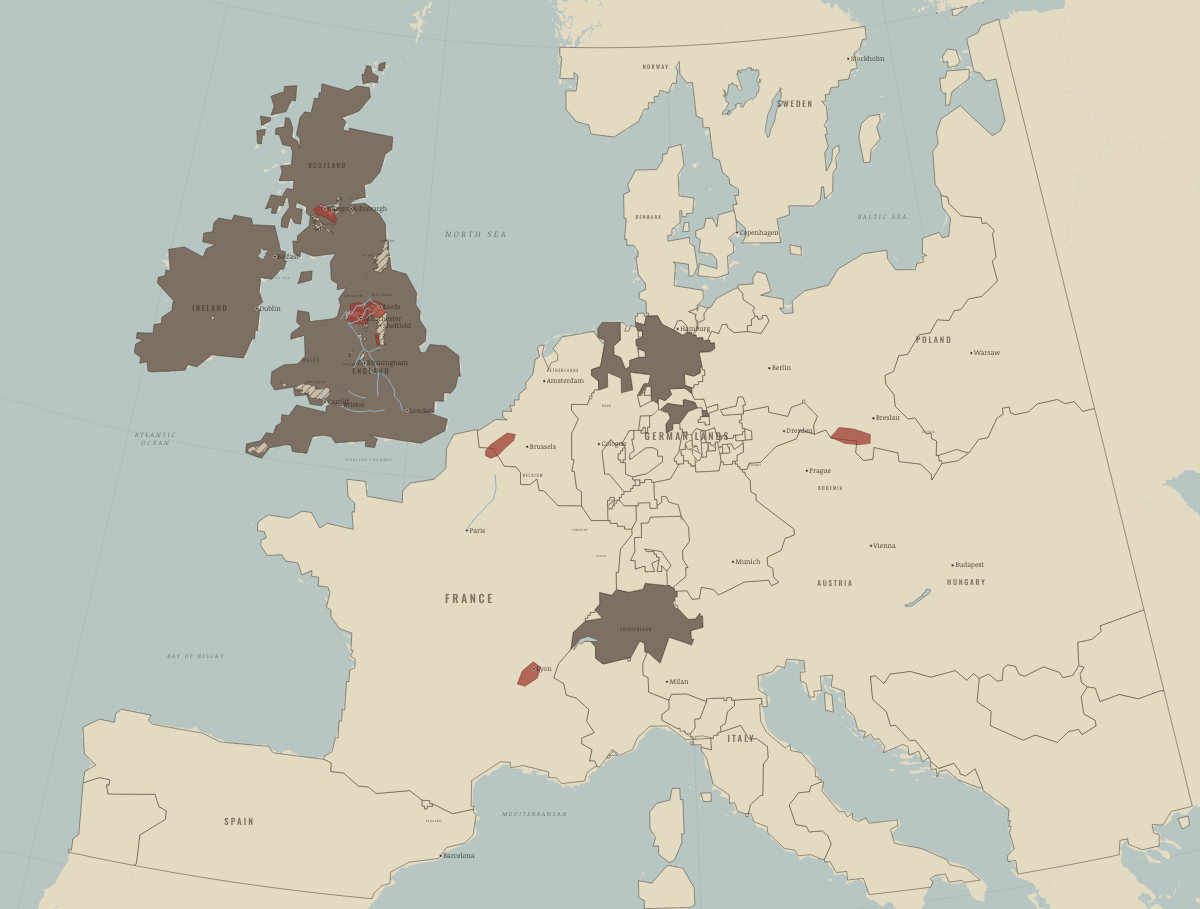
What was Switzerland before it was Switzerland? The sections below follow this land through every era covered by the Maps of History atlases: who ruled it, what it was called, and when control changed. Each line links to the dated map. Modern borders serve as an approximation, as each atlas says on the map itself.
Raetia (mod. Switzerland) · Ancient Rome
| 264 BC | Tribal peoples & confederations — the opening position |
| 50 BC | Roman territory |
| Former Roman lands (lost) |
ANCIENT ROME: EVERY CHAPTER AND MAP →
Switzerland · Norse and Aztecs
| Other peoples and states — the opening position | |
| Chinampa fields | |
| Chinampa fields |
NORSE AND AZTECS: EVERY CHAPTER AND MAP →
The Swiss passes (mod. Switzerland) · Crusades
| Latin Christendom — the opening position |
CRUSADES: EVERY CHAPTER AND MAP →
Switzerland · Industrial Revolution
How did a mountain country without coal industrialize early? Switzerland used water power to mechanize cotton spinning in the first decades of the nineteenth century, and its firms excelled in precision trades such as watches, machine tools and textile machinery. Chemicals and electrical engineering followed. By 1880 it was among Europe’s most industrial countries per head: skill and specialization could stand in for coal.
| Industrialising — the opening position | |
| Industrialising | |
| Industrial economy | |
| Industrialising | |
| Industrial economy |
INDUSTRIAL REVOLUTION: EVERY CHAPTER AND MAP →
Switzerland · Age of Revolutions
France transformed the old Confederacy into the Helvetic Republic in 1798, and Vienna restored it as a neutral buffer. Switzerland then made a lasting success of 1848. After a short civil war in 1847, it adopted the federal constitution it still uses. The age’s one unambiguous constitutional victory came from the country that fought its shortest war.
| Neutral / uncommitted — the opening position | |
| Napoleonic client & satellite states | |
| Neutral / uncommitted |
AGE OF REVOLUTIONS: EVERY CHAPTER AND MAP →
Switzerland · Meiji Japan and post-Soviet Russia
| Non-aligned or stateless — the opening position |
MEIJI JAPAN AND POST-SOVIET RUSSIA: EVERY CHAPTER AND MAP →
Switzerland · WWI
Switzerland · Stalin’s Soviet Union
STALIN’S SOVIET UNION: EVERY CHAPTER AND MAP →
Switzerland · Road to WW2
| Neutral & unaligned — the opening position |
ROAD TO WW2: EVERY CHAPTER AND MAP →
Switzerland · WW2
Switzerland’s neutrality had to be defended. It mobilized 850,000 men, mined its tunnels and prepared to retreat to an Alpine redoubt. At the same time, it served as banker and intermediary for both sides. Neutrality was a strategy, with choices of its own.
Switzerland · Cold War
COLD WAR: EVERY CHAPTER AND MAP →
Switzerland · Feminism and the Tunisian Revolution
On the vote maps Switzerland appears in charcoal. Men rejected federal votes for women in a 1959 referendum and granted them only in February 1971. The last canton, Appenzell Innerrhoden, had to be compelled by the federal court in 1990. Switzerland signed CEDAW in 1987, and on 14 June 1991 about half a million Swiss women joined a national women’s strike.
| Refused: women excluded; ERA never ratified — the opening position | |
| No reform yet / outside this story |
FEMINISM AND THE TUNISIAN REVOLUTION: EVERY CHAPTER AND MAP →
Switzerland · Refugee crises
Neutral Switzerland gave much of the international refugee system a home in Geneva. The city hosted Nansen’s League of Nations refugee work, the conference that adopted the 1951 Convention and UNHCR headquarters. It also hosted the Indochina meetings of 1979 and 1989, which decided the fate of the boat people. Switzerland resettled about 12,000 Hungarians in 1956.
REFUGEE CRISES: EVERY CHAPTER AND MAP →
Related
THE FREE PRINTABLE STUDY GUIDE
Get a printable atlas study guide of your choice free. I’ll send you a few short letters, then one when a new atlas opens. That’s all. — Paul
NO TRACKING · YOUR ADDRESS IS USED FOR THE DISPATCH AND NOTHING ELSE · UNSUBSCRIBE ANYTIME