12 ATLASES
History of Spain in maps
Spain as it appears in 12 interactive history atlases, from 264 BC to 2015: Hispania, Iberia — al-Andalus & the Christian kingdoms, Spain. Each era below lists who ruled the land and when control changed, linked to the dated map that shows it.
WW2 is free in full, and chapter 1 of every atlas is free. A free account opens 3 more chapters a day. Starter, at $9 a month, opens all 21 with no daily limit — see the plans.
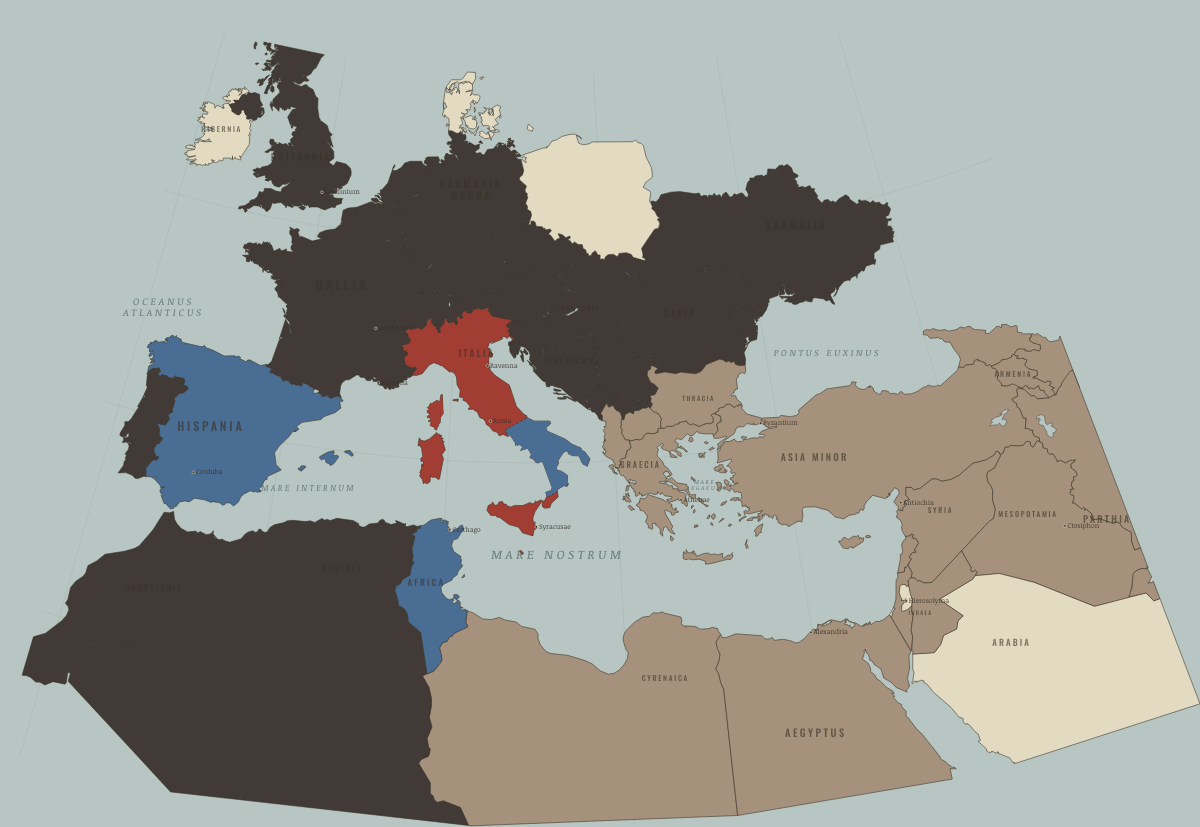
What was Spain before it was Spain? The sections below follow this land through every era covered by the Maps of History atlases: who ruled it, what it was called, and when control changed. Each line links to the dated map. Modern borders serve as an approximation, as each atlas says on the map itself.
Hispania (mod. Spain) · Ancient Rome
Hispania’s silver helped Carthage finance its renewed contest with Rome (Ch. 2). Roman conquest followed and took roughly two centuries; Numantia fell in 133 BC. Hispania was then deeply integrated into the empire: Seneca, Trajan and Hadrian all came from the region. Vandal, Suevic and Visigothic settlers entered in the fifth century. The later Visigothic kingdom wrote laws in Latin and became part of medieval Spain’s inheritance.
| 264 BC | Tribal peoples & confederations — the opening position |
| 216 BC | Rival great powers |
| 201 BC | Tribal peoples & confederations |
| 133 BC | Roman territory |
| Breakaway Roman empires (260–274) | |
| Roman territory | |
| Former Roman lands (lost) |
ANCIENT ROME: EVERY CHAPTER AND MAP →
Spain · Norse and Aztecs
| Other peoples and states — the opening position |
NORSE AND AZTECS: EVERY CHAPTER AND MAP →
Iberia — al-Andalus & the Christian kingdoms · Crusades
In Iberia, the crusade against Islam achieved a lasting territorial success. The long Reconquista became part of the crusading movement, and victory at Las Navas de Tolosa in 1212 broke Almohad power. Córdoba followed in 1236 and Seville in 1248. Al-Andalus, once half the peninsula, was reduced to the tributary emirate of Granada until 1492. Unlike the distant Levantine coast, Iberia offered Christendom a contiguous land war supported by settlers, which it could sustain.
| Latin Christendom — the opening position |
CRUSADES: EVERY CHAPTER AND MAP →
Spain · Industrial Revolution
Most Spaniards remained farm workers, even as industrial regions grew within their agrarian country. From the 1830s Catalonia built a cotton industry around Barcelona; from the 1870s the Basque provinces exported iron ore and built steelworks at Bilbao. The historian Jordi Nadal called this the failure of Spain’s industrial revolution. Others emphasize the regional successes and the obstacles posed by poor land, weak markets and political instability.
INDUSTRIAL REVOLUTION: EVERY CHAPTER AND MAP →
Spain · Age of Revolutions
Spain began as France’s ally, only to be betrayed by Napoleon at Bayonne in 1808. While fighting for an absolutist king, Spaniards developed guerrilla warfare and wrote the liberal constitution of Cádiz in 1812. The restored king tore the constitution up. Riego’s revolt in 1820, French intervention in 1823 and the loss of the American empire (Chapter 10) followed. Spain’s institutions could not outlast the quarrels over them.
| The conservative monarchies — the opening position | |
| Napoleonic client & satellite states | |
| Restored monarchies (after 1815) |
AGE OF REVOLUTIONS: EVERY CHAPTER AND MAP →
Spain · Meiji Japan and post-Soviet Russia
| Western powers and allies — the opening position | |
| Western powers and allies |
MEIJI JAPAN AND POST-SOVIET RUSSIA: EVERY CHAPTER AND MAP →
Spain · WWI
Spain · Road to WW2
Spain's civil war began as an internal conflict in 1936, but by its end in 1939 its execution had become international. Guernica and the Condor Legion gave the dictators a proving ground; the democracies saw the price of non-intervention, and Moscow took a warning. Franco's new state joined the Anti-Comintern Pact, yet stayed out of the world war. He was the one Axis-aligned leader who never repaid his patrons with soldiers.
| Neutral & unaligned — the opening position | |
| At war on its own soil | |
| Aggressor clients & partners |
ROAD TO WW2: EVERY CHAPTER AND MAP →
Spain · WW2
Franco’s Spain stayed neutral after the civil war of 1936–39, a conflict that rehearsed WW2 and left the country too ruined to fight another war. Neutrality still allowed Spain to trade with both sides and send one volunteer division against the USSR. Exhaustion was central to its decision to stay out.
Spain · Cold War
| US-aligned states — the opening position | |
| US-aligned states | |
| US-aligned states |
COLD WAR: EVERY CHAPTER AND MAP →
Spain · Feminism and the Tunisian Revolution
| Right won in law — the opening position | |
| No reform yet / outside this story | |
| Right won in law |
FEMINISM AND THE TUNISIAN REVOLUTION: EVERY CHAPTER AND MAP →
Spain · Refugee crises
REFUGEE CRISES: EVERY CHAPTER AND MAP →
Related
THE FREE PRINTABLE STUDY GUIDE
Get a printable atlas study guide of your choice free. I’ll send you a few short letters, then one when a new atlas opens. That’s all. — Paul
NO TRACKING · YOUR ADDRESS IS USED FOR THE DISPATCH AND NOTHING ELSE · UNSUBSCRIBE ANYTIME