6 ATLASES
History of Nigeria in maps
Nigeria as it appears in 6 interactive history atlases, from 1890 to 2015: Nigeria. Each era below lists who ruled the land and when control changed, linked to the dated map that shows it.
WW2 is free in full, and chapter 1 of every atlas is free. A free account opens 3 more chapters a day. Starter, at $9 a month, opens all 21 with no daily limit — see the plans.
Free printable Feminism and the Tunisian Revolution study guide, sent by email ↓
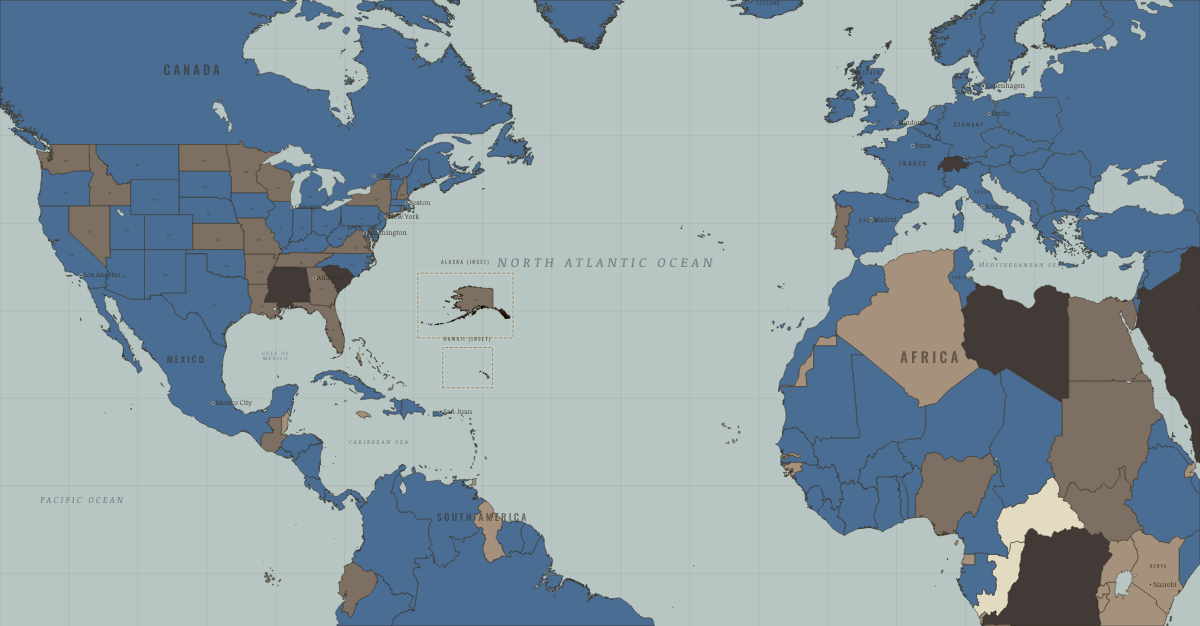
What was Nigeria before it was Nigeria? The sections below follow this land through every era covered by the Maps of History atlases: who ruled it, what it was called, and when control changed. Each line links to the dated map. Modern borders serve as an approximation, as each atlas says on the map itself.
Nigeria · Industrial Revolution
States and merchants of the Niger delta supplied many enslaved people in the eighteenth century. After British abolition, they turned to palm oil, a product used both to lubricate industrial Britain’s machines and to make its soap. Britain annexed Lagos in 1861; by 1903 it had extended its rule across the region and conquered the Sokoto Caliphate.
| Colony or dependency — the opening position | |
| Colony or dependency |
INDUSTRIAL REVOLUTION: EVERY CHAPTER AND MAP →
Nigeria · WWI
| Entente-aligned & imperial territories — the opening position |
Nigeria · Road to WW2
| Colonial empires & possessions — the opening position |
ROAD TO WW2: EVERY CHAPTER AND MAP →
Nigeria · Cold War
| NATO & core Western allies — the opening position | |
| Non-aligned & neutral |
COLD WAR: EVERY CHAPTER AND MAP →
Nigeria · Decolonization of Africa
Nigeria became independent on 1 October 1960 as Africa’s most populous nation. Its British-built federation brought together three great regions and some 250 peoples: holding them together was a major federal experiment. Within six years regional divisions had given way to two coups, anti-Igbo pogroms, and the Biafran secession and war. Perhaps a million people died, mostly of famine. Oil wealth and enormous scale made Nigeria Africa’s giant, while its divisions made it a particularly difficult country to balance.
| British-ruled — the opening position | |
| Independent Africa |
DECOLONIZATION OF AFRICA: EVERY CHAPTER AND MAP →
Nigeria · Feminism and the Tunisian Revolution
| Authoritarian, one-party or colonial rule — the opening position | |
| Partial or unequal; treaty signed only; transition | |
| No reform yet / outside this story | |
| Right won in law |
FEMINISM AND THE TUNISIAN REVOLUTION: EVERY CHAPTER AND MAP →
Related
THE FREE PRINTABLE STUDY GUIDE
Get a printable atlas study guide of your choice free. I’ll send you a few short letters, then one when a new atlas opens. That’s all. — Paul
NO TRACKING · YOUR ADDRESS IS USED FOR THE DISPATCH AND NOTHING ELSE · UNSUBSCRIBE ANYTIME