13 ATLASES
History of Belarus in maps
Belarus as it appears in 13 interactive history atlases, from 1206 to 2015: White Rus, Belarus, Belorussia, the Byelorussian SSR, Soviet Byelorussia, Soviet Union. Each era below lists who ruled the land and when control changed, linked to the dated map that shows it.
WW2 is free in full, and chapter 1 of every atlas is free. A free account opens 3 more chapters a day. Starter, at $9 a month, opens all 21 with no daily limit — see the plans.
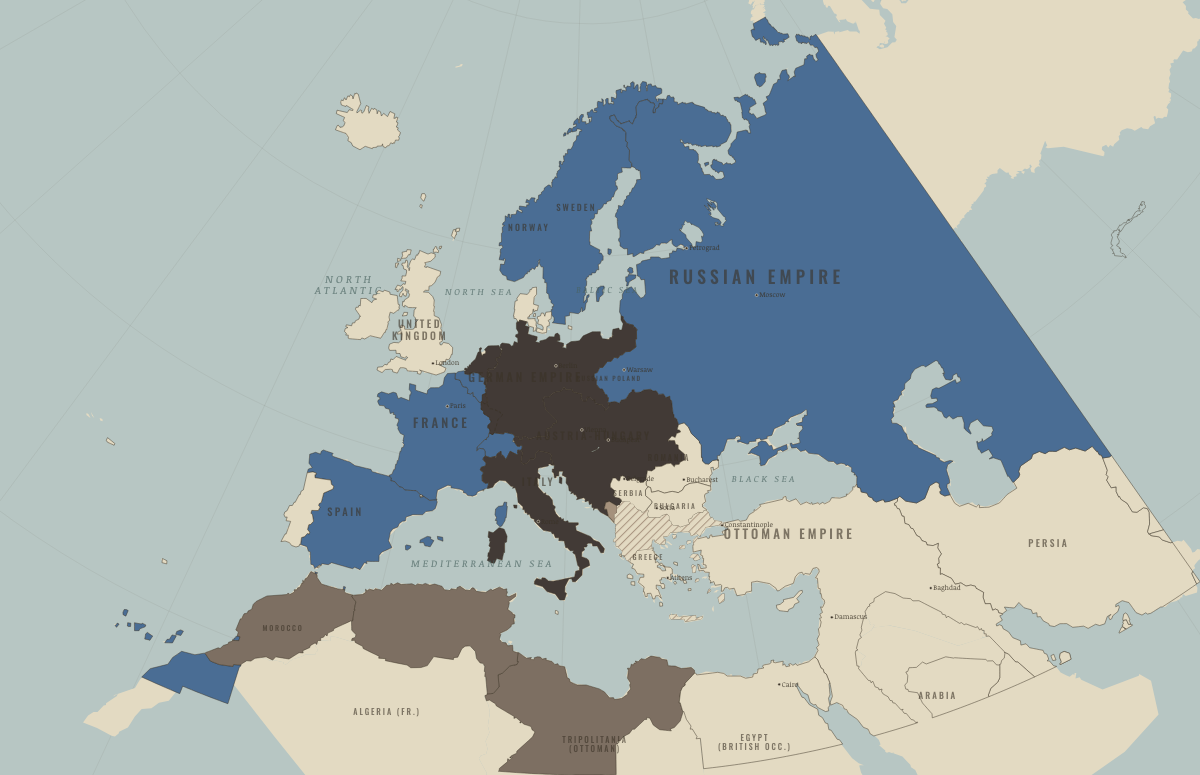
What was Belarus before it was Belarus? The sections below follow this land through every era covered by the Maps of History atlases: who ruled it, what it was called, and when control changed. Each line links to the dated map. Modern borders serve as an approximation, as each atlas says on the map itself.
Belarus · Norse and Aztecs
| Other peoples and states — the opening position |
NORSE AND AZTECS: EVERY CHAPTER AND MAP →
White Rus (mod. Belarus) · Mongol Empire
| Other settled powers (Jin China, Christendom, Delhi) — the opening position | |
| Tributaries & vassals |
MONGOL EMPIRE: EVERY CHAPTER AND MAP →
Belarus (Russian Empire) · Industrial Revolution
| Industrialising — the opening position | |
| Industrialising | |
| Industrialising |
INDUSTRIAL REVOLUTION: EVERY CHAPTER AND MAP →
Belarus · Age of Revolutions
| The conservative monarchies — the opening position |
AGE OF REVOLUTIONS: EVERY CHAPTER AND MAP →
Belarus (Byelorussia) · Meiji Japan and post-Soviet Russia
At Belavezha in Belarus, leaders declared the Soviet Union dissolved. Belarusian leader Stanislav Shushkevich signed alongside Yeltsin and Ukraine’s Leonid Kravchuk. Belarus had also suffered heavily from Chernobyl fallout carried north by the wind. In 1994 voters elected Alexander Lukashenko, who halted market reforms and retained a Soviet-style economy. The breakup of the Union did not lead every republic along the same path.
| The USSR, then Russia — the opening position | |
| Independent neighbours |
MEIJI JAPAN AND POST-SOVIET RUSSIA: EVERY CHAPTER AND MAP →
Belorussia · Russian Revolution
Western armies repeatedly crossed Belorussia. It was occupied under Brest and fought over in the Polish war; then the Peace of Riga divided it, giving the west to Poland and making the east a Soviet republic. The borderland received no independence. Others drew a border through it instead.
| The Tsarist empire — the opening position | |
| Provisional Government, then the Whites | |
| Soviet power | |
| Breakaway national states | |
| Soviet power |
RUSSIAN REVOLUTION: EVERY CHAPTER AND MAP →
Belarus (Russian Empire) · WWI
| The Entente & Allies — the opening position | |
| The Entente & Allies | |
| Russia in revolution | |
| Under Central Powers occupation | |
| Russia in revolution | |
| Russia in revolution |
The Byelorussian SSR · Stalin’s Soviet Union
Byelorussia stood on the invasion road to Moscow. Its peasants were collectivised in the 1930s, and the Terror brought the shooting of intellectuals; mass graves such as Kurapaty near Minsk were discovered only in 1988. The republic absorbed Poland’s western Belarusian lands in 1939. During German occupation in 1941–44, perhaps a quarter of its population died, including most of its Jews, and hundreds of villages were burned with their inhabitants.
| The Soviet Union — the opening position | |
| Under German occupation | |
| The Soviet Union |
STALIN’S SOVIET UNION: EVERY CHAPTER AND MAP →
Soviet Byelorussia · Road to WW2
| Neutral & unaligned — the opening position | |
| Aggressor clients & partners | |
| Democracies & powers fighting them |
ROAD TO WW2: EVERY CHAPTER AND MAP →
Belarus · WW2
Soviet Belarus lost a quarter of its population, proportionally the highest toll of the war. German forces overran it in the first weeks of Barbarossa, and its forests became a heartland of partisan warfare. By 1944 whole districts were effectively “partisan republics,” while the occupiers had burned more than 600 villages together with their inhabitants. Khatyn stands as their memorial. The great 1944 offensive, Bagration (Ch. 12), crossed the same forests and marshes. Minsk was liberated on 3 July 1944 as a field of rubble, with barely a fifth of the city standing.
| Soviet Union — the opening position |
Belarus · Cold War
| USSR & Warsaw Pact — the opening position | |
| Non-aligned & neutral | |
| Non-aligned & neutral |
COLD WAR: EVERY CHAPTER AND MAP →
Soviet Union (Byelorussia) · Feminism and the Tunisian Revolution
| Right won in law — the opening position | |
| No reform yet / outside this story | |
| Right won in law |
FEMINISM AND THE TUNISIAN REVOLUTION: EVERY CHAPTER AND MAP →
Soviet Byelorussia · Refugee crises
| Soviet-occupied or communist — the opening position |
REFUGEE CRISES: EVERY CHAPTER AND MAP →
Related
THE FREE PRINTABLE STUDY GUIDE
Get a printable atlas study guide of your choice free. I’ll send you a few short letters, then one when a new atlas opens. That’s all. — Paul
NO TRACKING · YOUR ADDRESS IS USED FOR THE DISPATCH AND NOTHING ELSE · UNSUBSCRIBE ANYTIME