MAPS OF HISTORY · WW2 · ALL CHAPTERS · CHAPTER 5
CHAPTER 5 · OCT 1940–JUN 1941 · MAY 1941
Mussolini’s Parallel War
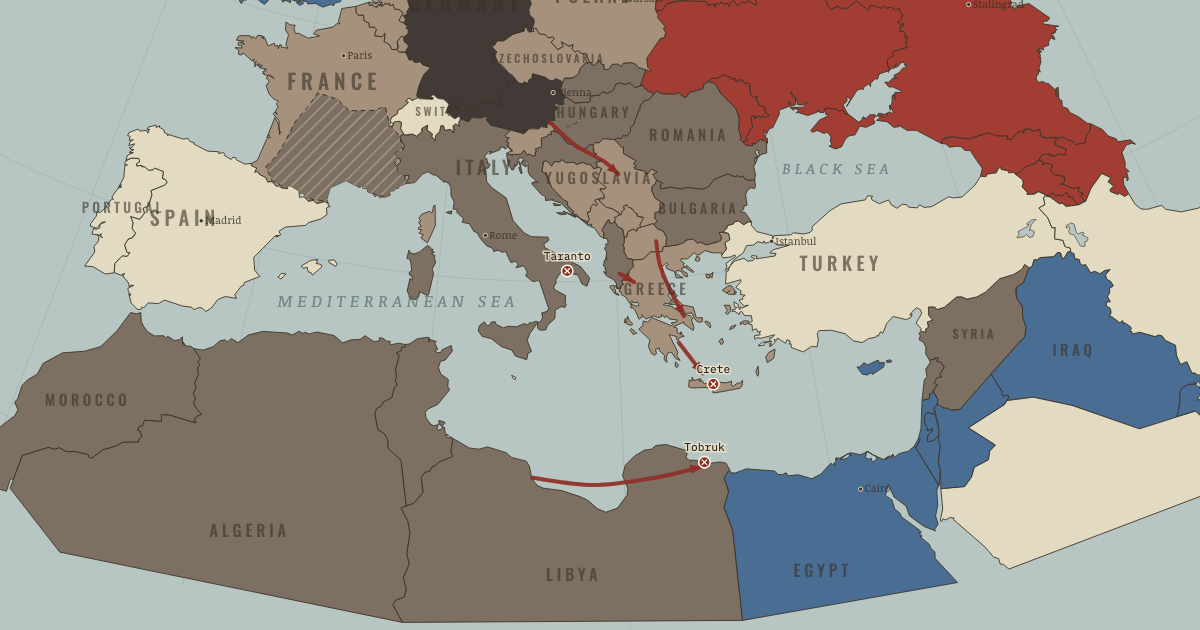
The map above is the world of MAY 1941 — The Balkans overrun.
BRIEF EXPLANATION — THE ESSENTIAL ARGUMENT
Italy entered the war expecting to build an empire of its own, and the failure of that ambition drew Germany into the Mediterranean and the Balkans. Benito Mussolini wanted victories independent of Berlin, a “parallel war” in which Italy would carve out a Mediterranean empire and bargain as Germany’s equal. His means fell far short of his aims. Italian invasions of Greece and of British-held Egypt were both driven back, and in November 1940 a handful of British carrier aircraft crippled the Italian battle fleet at anchor in Taranto, a raid that showed the world how far naval air power could now reach.
Italy’s defeats forced Germany to rescue its ally and take over the campaign. German forces overran Yugoslavia and Greece in the spring of 1941, seized Crete in a costly airborne assault, and sent Rommel’s Afrika Korps to Libya to restore the desert front. These victories painted large areas of the map in Axis colours, but they came at a price, because each new conquest added burdens of occupation, lengthening supply lines, and armed resistance that would tie down German troops for years without bringing the defeat of Britain any closer.
GUIDED EXPLANATION
Mussolini wanted victories that owed nothing to Germany, and his regime called this ambition a “parallel war,” in which Italy would build a Mediterranean empire and negotiate as an equal partner. The means never matched the goal. The invasion of Greece launched from Albania was badly supplied and soon thrown back across the border. In North Africa a much larger Italian army was routed by a small British force. At Taranto in November 1940, twenty-one British biplanes flying from an aircraft carrier disabled the Italian battle fleet in harbour, a result that Japanese naval planners studied closely before Pearl Harbor.
These failures forced Germany to divert forces it had meant for other fronts. After a coup in Belgrade overturned Yugoslavia’s alignment with the Axis, Germany invaded both Yugoslavia and Greece in April 1941, and Crete fell in May after a paratroop assault that cost the attackers dearly. In Libya, Rommel used the newly arrived Afrika Korps to stabilize the front and push the British back east. The Axis gained ground across the Balkans and the African coast, yet the campaign exposed a deep imbalance in the alliance, because German resources repeatedly had to bail out Italian ventures, while the occupation duties and long supply routes they created did nothing to defeat Britain directly.
The Mediterranean mattered because Britain’s lifeline ran through Suez, and because Axis armies in Africa had to be supplied by sea from Europe. Control of Malta, of the ports, and of the fuel that crossed the water could decide a campaign more surely than any dramatic advance across the desert, and Rommel repeatedly outran the supply system that made his victories possible. In the Balkans, occupation bred armed resistance that pinned down Axis divisions for the rest of the war. These campaigns delayed and wore down German forces before the invasion of the Soviet Union, though historians dispute whether that delay cost Germany the battle for Moscow, since wet ground, Soviet resilience, and German logistics probably weighed more. The safest judgment is that Mussolini’s war saddled Germany with extra costs while opening no independent path to strategic victory.
DEEP EXPLANATION — EVIDENCE & INTERPRETATION
The cost of an unequal coalition
Coalitions multiply strength only when the partners coordinate their aims and their capabilities, and the Axis in the Mediterranean shows what happens when they do not. Italy went to war to win prestige and territory for itself rather than to carry out a shared plan, and its attacks opened fronts that Germany had never chosen. Berlin then faced an unwelcome choice, either to let an ally collapse and damage Axis credibility, or to spend scarce aircraft, armour, shipping, and time repairing the damage. Germany chose rescue in Greece and North Africa, and the resulting victories brought lasting obligations, because British-held Malta and naval pressure made supplying Libya ruinously expensive while resistance in Yugoslavia consumed occupation troops. The Axis remained a set of loosely joined separate wars, in contrast to the increasingly coordinated Allied system that emerged later. This helps explain a paradox visible throughout the atlas, which is that the total area under Axis control could keep growing while the strategic position steadily worsened, since more coloured space on the map did not automatically mean more usable power.
Did the Balkans delay Barbarossa?
The claim that the Balkan campaign cost Germany Moscow is appealing because it points to a single, clear missed deadline. The invasion of the Soviet Union did open on 22 June rather than on an earlier planned date, and the operations in Greece and Yugoslavia did consume fuel, equipment, and airborne strength that would soon be needed in the east. Yet an unusually wet spring and flooded ground also argued against an earlier start, and the invasion ultimately failed through a whole cluster of interacting problems, including vast distances, the need to convert Soviet railways, chronic truck shortages, competing objectives, rapid Soviet mobilization, and a German underestimate of the reserves it would face. Blaming five lost weeks makes the calendar carry more weight than it can bear. Most historians therefore treat the Balkans as one contributing burden rather than the decisive cause. The debate is valuable because it disciplines counterfactual reasoning, showing that changing a single variable settles little when the larger logistical and political system remains the same.
The WW2 atlas is free in full — no sign-up.
THE SITES
ON THIS DAY
WHY IT HAPPENED
Fascist prestige economics. Mussolini’s regime ran on spectacle. With Hitler devouring Europe, Italy “needed a few thousand dead” to claim a share of the new order — wars chosen for headlines, not strategy, against Greece and a British Empire he assumed was finished.
Britain’s imperial artery. Suez was the pipe through which India, Persian oil and the Dominions reached the war. Britain would fight for the Mediterranean with everything spare — which is why tiny garrisons like Malta and Tobruk mattered wildly beyond their size.
A coup in Belgrade. Yugoslavia signed with the Axis; two days later its officers overthrew the government to cheering crowds. Hitler, enraged, ordered the country destroyed — an improvised campaign wedged in weeks before his Russian invasion.
THE TURN
Crete, May 1941 — a pyrrhic first. Airborne invasion succeeds, but a third of the paratroopers are killed or wounded in ten days. Hitler concludes big airborne operations are finished; the Allies conclude the opposite. Remember both conclusions on D-Day.
WHAT IT CHANGED
Barbarossa loses five weeks — maybe. The Balkan detour and a late spring push the Russian invasion from May to 22 June. Whether those weeks cost Germany Moscow in December is one of the war’s great debated what-ifs — hold the question until Chapter 6.
A guerrilla war ignites. Occupied Yugoslavia and Greece never pacify. Tito’s partisans will tie down dozens of Axis divisions for four years — Europe’s largest resistance war, and the seed of postwar Yugoslavia.
The desert seesaw. Rommel’s Afrika Korps and the British 8th Army will chase each other across this coastline for two years. The finale comes at a rail halt called El Alamein.
FIELD QUESTION — Was the Balkan campaign a fatal distraction from Barbarossa, or a convenient excuse for its failure?
It contributed delay, equipment wear, and losses, but it does not explain the whole failure. Wet ground also constrained the start, while logistics, Soviet reserves, strategic depth, and intelligence errors remained decisive. The strongest judgment is “contributing factor, not primary cause.”
AN INTERESTING FACT
Greece keeps the anniversary as a national holiday: every 28 October is Ohi Day — “No Day” — marking the pre-dawn moment Prime Minister Metaxas rejected Mussolini’s ultimatum in 1940. Legend compresses his answer to a single defiant “Ochi!”; by the Italian ambassador’s own account, what he actually said, in the French of diplomacy, was “Alors, c’est la guerre” — then it is war. Either way, within weeks Greek soldiers had chased the invaders back into Albania — the first land defeat any Axis army had suffered.
THE DISPATCH
One short letter when a new atlas opens — and the printable study guide for WW2 is yours now, free.
NO TRACKING · YOUR ADDRESS IS USED FOR THE DISPATCH AND NOTHING ELSE · UNSUBSCRIBE ANYTIME