MAPS OF HISTORY · WW2 · ALL CHAPTERS · CHAPTER 6
CHAPTER 6 · JUN–DEC 1941 · DEC 1941
Barbarossa: The War of Annihilation
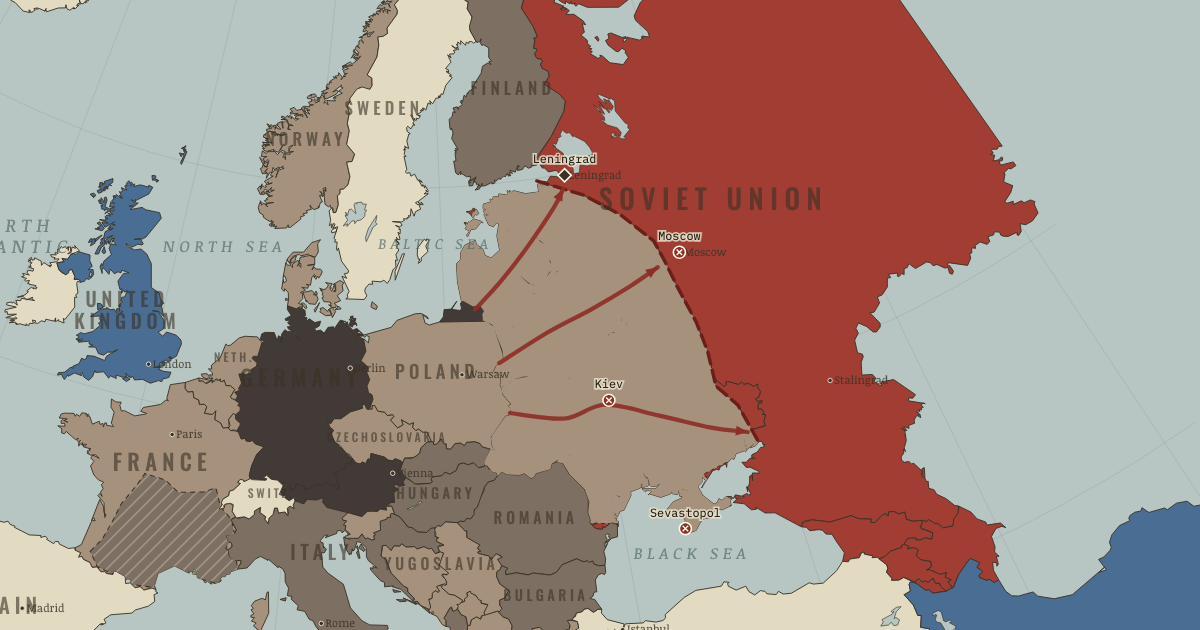
The map above is the world of DEC 1941 — Barbarossa checked at Moscow.
BRIEF EXPLANATION — THE ESSENTIAL ARGUMENT
The invasion of the Soviet Union was the decision that turned the conflict into a world war of extermination, and it grew from the core of Nazi ideology rather than from ordinary strategy. On 22 June 1941 Germany and its allies attacked across a front of some 2,900 kilometres, sending three great army groups toward Leningrad, Moscow, and the farmland and oil of Ukraine and the south. The opening weeks brought staggering success, as fast-moving encirclements destroyed or captured huge Soviet armies. German planners assumed the Soviet state would shatter before distance, weather, and their own strained supply lines could catch up with them.
This was also a war of racial annihilation, and that fact cannot be separated from the fighting. German forces deliberately starved prisoners and civilians, while the Einsatzgruppen, the mobile killing squads that followed the army, murdered whole Jewish communities in mass shootings. The Soviet Union survived because it could trade its vast space for time, raising fresh armies, moving more than 1,500 factories eastward, and drawing on reserves that German intelligence had never counted. When Soviet forces counterattacked in front of Moscow that December, they ended any hope of the short war on which Germany’s entire strategy depended.
GUIDED EXPLANATION
The German plan rested on a single gamble, which was that the Soviet state would collapse if its frontier armies were destroyed quickly enough. Around 3.6 million Axis troops crossed the border in the largest invasion in history, and three army groups drove toward Leningrad, Moscow, and Ukraine. German mobile formations trapped and destroyed enormous Soviet forces at Minsk, Smolensk, and Kiev, taking more than three million prisoners by winter. Each victory seemed to confirm the plan, yet the state behind those armies did not break, and the deeper the Germans advanced, the more clearly the limits of their own supply became a problem they could not solve.
Barbarossa was never a conventional campaign, because Nazi racial ideology defined Soviet territory as colonial Lebensraum, or living space, to be cleared and settled. Occupation policy planned deliberate hunger and forced labour, German authorities allowed most of the Soviet prisoners taken in 1941 to die, and the Einsatzgruppen and supporting units shot Jews in their hundreds of thousands. The language here must stay precise, because military advance and genocide were interlocking parts of the same invasion. The Soviet state nevertheless moved more than 1,500 industrial enterprises to the east, raised new armies from its enormous population, and kept fighting after losses that would have destroyed most nations. In December its forces counterattacked near Moscow, and Germany had failed to win the quick victory its strategy required.
The German plan failed because it misread what it was attacking. It assumed that smashing the Soviet armies near the border would bring down the state, and it underestimated strategic depth, the capacity to raise reserves, the evacuation of industry, and the willingness of people to resist a regime that openly promised them enslavement and death. German supply weakened with every kilometre travelled, because the railways had to be converted to a different gauge, trucks broke down on poor roads, and much of the army still moved by horse. Historians debate whether an earlier start or a single concentrated drive on Moscow could have changed the result, yet those alternatives still run into the same shortages and the same Soviet ability to regenerate. By winter the campaign had become a war of attrition, and Germany now faced an enemy with more manpower, greater industrial potential, and growing access to Allied aid.
DEEP EXPLANATION — EVIDENCE & INTERPRETATION
War, occupation, and genocide
Nazi plans for the East fused military conquest with racial transformation, and the two cannot be told apart. The Hunger Plan expected German forces and cities to feed themselves from Soviet harvests even though this was certain to starve millions, and the Commissar Order directed the killing of captured Soviet political officers. Behind the front, Einsatzgruppen, police battalions, Waffen-SS units, and local collaborators murdered Jewish men, women, and children, including at Babi Yar outside Kiev. These crimes were not a breakdown of discipline; they followed policy, ideology, and the cooperation of many institutions. By the end of 1941 more than a million Jews had already been murdered in mass shootings, and the later deportations and extermination camps would extend this genocide across occupied Europe. Separating a clean “military war” from the Holocaust hides the actual mechanism, because conquest opened access to the victims while racial goals shaped how the whole campaign and occupation were conducted.
Why the Soviet system survived
German intelligence carefully counted the Soviet formations near the border but badly underestimated the capacity to replace them, and that gap decided the campaign. Strategic depth let the Soviet government trade land for time, and the railways carried factories, workers, and machinery beyond the Ural Mountains, where production resumed under brutal conditions. The mobilization system raised new armies faster than Germany believed possible, while scorched-earth measures denied some resources to the invader. Lend-Lease aid was still small in 1941 but grew vital later, supplying trucks, food, rails, and radios. Survival also rested on coercion, on patriotic mobilization, and on the plain knowledge that Nazi rule meant enslavement and death. Geography alone did not stop Germany; it mattered because Soviet institutions could use distance to rebuild their forces. German logistics, moving mainly by rail and horse and hobbled by incompatible rail gauges, delivered less combat power the farther the front advanced, so the invader grew weaker exactly as its enemy grew stronger.
The WW2 atlas is free in full — no sign-up.
THE SITES
ON THIS DAY
WHY IT HAPPENED
Ideology: Lebensraum and the “Jewish-Bolshevik” enemy. For Hitler this was always the real war — colonial conquest of the East, enslavement of Slavs, annihilation of Jews and communists. The economic and strategic arguments were rationalizations layered on a fixed racial-imperial goal. You cannot explain 1941 without ideology.
“Kick in the door and the whole rotten structure comes down”. The purges (Stalin had shot most of his own senior officers in 1937–38) and Finland’s Winter War convinced Berlin the Red Army would collapse in weeks. German intelligence undercounted Soviet divisions by half — the greatest intelligence failure of the war.
Britain’s last hope. With invasion impossible (Ch. 4), Hitler reasoned Britain fought on only in hope of Russia and America. Destroy Russia, and Britain must make peace before America was ready. The eastern war was also, in his mind, the fastest way to end the western one.
THE TURN
The gates of Moscow, 5 December. Zhukov — informed by his Tokyo spy Richard Sorge that Japan would strike south, not at Siberia — has quietly massed reserve armies. Their winter counteroffensive throws the frozen, exhausted Wehrmacht back 100–250 km. Germany has lost the only kind of war it knew how to win: a short one.
WHAT IT CHANGED
A war of attrition Germany cannot win. From December 1941 the contest becomes factories, oil and manpower — categories in which the USSR (plus Lend-Lease) dwarfs the Axis. Every later German offensive is a search for a shortcut out of this arithmetic.
The Holocaust escalates to genocide. Mass shootings in the East — over a million dead by end of 1941 — lead to the Wannsee Conference (Jan 1942) coordinating a continent-wide “Final Solution”: deportation of Europe’s Jews to extermination camps in occupied Poland. This map’s grey zones hide the war’s deepest crime.
The Grand Alliance forms. Churchill, the arch anti-communist, pledges aid to Stalin the same day the invasion begins (“If Hitler invaded Hell…”). Days after Pearl Harbor, Hitler gratuitously declares war on the USA too — personally completing the coalition that will destroy him.
FIELD QUESTION — Every military expert — including most Allied ones — predicted Soviet collapse within weeks. Why were they all wrong?
They projected early Soviet defeats forward and underestimated regeneration. Strategic depth, factory evacuation, mass mobilization, coercion, patriotism, and a war for survival kept the USSR fighting. German supply systems could not sustain the same tempo over vast distances. Visible battlefield losses concealed the Soviet state’s remaining capacity.
AN INTERESTING FACT
Inside besieged Leningrad stood the world’s largest seed bank: the Vavilov Institute, hundreds of thousands of samples of wheat, rice and potato collected from five continents. Through the starvation winter of 1941–42 its scientists guarded the collection and refused to eat it — at least nine died of hunger at their posts, the rice curator among them, found beside full sacks of grain. The institute’s founder, the geneticist Nikolai Vavilov, was starving at the same time in an NKVD prison, where he died in 1943. The seeds were being kept for the harvests after the war — a quiet, absolute answer to a war of annihilation.
THE DISPATCH
One short letter when a new atlas opens — and the printable study guide for WW2 is yours now, free.
NO TRACKING · YOUR ADDRESS IS USED FOR THE DISPATCH AND NOTHING ELSE · UNSUBSCRIBE ANYTIME