Russian Revolution · CHAPTER 5 ·
Dual power in Russia (1917)
Chapter 5 of The Russian Revolution, 1855–1924: “Dual Power”
From March to September 1917 the Provisional Government held legal authority while the Petrograd Soviet held the loyalty of soldiers and workers. Its decision to keep fighting the war, the failed June Offensive, the July Days and the Kornilov affair of late August made Lenin’s call for soviet power persuasive.
Chapter 5 is included with every paid plan. WW2 is free in full, and chapter 1 of every atlas is free. A free account opens 3 more chapters a day. Starter, at $9 a month, opens all 21 with no daily limit — see the plans.
Free printable Russian Revolution study guide, sent by email ↓
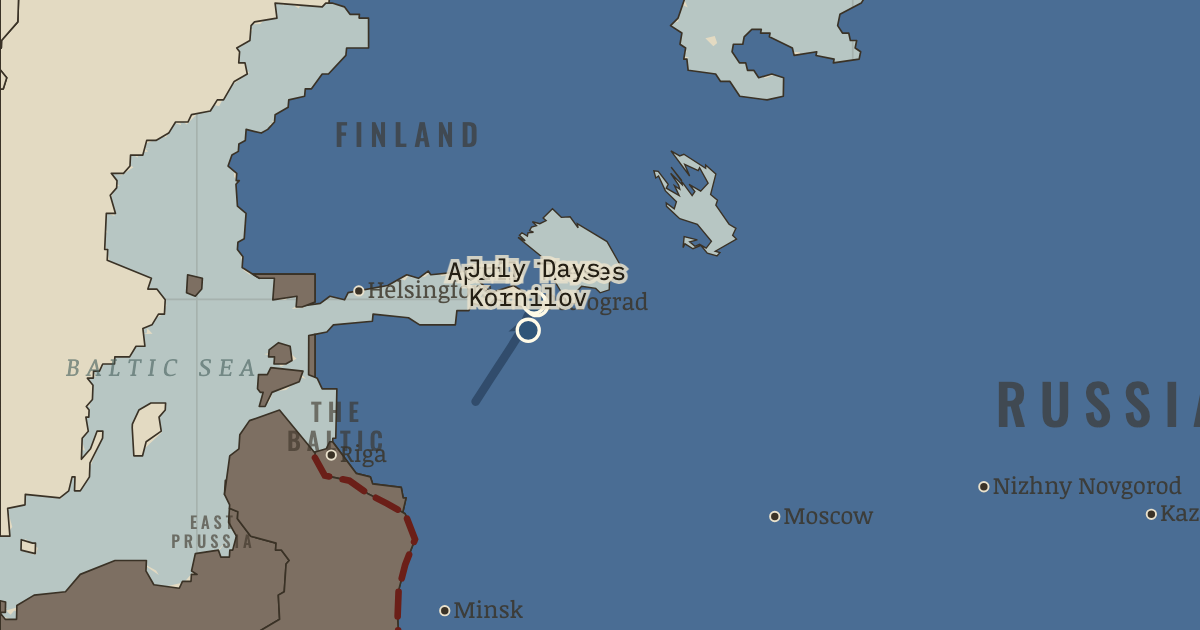
The map above is the world of Russia, July 1917 — Dual power falters.
Every state on the map that year: The world in 1918 · Europe in 1918.
Part of IB History: The Russian Revolution →
SHORT EXPLANATION
After the Tsar fell, the ministries belonged to the Provisional Government, but the Petrograd Soviet, a council of workers and soldiers, commanded the loyalty of the garrison, factories and railways. For eight months this division of authority and force made each dependent on the other. They also faced different demands: the government postponed land, constitutional and above all war decisions until an elected assembly could meet.
Lenin returned from exile in April and called for an end to support for the war and government and for all power to pass to the soviets. His position initially isolated him even within his party. The failed June Offensive and the crushed July Days rising appeared to weaken the Bolsheviks, but the Kornilov affair changed their fortunes. Kerensky armed radicals he had been jailing to stop the general’s advance; their organizers helped stop it without battle. They kept the weapons and gained credit for defending the revolution. By September they held majorities in the Petrograd and Moscow soviets.
The full story
Who could govern Russia after the Tsar fell? The Provisional Government occupied the ministries, claimed legal authority and had the recognition of Russia’s allies. But orders needed people willing to carry them out, and soldiers and workers looked to the Petrograd Soviet. The Soviet had loyalty without formal power; the government had authority without dependable force. This was dual power, and neither side could simply dispense with the other.
Lenin returned in April with a way out of the arrangement. His April Theses rejected support for both the government and the war and called for power to pass to the soviets. At first even his own party isolated him. The government, meanwhile, continued the war. Soldiers remained at the front, cities went short of bread, and the men who might receive redistributed land stayed in uniform. The promise of an elected assembly offered little immediate relief to people confronting those problems.
The June Offensive was intended to restore morale. Its rapid collapse, accompanied by desertions, instead destroyed the government’s remaining credit. In the July Days, armed workers and sailors came into Petrograd demanding soviet power before Bolshevik leaders were ready to take it. The rising was crushed and Lenin went into hiding. Peasants, meanwhile, began taking the gentry’s estates without waiting for legislation.
The danger that revived the Bolsheviks came from the other direction. In late August General Kornilov, the army commander, moved troops toward Petrograd. Historians dispute whether he meant to crush the Soviet, restore order with Kerensky’s blessing, or acted amid mutual misunderstanding. Kerensky feared a coup and released and armed the Bolsheviks and the Red Guard. Railway workers stopped the trains and agitators dissolved Kornilov’s regiments; the threat disappeared without a shot.
The party nearly destroyed in July now had weapons, legal standing and credit for defending the revolution. Lenin’s insistence on soviet power gave its disciplined members a common objective, while rivals pursued coalitions and delay. In this crisis a smaller party with a definite aim could gain a considerable advantage over larger, divided opponents.
FULL EXPLANATION
The trap created by continuing the war
Russia’s new ministers had reasons to continue a war inherited from the Tsar. Treaties tied them to the Allies, and Russia depended on Allied loans and supplies. They feared that a separate peace would let Germany win, and believed a democratic Russia should stand by the common cause. On those terms, continuing to fight was a defensible diplomatic decision. At home it made the government’s position harder to sustain. Millions of peasants remained under arms instead of returning to land that might be redistributed. War deepened the food and transport crisis and tied the government to unpopular officers. The June Offensive was meant to restore morale and bargaining power; its swift collapse showed how far command authority had dissolved. A separate peace promised no easy escape, as the heavy terms of Brest-Litovsk would soon show. The difficulty was that each military commitment consumed legitimacy the government needed to survive and negotiate its way out.
What can be said about Kornilov
Kornilov’s movement toward Petrograd admits several interpretations. He may have intended a personal dictatorship, sought to restore order with Kerensky’s approval, or acted in a chain of mutual misunderstanding. Historians still dispute his intentions, so we should distinguish those intentions from the consequences of the affair. Kerensky publicly treated the advance as a coup and appealed to the Soviet. Forces he had repressed after the July Days gained weapons and room to organize. Bolshevik railway workers and agitators helped stop the units without a major battle, giving the party a powerful claim to have defended the revolution against counter-revolution. Conservatives saw Kerensky as betraying the army’s commander, while radicals concluded that armed soviets alone could prevent reaction. Whatever Kornilov privately planned, the affair changed the distribution of rifles, credibility and soviet majorities in the weeks before October.
Key places on the map
Why it happened
Two powers, opposite aims. The government sought to honor its Allied commitments and defer decisions on land, the constitution and the war to an elected assembly. The Soviet answered to soldiers who wanted peace and peasants who wanted land now. An appeal to a future assembly could not satisfy demands that people were already acting upon.
The fatal decision to continue the war. War kept soldiers in the field and contributed to shortages of bread in the cities. It also held at the front men who would farm redistributed land. When the June Offensive failed, it destroyed the government’s last credit. Lenin could offer “Peace, Land, Bread,” the three things the government had not delivered.
Lenin’s clarity in a fog. Where other leaders sought coalitions or delay, Lenin refused compromise and demanded soviet power. His party was small, but a disciplined organization with a shared objective had an advantage over larger, decent opponents divided about what to do.
The Kornilov affair arms the left. Kerensky armed the Bolsheviks because he feared Kornilov more. The decision rescued a party nearly destroyed in July and enabled it to claim that it had defended the revolution. Guns supplied to the Red Guard would be used against the Winter Palace ten weeks later.
THE TURNING POINT
The Kornilov affair, late August 1917. After the July Days Kerensky jailed radicals. When Kornilov’s troops approached Petrograd in late August, he feared a seizure of power and armed those same forces to stop them. Kornilov’s intentions remain disputed, but the advance failed on the railways. The Bolsheviks kept the weapons and gained credit for saving the capital. Kerensky’s defense against one threat had strengthened a party that would soon replace his government.
What it changed
The soviets go Bolshevik. The Bolsheviks won majorities in the Petrograd and Moscow soviets during September. Their demand for “All power to the soviets” now promised power to their own party in practice. From hiding, Lenin urged its cautious leaders by letter to stage an insurrection before the Constituent Assembly met and made a coup look illegitimate.
Kerensky discredited from both sides. Kerensky’s stand against Kornilov cost him support on both sides. Conservatives blamed him for breaking the army’s last defender; the left regarded him as a would-be dictator. Having armed the Bolsheviks against the general, he could trust neither camp to sustain him.
The countryside takes the land itself. Across the summer and autumn peasants took gentry estates while politicians debated in Petrograd. This was the greatest transfer of land in European history, carried out from below. A successor government would have to fight the seizures or accept them. The Bolsheviks would accept them, then try to take the grain.
DISCUSSION QUESTION — The Provisional Government kept Russia in the war — the decision that destroyed it. Given the pressures, could it realistically have chosen otherwise?
The choice to fight had a strong diplomatic case. Treaties and loans bound Russia to the Allies; liberal ministers feared that a separate peace would betray the democratic cause and allow Germany to win. A unilateral armistice also risked German occupation on far worse terms, as Brest-Litovsk would soon show. Yet the war undermined the government with every month it continued. A government that had made peace and land its first acts might have deprived the Bolsheviks of their program. Continuing the war was rational for the elite and suicidal for the state: the commitments ministers felt bound to honor threatened the government’s survival.
An interesting fact
The famous “sealed train” that brought Lenin home was sealed mostly by chalk. A line across the corridor separated the Russian exiles from their two German escort officers, and the parties agreed not to cross it. Lenin sent smokers to the lavatory, then issued paper permits when smokers and non-smokers quarreled over the queue. Churchill later described Germany as having transported Lenin into Russia “like a plague bacillus.”
Related
THE FREE PRINTABLE STUDY GUIDE
Get the printable study guide for The Russian Revolution free. I’ll send you a few short letters, then one when a new atlas opens. That’s all. — Paul
NO TRACKING · YOUR ADDRESS IS USED FOR THE DISPATCH AND NOTHING ELSE · UNSUBSCRIBE ANYTIME