Age of Revolutions · CHAPTER 7 ·
Peninsular War
Chapter 7 of The Age of Revolutions, 1775–1848: “The Empire and Its Cracks”
To enforce the Continental System, French troops crossed Spain toward Portugal in 1807, and Napoleon made his brother Joseph king of Spain. Madrid rose on 2 May 1808, a French corps surrendered at Bailén in July, and Spanish juntas, guerrillas and Wellington’s sea-supplied army pinned down hundreds of thousands of troops.
Chapter 7 is included with every paid plan. WW2 is free in full, and chapter 1 of every atlas is free. A free account opens 3 more chapters a day. Starter, at $9 a month, opens all 21 with no daily limit — see the plans.
Free printable Age of Revolutions study guide, sent by email ↓
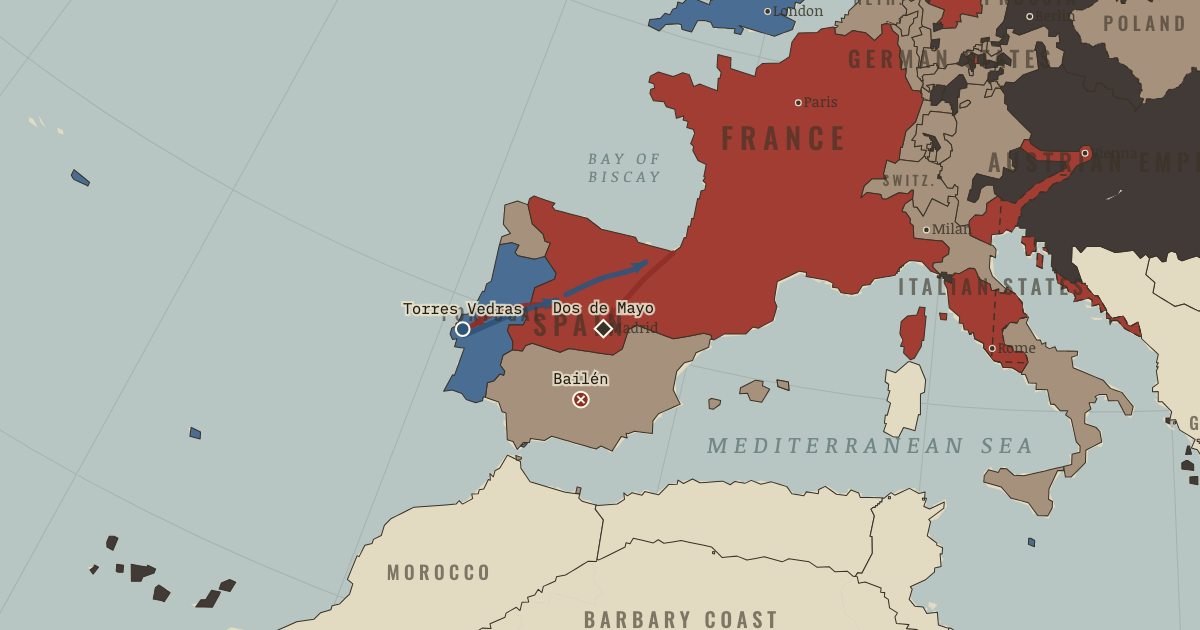
The map above is the world of Europe, June 1810 — The Grand Empire.
Every state on the map that year: The world in 1815 · Europe in 1815.
Part of IB History: The Age of Revolutions →
SHORT EXPLANATION
After Trafalgar, Napoleon tried to weaken Britain by excluding its trade from Europe. Portugal would not join the blockade. French troops crossed Spain to reach Portugal, and Napoleon then replaced Spain's Bourbon king with his brother Joseph. An operation against one reluctant ally had become an occupation contested by another.
French victories did not bring Spanish resistance to an end. Juntas claimed authority for the absent king, guerrillas troubled French communications, and regular armies returned to the field. Wellington's army, supplied by sea from Portugal, forced the French to face another opponent. Together these forces tied down hundreds of thousands of imperial troops. In 1812 the Cádiz constitution declared national sovereignty, offering liberals in Europe and Spanish America an example, even as many Spaniards fought for an absolutist king.
The full story
Napoleon could not carry an army across the sea to Britain after Trafalgar. He could, however, try to deny Britain its European markets. The Continental System depended on governments closing their ports to British goods, and Portugal refused. In 1807 French troops crossed Spain on their way to enforce the blockade. Napoleon then went beyond the immediate problem of Portugal: he forced the Spanish royal family to abdicate and put his brother Joseph on the throne. Madrid rose on 2 May 1808; severe French reprisals followed. Across Spain, local juntas, or emergency councils, claimed authority in the name of the absent king.
The surrender of a French corps at Bailén in July 1808 showed that an imperial army could be defeated. Napoleon retook Madrid, but a captured capital did not settle the question of who could govern Spain. Regular Spanish armies rebuilt after defeats, while guerrillas struck couriers, foragers and isolated units. Britain, meanwhile, could sustain an army in Portugal by sea. Wellington's Lines of Torres Vedras protected Lisbon, and Masséna withdrew when he could no longer feed his forces. None of these opponents could have done the whole job alone: guerrillas could not remove major garrisons, and Britain could not hold the countryside by itself. Together they kept the French fighting on several terms at once.
The British arrows trace a route from Portugal's protected coast into Spain. Behind Wellington stood the Royal Navy and a secure supply line; French troops had to forage and protect long roads. Concentrating against Wellington left those roads exposed to guerrillas. Guarding them dispersed troops who might otherwise have faced Wellington. Occupation of a city therefore did not mean control of the country around it. The crisis had political consequences across the Atlantic as well. If Spanish juntas could exercise authority for a captive king, American cities could use the same argument to form their own. At Cádiz, the constitution of 1812 declared national sovereignty, supplying a program that Ferdinand VII would later reject.
FULL EXPLANATION
A blockade that demanded occupation
The Continental System was Napoleon's answer to a military difficulty: Britain could not be invaded, but its exports, credit and customs revenue might be damaged by excluding its trade. Britain did suffer in the crisis years. Yet the system depended on a great many ports and governments, and Britain could redirect some trade while smugglers carried goods into Europe. Continental consumers and producers also bore the cost of shortages and lost markets. An opening in the blockade was therefore more than a commercial dispute for Napoleon. To close Portugal's ports he sent troops through Spain, where intervention became occupation. Russia's withdrawal from the system helped produce the breach leading to the campaign of 1812. The policy's enforcement drew France into costly occupations and made enemies of states whose cooperation it needed; those costs could exceed what imperfect compliance cost Britain.
Why the Iberian combination worked
No single arm of the resistance could have achieved what the Iberian coalition did. Guerrillas gathered intelligence, punished collaborators and made roads unsafe, but could not readily overcome fortifications or concentrated troops. Wellington brought an army able to fight in the field, and depended in turn on Portuguese reforms, local information and naval supply. The Royal Navy sustained a base that France could not close. These capabilities worked on the French army at the same time. Troops spread along communications were vulnerable to insurgents; troops gathered against Wellington left roads and territory behind them exposed. French armies remained formidable in battle. But a victory over a principal army, or the occupation of a capital, could not by itself compel every source of resistance to stop. This combination of unlike strengths is what made the alliance effective.
Key places on the map
On this day
Why it happened
Economic war without an exit. The blockade damaged Britain: exports slumped, and 1808 and 1811–12 were years of crisis. It also deprived continental producers of markets and consumers of supplies. Smuggling spread from Lisbon to Riga. Each port that admitted British goods weakened Napoleon's system, so the commercial choices of Portugal, the Papal states and eventually Russia became problems he sought to solve through coercion or occupation. Enforcement created conflicts with the very states whose cooperation the blockade required.
Bayonne: legitimacy fumbled. In parts of Italy and the Rhineland, the French could present their rule as liberation from foreign or feudal rulers. At Bayonne, Napoleon instead displaced the Bourbons of an intact Spanish kingdom and gave their crown to Joseph. Many Spaniards across social classes saw a seizure of their king's authority. Defeating their armies could secure ground, but it could not make them accept Joseph. Napoleon later called the Spanish affair the knot that strangled him.
Insurgency plus sea power. France faced enemies with different strengths. Guerrillas disrupted intelligence and forage and made roads dangerous, though fortresses lay beyond their usual reach. Wellington could meet French armies in the field, but could not hold Spain alone against roughly 250,000 imperial troops. The Royal Navy could supply Lisbon and Cádiz, and the insurgents raised the cost of occupying the land between them. France had to counter these threats together.
THE TURNING POINT
Bailén, 19 July 1808. At Bailén on 19 July 1808, about 18,000 imperial troops surrendered to Spanish regulars and levies in the Andalusian heat. Many were second-line soldiers, and their loss was materially recoverable. The surrender nevertheless broke the impression that a Napoleonic army could not capitulate in the open field. News reached Europe's capitals. Austria began rearming within weeks and fought France in 1809; other opponents, too, had reason to reconsider what resistance could accomplish. Napoleon retook Madrid, but the Spanish war demanded further forces.
What it changed
The veteran drain. The war in Iberia became a lasting second front. Men and horses committed or lost there could not serve elsewhere, reducing the resources available for the Russian campaign of 1812. France raised a multinational army that included allied conscripts of doubtful loyalty, but replacing experienced soldiers and horses was harder than raising numbers.
Nationalism changes sides. The French Revolution had demonstrated the force of an appeal to the nation. In Spain, that appeal helped sustain resistance to France itself. Prussian reformers, including Stein and Scharnhorst, rebuilt their state and army after defeat; by 1813, France's opponents as well as its supporters were mobilizing people through national appeals.
Cádiz writes the liberal script. The Cádiz constitution combined national sovereignty with a Catholic monarchy. For the next thirty years it offered liberals in the Mediterranean world and Latin America a model, while the political term “liberal” spread from Spanish usage. Ferdinand VII abolished the constitution on his return in 1814. Its supporters retained a grievance that helped fuel the revolutions of 1820.
An empire decapitated across the ocean. With the king held by France and a junta governing under siege in Spain, Spanish American cities faced a question of authority. Some formed juntas that claimed to conserve sovereignty for the captive monarch. A claim made in his name could also allow local governments to act for themselves, opening a path to independence even where its authors had not intended that outcome.
DISCUSSION QUESTION — Why did victories over Spanish armies fail to end Napoleon’s war in Spain?
Napoleon could defeat an army without finding a government able and willing to end the war. Juntas continued to claim authority, guerrillas made French communications costly to protect, and Wellington's army, supplied by sea, remained a threat in the field. Difficult terrain and poor forage increased the strain. Joseph's installation at Bayonne had also left his government without legitimacy among many Spaniards. Each victory dealt with part of the resistance; none removed all of it.
An interesting fact
Francisco Goya's paintings of the Madrid rising were made in 1814, six years after events he had witnessed. To obtain funds for the Second of May and the firing squad of the Third of May, he petitioned the restored government to “perpetuate by means of his brush the most notable and heroic actions of our glorious insurrection.” His other record, the eighty-two etchings of The Disasters of War, remained unpublished in his lifetime. It appeared in 1863, thirty-five years after his death.
Related
THE FREE PRINTABLE STUDY GUIDE
Get the printable study guide for The Age of Revolutions free. I’ll send you a few short letters, then one when a new atlas opens. That’s all. — Paul
NO TRACKING · YOUR ADDRESS IS USED FOR THE DISPATCH AND NOTHING ELSE · UNSUBSCRIBE ANYTIME