Age of Revolutions · CHAPTER 8 ·
Napoleon’s invasion of Russia
Chapter 8 of The Age of Revolutions, 1775–1848: “1812: The Russian Campaign”
About 600,000 troops crossed the Niemen on 24 June 1812, but the Russians retreated instead of fighting at the frontier. Borodino on 7 September cost both sides over 70,000 men without destroying the Russian army; Napoleon waited five weeks in Moscow, and disease, hunger and then cold left fewer than 100,000 effective troops.
Chapter 8 is included with every paid plan. WW2 is free in full, and chapter 1 of every atlas is free. A free account opens 3 more chapters a day. Starter, at $9 a month, opens all 21 with no daily limit — see the plans.
Free printable Age of Revolutions study guide, sent by email ↓
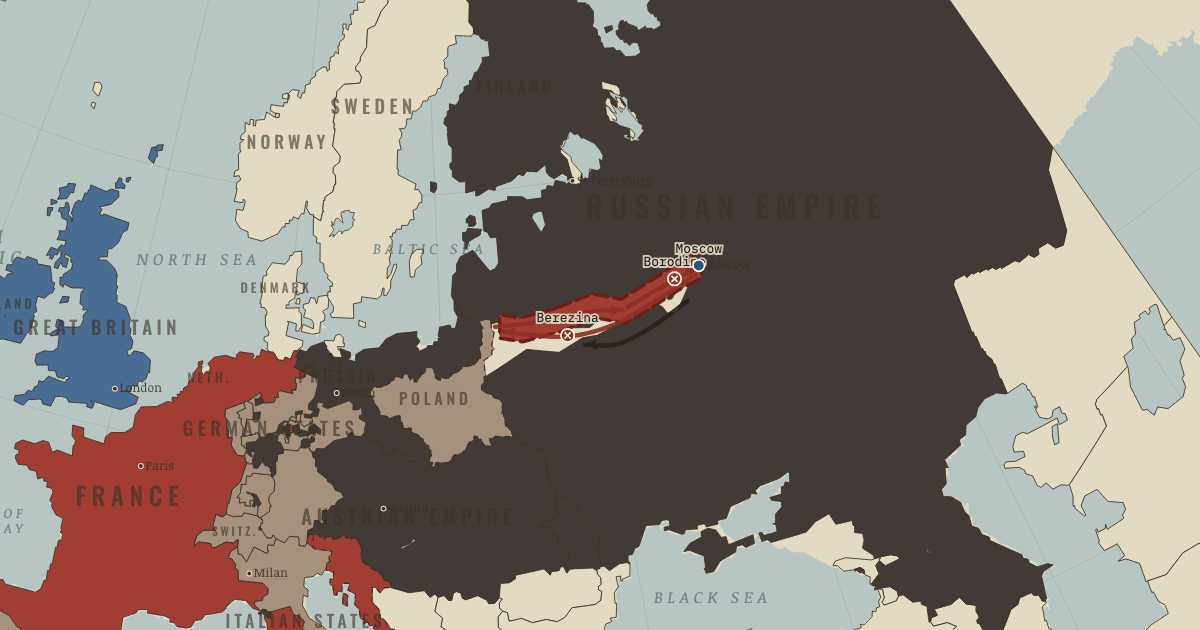
The map above is the world of Europe, September 1812 — To Moscow.
Every state on the map that year: The world in 1815 · Europe in 1815.
Part of IB History: The Age of Revolutions →
SHORT EXPLANATION
The partnership Napoleon and Alexander I had made at Tilsit came apart as Russia relaxed the Continental System. Napoleon invaded in June 1812, expecting to defeat the Russian armies near the frontier and make a quick peace. Instead they withdrew, whether by design or necessity. Following them took his vast army farther from its supplies into country that could not easily feed it.
Borodino cost both sides heavily without destroying the Russian army. Napoleon occupied Moscow, but Alexander refused peace, and five weeks passed before the retreat began. The army had already lost men to disease, heat, hunger and desertion; severe cold deepened the collapse. The destruction of horses and experienced troops, together with lost confidence among allies, helped make a new coalition possible.
The full story
Napoleon crossed the Niemen on 24 June 1812 with a plan for a short war. Around 600,000 men took part in the campaign, many supplied by allied or subject states. A battle near the frontier would allow him to defeat the Russian armies before distance and supply became overwhelming, then seek peace. But the Russians withdrew. Whether this was deliberate or resulted from the difficulties of divided command, the effect was the same: Napoleon had to march east to reach them. His supply lines lengthened, forage grew scarcer, and typhus, dysentery, heat and desertion took large numbers before the first major battle.
That battle came at Borodino on 7 September. More than 70,000 men on the two sides became casualties, yet the Russian army escaped. Napoleon entered Moscow a week later, only to see much of the city destroyed by fire. He had gained a great city without gaining the peace for which he had fought. Alexander I refused to negotiate, and Napoleon waited about five weeks for a change of mind. On 19 October he ordered the retreat.
The outward and return arrows follow much of the same narrow corridor. On the way east the army had consumed the food it could find; now the retreating columns returned over exhausted ground. Russian forces marched alongside, attacking vulnerable troops and harassing flanks and river crossings. Hunger and disease had already weakened the army when severe cold added to the disaster. At the Berezina, engineers built bridges under attack and saved part of the force. Fewer than 100,000 effective troops returned. France could call up young conscripts, but trained officers and gunners and cavalry horses were much harder to replace. The decision to wait at Moscow had brought this depleted army closer to winter without persuading Alexander to end the war.
FULL EXPLANATION
The plan depended on a short war
Napoleon did make provision for supply. Depots and wagon battalions were meant to support the army until a decisive battle and peace brought the campaign to an end. The difficulty lay in the length and scale of the operation those supplies had to sustain. Roads damaged vehicles, draft animals consumed part of the loads, and troops spread out to forage from a landscape and population unable to meet their demands. Russian withdrawal changed the timetable on which the provision depended. The army marched farther without securing the decision Napoleon expected, and each additional march increased its need for food and transport. The system was not built to sustain a long advance followed by retreat over ground already exhausted. Meanwhile, the Russian army and government remained able to continue the war.
Why “General Winter” is incomplete
“General Winter” names a real part of the disaster. Severe cold killed men and animals and made the retreat still harder. Yet the force that encountered it had already been reduced by disease, exhaustion, hunger and desertion during the warmer months. Incomplete unit returns and the different reasons men left the ranks make estimates uncertain. Napoleon's emphasis on weather drew attention away from his decisions; Russian patriotic memory also celebrated climate as a defender. To understand the cold's effect, consider where it found the army: far from its supplies, weakened by the advance, delayed in Moscow and returning along a depleted route. Winter was deadly, and the earlier course of the campaign had left the troops exceptionally exposed to it.
Key places on the map
On this day
Why it happened
Logistics against arithmetic. Napoleon's familiar way of war joined rapid movement, local forage and a decisive battle. In the comparatively rich, densely settled regions of Western Europe, roads and supplies had helped make that possible. Russia posed another problem: distances were longer, roads poor and forage sparse. Wagons brought food, but their draft horses consumed some of it. One estimate puts losses from disease and other attrition at roughly 120,000 before Smolensk. Napoleon expected a short campaign near Vilna; as the march continued east, the army's needs exceeded what could be supplied.
Scorched earth and the refused battle. Barclay's retreat, whether chiefly planned or improvised, kept the Russian army away from the decisive battle Napoleon wanted near his supply base. Each march east increased the strain on the invaders and the danger of their eventual return. In Spain, dispersed resistance prolonged the war; in Russia, an army that kept receding remained available to fight another day. Both denied Napoleon the ending he sought, by different means.
An empire of conscripted allies. Roughly half the invading force came from outside France. Prussian, Austrian, German, Italian and Polish contingents served under treaties, but their reasons for following Napoleon differed. Many Poles attached strong hopes to him; other states had recently suffered defeat at his hands. Hardship damaged the army, and defeat strained the political ties that held its contingents together. In December the Prussian corps agreed to neutrality, and Austria later moved away from France.
Winter was the finisher, not the cause. The cold of November killed and disabled men and horses on a terrible scale. It did not begin the army's losses. During the warmer months, heat, typhus, dysentery, hunger and desertion had already reduced its strength, although estimates of the proportion lost before the first hard frost vary. Napoleon emphasized weather, while Russian patriotic accounts celebrated “General Winter”. The cold struck a force already depleted and far from its supplies.
THE TURNING POINT
Moscow, September–October 1812. Moscow was supposed to give Napoleon leverage over Alexander. Occupying an enemy capital had helped secure settlements in earlier wars, and he hoped this capture would do the same. Alexander continued fighting. After about 35 days Napoleon ordered a retreat, having spent valuable time in a city that had not brought peace. His army now had to return still farther into the cold season. Capturing a city had proved a different achievement from persuading its government to make terms.
What it changed
The spell breaks in public. France learned of the disaster through the 29th Bulletin, which nevertheless assured readers that the Emperor's health “has never been better”. Prussian forces moved away from the alliance within weeks, and Austria joined the opposing coalition in 1813. Russia's surviving army helped sustain the effort that became the Sixth Coalition. Bailén had already damaged Napoleon's reputation; Russia revealed a defeat on a much larger scale.
The instrument is gone. Men could be conscripted more quickly than experience could be replaced. France raised young soldiers, including the “Marie-Louises” who fought in 1814, but horses, veteran noncommissioned officers and trained gunners were harder to recover. Napoleon rebuilt an army for 1813; its losses in experience and cavalry limited what it could accomplish, including after battles such as Leipzig.
Russia marches west, twice. The Russian pursuit carried armies west to Paris in 1814 and helped make the tsar a principal arbiter of Europe. The journey also exposed young Russian officers to societies and political ideas beyond their own country. For some, comparison with constitutional France contributed to the discontent expressed in the Decembrist revolt of 1825.
DISCUSSION QUESTION — Napoleon had studied Charles XII’s 1709 disaster in Russia. Why did knowledge of that precedent not save him?
Napoleon had addressed some dangers visible in Charles XII's experience: he started in summer and brought more men and supply formations. But the larger army also consumed more food and was difficult to move and supply. His plan still required a decisive battle and peace before distance exhausted the force. Russian withdrawal denied him that early decision. Knowing the precedent had not resolved the problem of an opponent able to exchange space for time.
An interesting fact
A retired French engineer, Charles-Joseph Minard, made a celebrated picture of the campaign in 1869, when he was eighty-eight. His band representing the Grande Armée leaves the Niemen 422,000 men wide and returns 10,000 wide, narrowing along its route. A temperature line accompanies the return journey below it. The chart brings strength, position, direction, distance, temperature and time together in one image.
Related
THE FREE PRINTABLE STUDY GUIDE
Get the printable study guide for The Age of Revolutions free. I’ll send you a few short letters, then one when a new atlas opens. That’s all. — Paul
NO TRACKING · YOUR ADDRESS IS USED FOR THE DISPATCH AND NOTHING ELSE · UNSUBSCRIBE ANYTIME