Age of Revolutions · CHAPTER 10 ·
Latin American wars of independence
Chapter 10 of The Age of Revolutions, 1775–1848: “Latin America Breaks Free”
Napoleon’s seizure of Spain’s monarchy in 1808 left Spanish America asking who held authority, and juntas formed in 1810. Bolívar, aided by Haiti, won at Boyacá in 1819, San Martín freed Chile and reached Peru, and Sucre won at Ayacucho in December 1824; Brazil became independent in 1822 as a monarchy that kept slavery.
Chapter 10 is included with every paid plan. WW2 is free in full, and chapter 1 of every atlas is free. A free account opens 3 more chapters a day. Starter, at $9 a month, opens all 21 with no daily limit — see the plans.
Free printable Age of Revolutions study guide, sent by email ↓
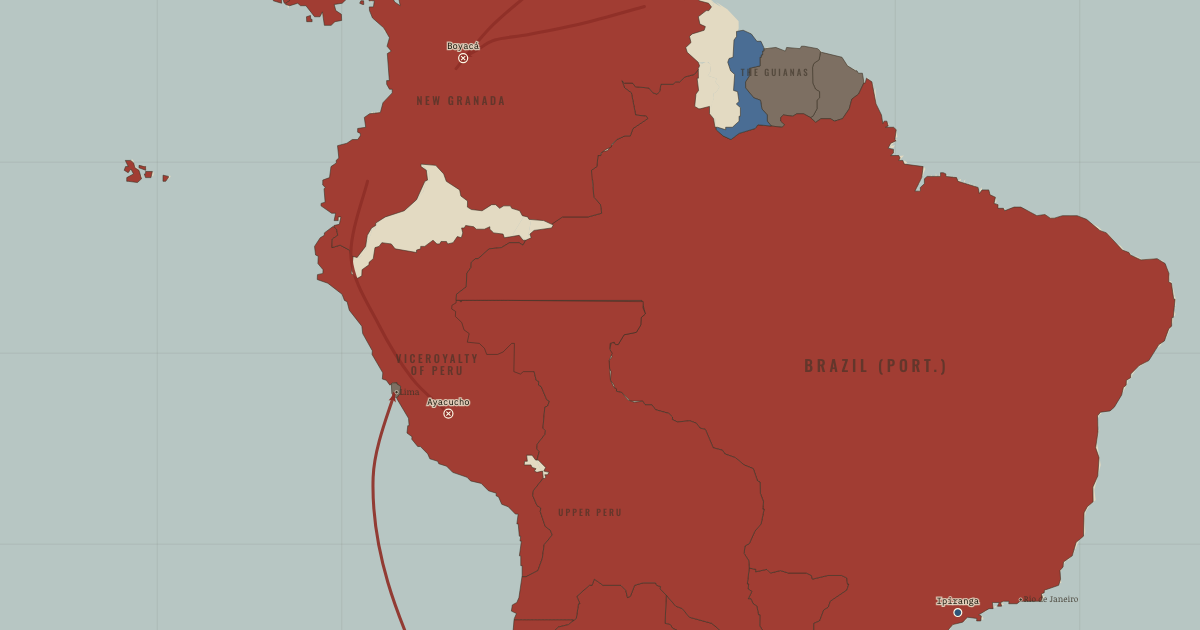
The map above is the world of The Atlantic world, December 1824 — Ayacucho: a free continent.
Every state on the map that year: The world in 1830 · Europe in 1830.
Part of IB History: The Age of Revolutions →
SHORT EXPLANATION
In 1808 Napoleon displaced Spain’s monarchy. Juntas in Spanish America claimed to preserve the captive Ferdinand VII’s sovereignty, but exercised power locally. His return and restoration of absolutism narrowed the room for compromise; reconquest pushed more moderates toward separation.
The wars followed different paths. Bolívar and San Martín traveled across plains, mountains and sea; Haitian aid carried expectations of emancipation; Mexican elites feared social revolt; and Brazil kept monarchy and slavery. Ayacucho broke Spain’s mainland field power in 1824. Independence left the new states with deep social and institutional divisions.
The full story
Napoleon’s removal of Spain’s royal family in 1808 raised a problem across the empire. If the legitimate king could not rule, who could govern in his name? Spanish American juntas formed in 1810 and often professed loyalty to Ferdinand VII. In practice they took authority locally, leaving open how that authority would be shared if the king returned.
The struggle over rule also exposed divisions within Spanish America. In Mexico, Hidalgo mobilized Indigenous and mestizo villagers. Their rising alarmed creole elites as well as royal officials, and his defeat showed that those who opposed imperial rule did not necessarily want the same social changes. Ferdinand returned in 1814, rejected constitutional rule and sent reconquest forces under Morillo. The old bargain was not restored.
After exile, Bolívar rebuilt his campaign with Haitian weapons and support and promised emancipation. He crossed flooded plains and the high Andes to win New Granada at Boyacá in 1819. Its resources helped him return to Venezuela, secured at Carabobo. From the south, San Martín crossed the Andes, liberated Chile and approached Peru by sea: a direct overland advance was impractical. He withdrew after meeting Bolívar at Guayaquil. Sucre defeated the last major royalist field army at Ayacucho in December 1824, although local conflicts continued.
The routes on the map show how hard it was to join these campaigns across mountains and long distances. Armies and governments had to operate regionally before they could overcome Spanish power. That experience helped shape what followed: commanders emerged stronger from the wars, while many regions remained weakly connected to their capitals. Removing Spanish appointment did not by itself settle borders, establish broad citizenship or provide institutions capable of containing those commanders.
Brazil’s separation took another course. The Portuguese court had moved to Rio, and Prince Pedro declared independence in 1822. Monarchy and slavery remained. Across the region, the end of colonial rule did not have a single social meaning.
FULL EXPLANATION
The king’s absence and the juntas
Spanish political thought allowed sovereignty to return to communities when their legitimate monarch was absent. Juntas could use that principle while professing loyalty to Ferdinand: they claimed to protect his rights against Napoleon. But protecting those rights required them to govern. They appointed officers, raised revenue and debated representation without the usual peninsular supervision. Local authority acquired habits and interests before its ultimate relationship to the monarchy had been settled. Ferdinand’s return made that settlement harder. He abolished the Cádiz constitution and pursued reconquest, leaving reformist autonomy difficult to reconcile with loyalty to him. The imperial center’s crisis had opened space for choices that were initially ambiguous; the attempt to restore its authority sharpened the conflict. The ensuing wars divided Americans from one another as well as setting them against European authorities.
Why so many states?
A federation needs ways to connect its regions and govern them together. British America had long-established elected assemblies and a comparatively connected Atlantic seaboard. Spanish American political centers were separated by the Andes, great river basins and immense distances, while peninsular appointees had dominated the highest offices. Years of war strengthened regional commanders and local revenue systems. Social hierarchy added another difficulty: elites who feared broad mobilization could hesitate to extend the citizenship a federation might need. These conditions did not make fragmentation inevitable. Gran Colombia and other unions were serious attempts to hold regions together, and the United States’ union faced dangers of its own. Brazil retained territorial unity under a monarchy, with slavery and concentrated power among its costs. The comparison is most useful when it follows inherited institutions, geography and the form of war, rather than assigning civic virtues or defects to entire populations.
Key places on the map
On this day
Why it happened
A crisis at the imperial center. The first crisis was in Spain itself: the king was captive and the country a battlefield. Juntas claimed to be “conserving sovereignty for Ferdinand” while making decisions locally. That claim let them exercise power without yet declaring independence. Ferdinand’s absolutist restoration made it harder to accommodate those practices. A dispute over who could govern for the king became a struggle over whether his American subjects should remain under his rule.
Creole grievances and divided aims. American-born elites had grievances against an imperial system in which peninsular Spaniards held prominent high offices. Ideas associated with 1776 and Cádiz also circulated among them. Yet many elites feared what might happen if Indigenous, mestizo and enslaved people mobilized for change of their own. Hidalgo’s rising exposed that fear; Peru’s elites had reasons to prefer royal protection to social upheaval. Independence and social revolution could therefore pull apart. Bolívar’s emancipation and Indian-tribute measures, encouraged by Haitian support, attempted to bring them together.
Riego’s mutiny. An expedition was assembling at Cádiz to fight Buenos Aires when Colonel Riego led a mutiny in January 1820. The force did not sail. Its revolt began Spain’s liberal revolution: the American war had helped bring about a crisis in Spain, and that crisis in turn changed the course of the war across the Atlantic.
British interests and American campaigns. British merchants saw opportunities in American markets. They supplied weapons and bought early republican bonds; British volunteers also fought, including the British Legion at Boyacá and Carabobo. British naval power discouraged European reconquest. Canning later boasted, “I called the New World into existence to redress the balance of the Old”. The boast tells us about British policy, though it gives Britain more credit than it can claim for independence.
THE TURNING POINT
Ayacucho, 9 December 1824. On the high Andean plateau of Ayacucho on 9 December 1824, Sucre, aged 29, commanded an army commonly estimated at 5,800 against about 9,300 royalists. The viceroy was wounded and captured, and that evening a capitulation provided for the surrender of the remaining royalist forces. Some garrisons resisted afterward, but Spain’s last major mainland field army had been broken. Several officers on opposite sides had trained together. The victors now faced a question on which they disagreed: what was independence for?
What it changed
Republics and regional commanders. By 1830 Gran Colombia had broken into Venezuela, New Granada and Ecuador. Near the end of his life that year, Bolívar wrote, “I have ploughed the sea,”. The wars had strengthened local commanders in militarized provinces. Independence could be proclaimed, but governing those regions together required institutions that a proclamation could not immediately supply. Authority remained the subject of a long struggle.
The Monroe Doctrine and British power. Washington declared the Americas closed to new European colonization in the Monroe Doctrine of 1823. British naval power also discouraged European intervention, in pursuit of Britain’s own interests. New commercial relationships followed independence: British loans, cloth and later railways brought finance and trade, while also creating possibilities for economic dependence. Freedom to seek finance left the terms of that finance to be negotiated.
Slavery ended unevenly. Emancipation followed different paths. Chile abolished slavery in 1823, Central America in 1824 and Mexico in 1829. Military service could bring freedom, and Bolívar acted imperfectly on his promise to Pétion. Brazil retained slavery, while Cuba’s sugar economy expanded under Spanish rule. Cuban planters’ fear of “another Haiti” helped keep them loyal to Spain, which ruled the island until 1898.
Losses for Spain and Portugal. Spain lost access to American resources, including silver, that had supported its power for centuries. Foreign intervention and the Carlist wars followed in Spain. Portugal, too, lost a major source of wealth with Brazil’s independence. Changes beyond Europe thus altered the position of powers whose European boundaries had been negotiated at Vienna.
DISCUSSION QUESTION — Same age, same Enlightenment, similar wars — why did British America produce one durable federation and Spanish America a dozen fragile republics?
Institutions, geography and the wars themselves explain more than cultural stereotypes. British colonies had long practiced elected government and were linked along an Atlantic coast. Spanish American centers lay far apart, and peninsular appointees had dominated their highest offices. Long civil wars strengthened regional commanders, while social divisions made many elites wary of broad participation. None of these conditions made division inevitable: Gran Colombia was a serious union, the United States was itself fragile, and Brazil remained united partly under a monarchy that preserved slavery and concentrated power.
An interesting fact
Bolívar inherited a great Caracas fortune, including cacao plantations, mines and town houses, and spent much of it during the wars. He died near Santa Marta in December 1830, aged forty-seven and traveling toward exile. The story of his burial in a borrowed shirt became a powerful image of his poverty. Venezuela brought his remains home in 1842; they were later placed in the Panteón Nacional, established in 1876. The honors after his death contrasted sharply with his difficult final years.
Related
THE FREE PRINTABLE STUDY GUIDE
Get the printable study guide for The Age of Revolutions free. I’ll send you a few short letters, then one when a new atlas opens. That’s all. — Paul
NO TRACKING · YOUR ADDRESS IS USED FOR THE DISPATCH AND NOTHING ELSE · UNSUBSCRIBE ANYTIME