MAPS OF HISTORY · THE QUESTIONS · Same age, same Enlightenment, similar wars —…
The Age of Revolutions, 1775–1848 · DEC 1824
Same age, same Enlightenment, similar wars — why did British America produce one durable federation and Spanish America a dozen fragile republics?
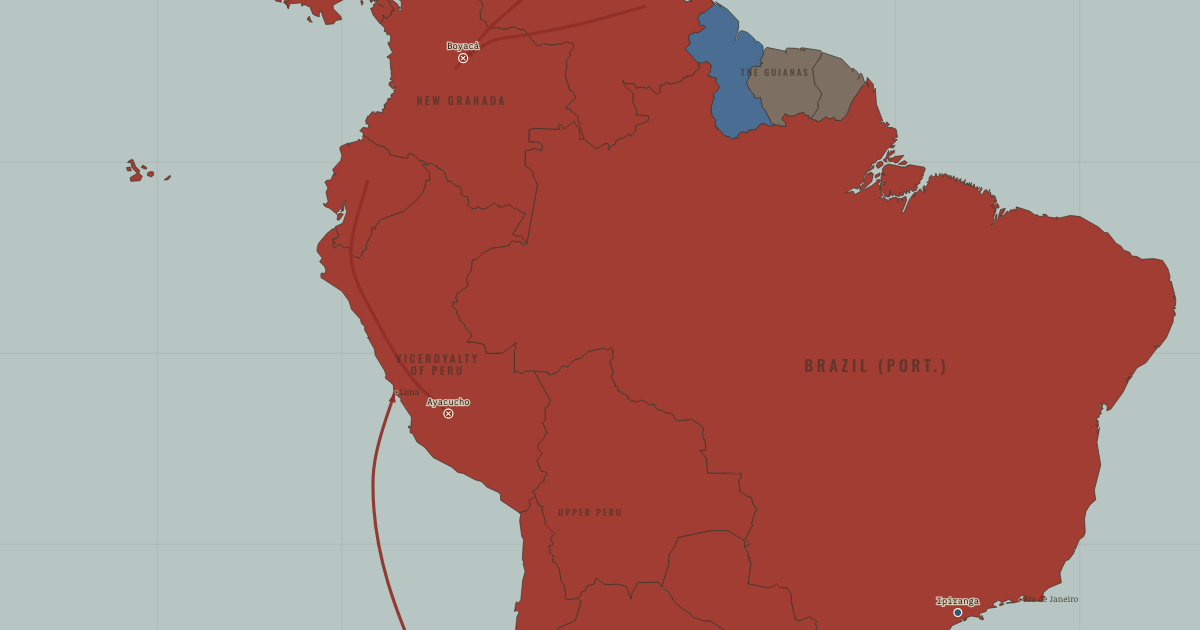
When Napoleon forced Spain’s royal family from power, Spanish American cities asked who held legitimate authority. Juntas formed in 1810, often claiming loyalty to Ferdinand VII while governing locally. In Mexico, Hidalgo mobilized Indigenous and mestizo villagers, which frightened creole elites as much as royal officials. His defeat showed that independence and social revolution could pull in different directions. Ferdinand’s return in 1814 did not restore the old bargain; he rejected constitutional rule and sent reconquest forces under Morillo.
THE SHORT ANSWER
- The metropole vanished first. Unlike 1776, the crisis began at the imperial center: with the king captive and Spain itself a battlefield, loyalty had no address. The juntas’ constitutional fiction — “conserving sovereignty for Ferdinand” — let self-rule grow behind a loyal mask; Ferdinand’s absolutist restoration then forced everyone to choose. Empires are most brittle not when colonies grow strong but when the metropole’s legitimacy machinery jams.
- Creole grievance, plural revolutions. American-born elites had wealth without office (peninsulares monopolized posts) and Enlightenment libraries without political rights — 1776 and Cádiz both circulated widely. But name the divisions honestly: creole revolutions feared their own Indigenous, mestizo and enslaved majorities (Hidalgo’s fate proves it), and Peru stayed royalist longest partly because its elite preferred Spanish garrisons to social revolt. Independence and social revolution were rival projects wearing one banner — Bolívar’s emancipation decrees and Indian-tribute abolitions were the exception Haitian aid had priced in.
- Riego’s mutiny: the reconquest that never sailed. In January 1820 the great expedition assembling at Cádiz to crush Buenos Aires mutinied under Colonel Riego rather than embark — igniting Spain’s liberal revolution (Chapter 11) and cancelling the counter-offensive at a stroke. Spanish liberalism and American independence saved each other without meaning to; watch the same three years doom Spain’s liberals at home.
- British interest, quietly decisive. Britain wanted markets, not colonies: its navy discouraged reconquest convoys, its ports sold the muskets, its volunteers (the British Legion at Boyacá and Carabobo) filled the line, and its merchants bought the new republics’ first bonds. Canning’s boast — “I called the New World into existence to redress the balance of the Old” — overstates the credit but names the policy exactly.
THE TURN
Ayacucho, 9 December 1824. Sucre, 29 years old, outnumbered 9,300 to 5,800 on a plateau higher than any European battlefield, destroys the Viceroy’s army in an afternoon — the viceroy himself wounded and captured. The capitulation signed that evening surrenders not a fortress but a hemisphere: every remaining royalist garrison on the mainland is ordered home. Three centuries of empire end with courtesies exchanged between creole generals who had, in several cases, been cadets together. The turn worth marking: after Ayacucho the question is no longer independence but what independence is for — and on that, the victors do not agree.
WHAT IT CHANGED
Republics on paper, caudillos in practice. Bolívar’s Gran Colombia fractures into Venezuela, New Granada and Ecuador by 1830 (“I have ploughed the sea,” he writes, dying, that year); war-made local strongmen inherit provinces the wars had militarized. Three centuries of exclusion from self-government could not be undone by proclamation — the institutional deficit, not the independence, set the next century’s politics.
The Monroe Doctrine and the British fleet. Washington’s 1823 declaration — the Americas closed to new European colonization — is famous; the enforcement mechanism was the Royal Navy, protecting its new trade. Latin America exited Spanish monopoly into British economic orbit: loans, railways, cloth, and the century-long pattern where political independence and economic dependence arrive together. Ask of every liberation: who financed it, and what did the financier buy?
Slavery’s uneven endings. The wars begin abolition’s ledger: Chile 1823, Central America 1824, Mexico 1829 — armies had freed slaves who enlisted, and Bolívar kept (imperfectly) his promise to Pétion. But Brazil’s slave empire and Spanish Cuba’s sugar boom absorb the trade the others abandon; Cuba, kept loyal partly by planters’ fear of “another Haiti,” remains Spain’s until 1898. The age’s emancipations trace exactly the map of where the enslaved could bargain.
Spain hollowed, Portugal halved. Losing the Americas removes the silver that had made Madrid a great power for three centuries; Spain spends the century fighting itself (Chapter 11’s intervention, then the Carlist wars). Portugal, poorer still without Brazil, follows. Vienna’s map of Europe quietly assumed empires that this chapter deleted.
THE FULL ANSWER, ARGUED
The strongest explanation is structural. British colonies had practiced elected government for generations and were linked along one coast; Spanish American regions were separated by enormous distances and had fewer incumbent representative institutions. Longer civil wars empowered regional military leaders, while caste conflict made elites wary of broad participation. The United States was not automatically stable, and Brazil stayed united partly by retaining monarchy. Continuity of institutions, geography and the form of war explain more than cultural stereotypes.
AN INTERESTING FACT
Bolívar was born one of the richest heirs in the Americas — a Caracas fortune of cacao plantations, mines and town houses three centuries in the making — and the wars consumed nearly all of it. When he died near Santa Marta in December 1830, aged forty-seven and en route to self-imposed exile, he was buried in a borrowed shirt; his physician recorded that the Liberator of six nations no longer owned a decent one. Venezuela brought his remains home in triumph in 1842, and in 1876 built the Panteón Nacional around them — the age’s arc from renunciation to altar in a single biography.
This is the study layer of Chapter 10 — Latin America Breaks Free in The Age of Revolutions, 1775–1848; the full index of the atlas is here.
SEE IT MOVE ON THE INTERACTIVE MAP →New here? Chapters 1–2 of every atlas are free to sample, and the WW2 atlas is free in full. One membership opens all thirteen — the Cartographer’s Circle.
MORE QUESTIONS FROM THE AGE OF REVOLUTIONS
THE DISPATCH
One short letter when a new atlas opens — and the printable study guide for The Age of Revolutions is yours now, free.
NO TRACKING · YOUR ADDRESS IS USED FOR THE DISPATCH AND NOTHING ELSE · UNSUBSCRIBE ANYTIME