MAPS OF HISTORY · The Mongol Empire · ALL CHAPTERS · CHAPTER 4
CHAPTER 4 · 1218–1223 · 1222
The Khwarazm Catastrophe
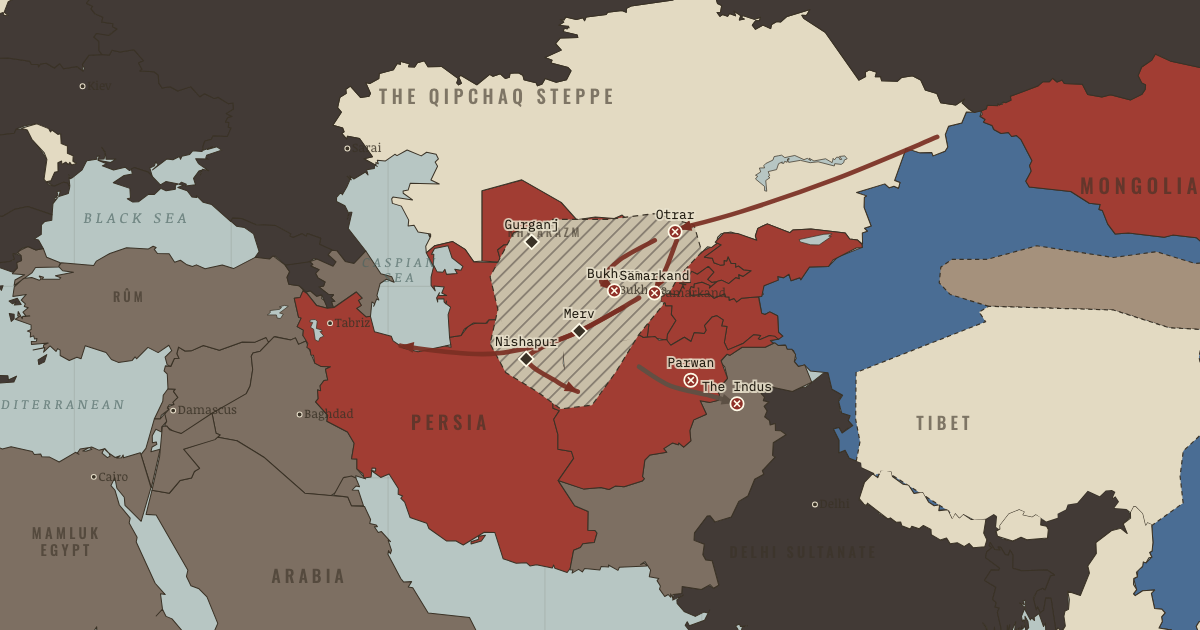
The map above is the world of 1221 — Khwarazm annihilated.
BRIEF EXPLANATION — THE ESSENTIAL ARGUMENT
The war against Khwarazm began with a diplomatic outrage that fell on an already unstable relationship. Officials at the border town of Otrar seized a Mongol trade caravan, and Shah Muhammad then killed or humiliated the envoys sent to demand redress. The insult was serious in a world where envoys were protected, but it struck a relationship already strained by trade, security and rival imperial ambition, which is why a single incident could unleash a full war.
From 1219 Mongol columns advanced along routes the shah had thought impassable and reduced his separated garrisons one at a time. Resistance was answered with deliberate mass killing and deportation. Medieval casualty totals are frequently impossible to credit, yet archaeology confirms severe destruction across parts of Central Asia and Khorasan. The campaign destroyed a major state and devastated communities whose recovery varied enormously from place to place.
GUIDED EXPLANATION
The immediate cause was the fate of a Mongol caravan that reached Otrar in 1218, whose governor, Inalchuq, accused the merchants of spying, confiscated their goods and killed almost all of them. When Chinggis Khan demanded punishment, Shah Muhammad refused and executed the senior envoy, an act that violated the protected status envoys held in steppe diplomacy. That refusal turned a tense commercial relationship into open war, though the Mongols’ appetite for secure trade routes and the visible weakness of Khwarazm also shaped the decision to invade.
The campaign’s method is written in the arrows. Mongol armies converged from several directions, and one crossed the Kyzylkum desert to appear behind Bukhara, while the shah, distrusting his own commanders, had scattered his forces among the cities and so could never assemble a united field army. Otrar, Bukhara, Samarkand and Urgench fell in turn, and later columns devastated Merv, Nishapur and other centres. Terror was used deliberately, because quick surrender could bring survival under taxation while resistance or revolt brought exemplary slaughter. Chroniclers’ totals are exaggerated and cannot be treated as statistics, but the scale of the destruction is not in doubt, and the escaped prince Jalal al-Din won at Parwan only to be crushed at the Indus, leaving no durable centre of resistance.
The hatched belt on the map records uneven devastation rather than a uniformly empty zone, since some cities and irrigation systems recovered while others lost population and importance for generations. Because the sources routinely convert slaughter into vast round numbers, exact totals stay uncertain, yet the policy behind them is clearer than the count. Violence served as communication, announcing terms to places not yet attacked, and from the conquerors’ standpoint it could shorten later sieges while forcing civilians to pay for decisions made by their rulers and garrisons. Explaining that grim calculation in no way softens the atrocity.
DEEP EXPLANATION — EVIDENCE & INTERPRETATION
Otrar: cause, trigger and justification
The sources agree that the caravan and the envoys were attacked, but the motives behind the attack remain uncertain. The caravan may have carried intelligence, as merchant parties often did, though that would not make the killing of accredited envoys either normal or wise. Mongol accounts present Otrar as a moral justification for overwhelming punishment, while Persian narratives written later under Mongol rule also had reasons to explain the catastrophe through the shah’s failings, so historians separate the trigger from the structure. Chinggis Khan wanted secure commerce and submission on his frontier, and Khwarazm was rich, recently assembled and internally divided. Otrar made the war legitimate within Mongol political language; it did not by itself create the capacity or the strategic interest that made conquest possible. The map records the result. Historical explanation must also keep institutions, environmental limits and decisions visible, because none of those forces worked alone.
How to read the massacre figures
Medieval authors report hundreds of thousands, or even more than a million, deaths at single cities, and such totals exceed plausible populations because numerical scale was often a way of expressing moral catastrophe. Rejecting the numbers must never become a rejection of the atrocity itself. Archaeological abandonment, damaged irrigation, disrupted settlement and multiple independent narratives together demonstrate extensive killing and displacement, even though the impact differed by region and some cities recovered. Mongol violence also followed a communicative logic, punishing resistance so that later places would surrender cheaply, and describing that mechanism explains the policy without excusing it. The tradeoff was calculated by conquerors and imposed on civilians who had little control over their governors, so honest analysis has to keep agency and suffering in the same account. That distinction prevents a visible event from becoming a single-cause story. Outcomes emerged through interacting political, material and human constraints over time.
New here? Chapters 1–2 of every atlas are free to sample, and the WW2 atlas is free in full. One membership opens all thirteen — the Cartographer’s Circle.
THE SITES
WHY IT HAPPENED
The murdered caravan — spark, not cause. The insult was real: in Mongol law envoys were inviolable, and the shah doubled the offense knowingly. But sparks need powder. Genghis needed the trade the shah strangled, needed victory’s momentum to feed the new state, and can hardly have missed that Khwarazm — rich, newly assembled, badly led — was the next logical acquisition. Treat “the caravan caused the war” the way you treat any single-cause story on this map: as the visible trigger of a loaded mechanism.
An empire with no skeleton. Khwarazm was a conquest-in-progress: the shah had seized Transoxiana and Persia within living memory, feuded with the caliph in Baghdad (who may have quietly welcomed his ruin), and distrusted his own Qipchaq generals — his mother’s clan — so deeply that he refused to concentrate an army someone else might command. Numbers on paper, 400,000 against perhaps 150,000, meant nothing: the Mongols fought one battle at a time against a state that had pre-divided itself.
Terror as doctrine. The massacres were policy, not frenzy: cities that surrendered instantly were mostly spared and taxed; cities that resisted, or worse, submitted and rebelled, were made into messages — artisans deported east, the rest killed, a minaret left standing to tell the story. It was economical by its own hideous logic (the next ten cities open their gates), and the Mongols advertised it deliberately. Name it what the evidence shows: calculated, communicative atrocity — and weigh that against every administrative achievement in Chapter 7.
Speed as strategic surprise. The shah planned against raiders who would come in summer, through the front door, and leave. Instead: winter marches, a desert crossing, five armies converging on a schedule, and — after his flight — Jebe and Subötai detached with 20,000 men for the sole purpose of hunting one man across Persia. The pursuit itself (follow the arrow west) announces a new kind of enemy: one for whom no distance is sanctuary.
THE TURN
Bukhara, February 1220. Strategically, the desert crossing that puts Genghis behind the shah’s lines unhinges the whole defense — every garrison east of it is instantly cut off. Symbolically, the pulpit speech does more: “I am the punishment of God” reframes the war, for both sides, as cosmic judgment on a sinful age. Persian chroniclers largely accepted the frame — it explained the inexplicable — and through them it governed how Islam remembered, and dreaded, the Mongols for a century.
WHAT IT CHANGED
A civilization’s lights go out. Khorasan and Transoxiana had been Islam’s intellectual engine — the world of al-Khwarizmi, Avicenna, Omar Khayyam. The sacked belt on your map marks libraries, observatories and the ulama of a dozen cities destroyed or scattered in four years. Persian culture survives — it will even capture its conquerors (Ch. 9) — but the region’s primacy never returns. Some historians read the later drift of Islamic science partly from this wound; others call that too neat. The debate is live; the loss is not.
The door to the west swings open. Khwarazm was the wall between the steppe and everything west of it. With the wall gone, Jebe and Subötai’s pursuit rolls on into a reconnaissance that will map the Caucasus and the Rus for the next generation (Ch. 5), and the Qipchaq steppe becomes Mongol pasture — the launch-ramp of 1236.
Jalal al-Din’s decade of aftershock. The escaped prince raises new armies in Persia and the Caucasus, wins, loses, and in wrecking Georgia’s army (1225) unwittingly clears the Mongols’ future path. His career proves both points at once: the Mongols could be fought — and no one could fight the Mongols and his neighbors at the same time. He dies obscurely in 1231; resistance dies of disunity, not despair.
The template for Baghdad. Everything Hülegü does in 1258 (Ch. 8) — the converging columns, the offer, the annihilation after refusal — is this campaign re-run. States on the target list had thirty years to study the pattern. Ask, when you reach Chapter 8, why so few did.
FIELD QUESTION — Shah Muhammad commanded perhaps double or triple the Mongols’ numbers, behind deserts and walled cities. Construct the best argument that his defeat was decided before the first battle.
Khwarazm’s numbers were fragmented by mistrust. Shah Muhammad distributed troops among garrisons because concentrating them under one commander threatened his own power. Mongol columns then crossed routes he considered unlikely and reduced those garrisons in sequence. Better intelligence and faster coordination widened the gap. Otrar started the conflict, but the state’s weak internal trust determined how the war unfolded.
AN INTERESTING FACT
The leap at the Indus has witnesses of a kind: Jalal al-Din’s own secretary al-Nasawi and the Persian historian Juvayni both record that Genghis, watching the prince spur his horse off the bank in armor and swim the river under fire, held his men back and told his sons, “Such a son must a father have.” Handle the quotation with care — Juvayni wrote for Mongol patrons, Nasawi for his defeated master, and each had reasons to polish the scene. But the afterlife is documented: Nasawi wrote the prince a full biography within a decade of his death, and the leap became the era’s emblem of honor salvaged from catastrophe — admired, tellingly, on both sides of the war.
THE DISPATCH
One short letter when a new atlas opens — and the printable study guide for The Mongol Empire is yours now, free.
NO TRACKING · YOUR ADDRESS IS USED FOR THE DISPATCH AND NOTHING ELSE · UNSUBSCRIBE ANYTIME