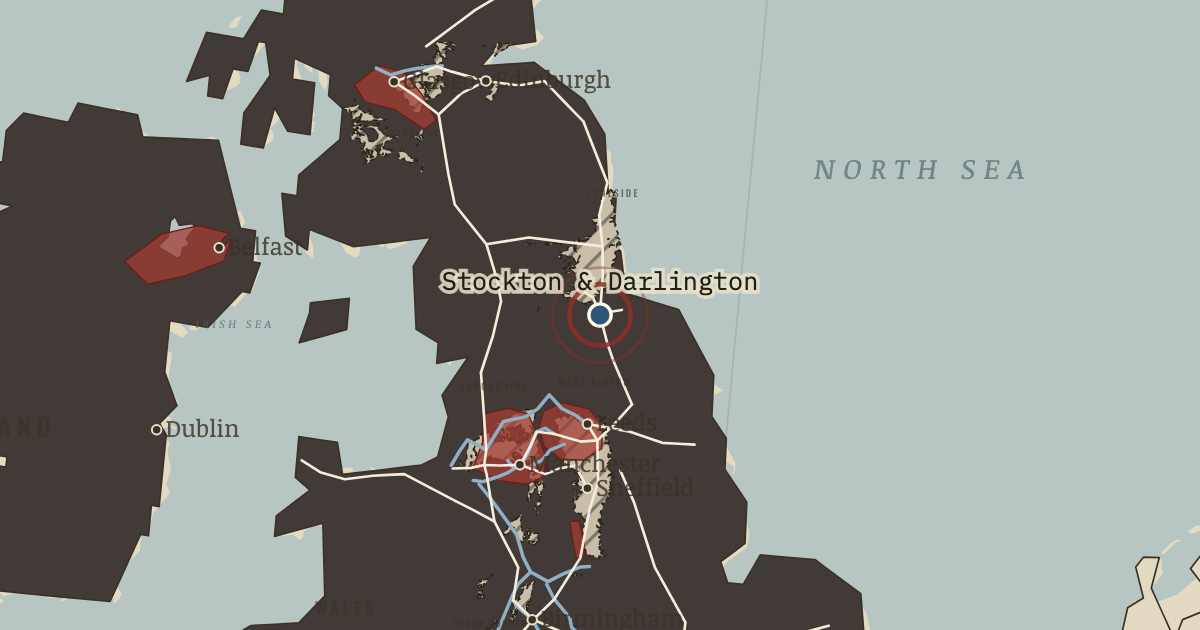
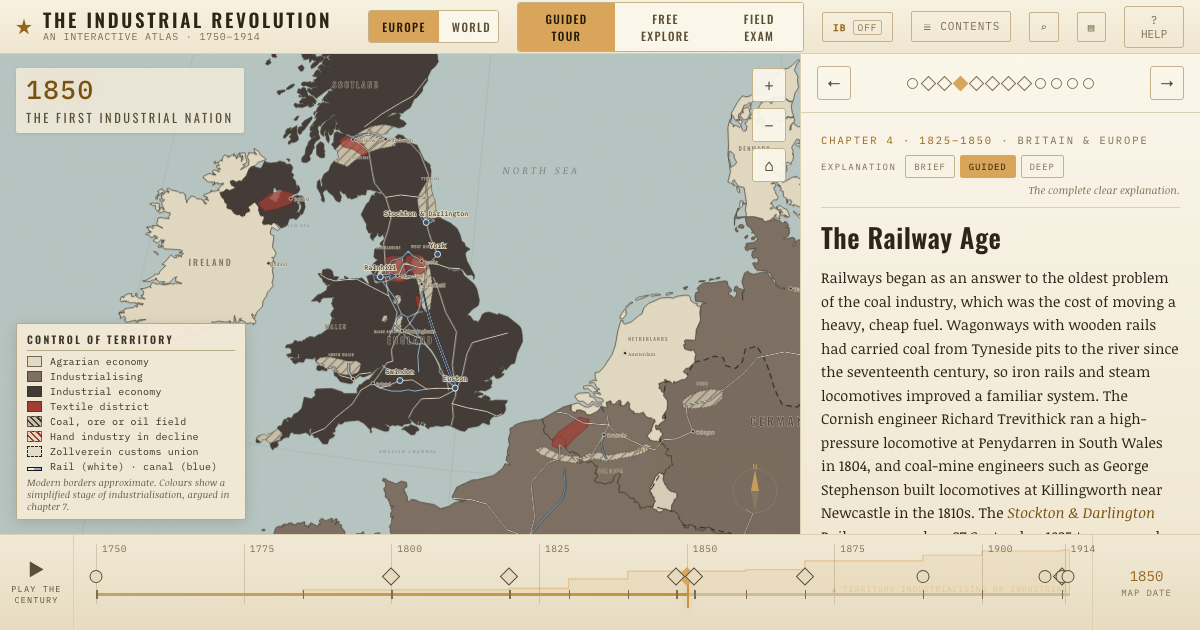
27 Sep 1825 — George Stephenson’s Locomotion No. 1 pulls coal wagons and a passenger coach from Shildon, through Darlington, to Stockton. The railway is built first to serve a colliery, and it becomes the world’s first public steam railway.
WW2 is free in full, and chapter 1 of every atlas is free. A free account opens 3 more chapters a day. Starter, at $9 a month, opens all 21 with no daily limit — see the plans.
27 SEPTEMBER 1825 · THE INDUSTRIAL REVOLUTION, 1750–1914
The moment in context
A coal owner could sell fuel cheaply at the pit and still face a large transport bill. Tyneside mines had dealt with the problem since the seventeenth century by sending wagons to the river on wooden rails. Iron rails improved the wagonway; steam offered a way to move the wagons themselves. Richard Trevithick ran a high-pressure locomotive at Penydarren in South Wales in 1804, and in the 1810s colliery engineers including George Stephenson built locomotives at Killingworth near Newcastle.
Why it happened — Coal needed cheaper carriage. Coal’s low price made carriage a large part of its cost; moving it often cost more than mining it. For two centuries collieries, or coal mines, had…
The turn — Rainhill, October 1829. The Liverpool & Manchester directors considered two ways to haul their trains: fixed engines pulling cables, or locomotives traveling with the…
What it changed — A national market and national time. A railway could take coal, cloth, fish, milk and newspapers across the country overnight. Goods could reach more buyers, prices converged and local…
Get the printable study guide for The Industrial Revolution free. I’ll send you a few short letters, then one when a new atlas opens. That’s all. — Paul
NO TRACKING · YOUR ADDRESS IS USED FOR THE DISPATCH AND NOTHING ELSE ·
UNSUBSCRIBE ANYTIME