MAPS OF HISTORY · The Crusades · ALL CHAPTERS · CHAPTER 2
CHAPTER 2 · 1096–1099 · 1099
The First Crusade
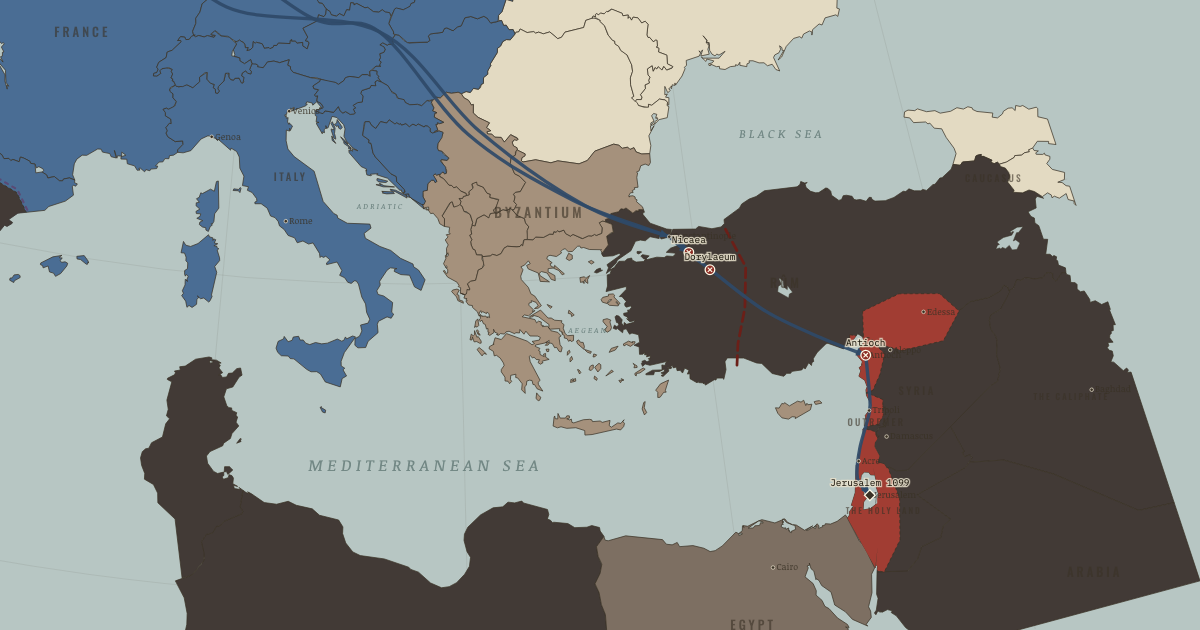
The map above is the world of 1099 — The four states appear.
BRIEF EXPLANATION — THE ESSENTIAL ARGUMENT
The First Crusade is remembered for taking Jerusalem, but its first violence fell on Jews in the Rhineland, and that killing belongs at the start of the story rather than hidden within it. As the expedition gathered in 1096, armed bands moving down the Rhine turned on the Jewish communities of Speyer, Worms and Mainz, murdering thousands who refused baptism. These people were not combatants, and the episode is marked here as an atrocity and mourned as such. The disorganized popular bands known as the People’s Crusade then pressed on ahead of the lords and were destroyed by the Turks near Nicaea.
The princely armies that followed were better led and better supplied, crossing into Asia with Byzantine transport and markets behind them. They survived a desperate siege at Antioch and stormed Jerusalem in 1099, massacring many of its Muslim and Jewish inhabitants. Out of these conquests came four Latin states strung along the Levant coast, known together as Outremer, “the land beyond the sea.” Their creation was an extraordinary feat, yet it depended above all on the political division of their enemies, a condition that later expeditions would not find waiting for them.
GUIDED EXPLANATION
The crusade drew its first blood in Europe, against Europeans, and the reason lay in the logic of the summons itself. Preachers had told ordinary men that they were marching to fight the enemies of Christ, and some asked why they should travel so far to do so while Jews lived in their own towns. In the spring of 1096 bands moving through the Rhineland attacked the Jewish communities of Speyer, Worms and Mainz, killing thousands who would not accept baptism, sometimes as local bishops tried and failed to shelter them. Explaining how a licence for distant holy war was turned against vulnerable neighbours does not excuse it, and these communities are remembered here as victims rather than as a prelude to adventure. The undisciplined People’s Crusade that ran ahead of the lords was then annihilated by the Turks near Nicaea.
The armies of the princes were a different force, and their success depended on help that later legend often forgot. Emperor Alexios ferried them across to Anatolia, guided them and kept them supplied, while Genoese and Pisan ships later brought the timber and food that made the great sieges possible. Nicaea fell in 1097 but surrendered to the Byzantines by a private arrangement, cheating the crusaders of plunder and planting an early distrust of the Greeks that would matter for a century. The turning point came at Antioch, where eight months of starvation outside the walls were followed, within days of the city’s capture, by a second siege that trapped the crusaders inside it as Kerbogha’s far larger relief army arrived. They survived a battle at Dorylaeum on the way and broke out at Antioch chiefly because Kerbogha’s emirs would not trust one another enough to fight as one.
On 15 July 1099 the crusaders stormed Jerusalem and killed many of its Muslim and Jewish inhabitants; the later claim that blood ran as high as the horses’ bridles borrows biblical imagery and is not a literal measurement, though the massacre itself is beyond doubt and is recorded here soberly. The conquest produced the four states of Outremer, but the victory had rested on a combination that did not repeat, because the Seljuks were fighting one another, Fatimid Egypt had just retaken Jerusalem and treated the newcomers as a possible counterweight, and Kerbogha’s coalition had failed to hold together. The new states were therefore born with two weaknesses built in from the start. There were far too few settlers to hold a long frontier, and the relationship with Byzantium, which linked them to Europe by land, had already soured when crusader lords kept the cities they had sworn to return. Their success created possessions without creating any stable means of defending them.
DEEP EXPLANATION — EVIDENCE & INTERPRETATION
The First Victims
The attacks of 1096 on the Jewish communities of Speyer, Worms, Mainz and other Rhineland towns are documented from several directions at once, in Hebrew chronicles, Latin accounts and legal records that differ in detail but agree on organized killing, forced conversion and, in some communities, suicide under the threat of it. Local bishops occasionally tried to protect Jewish residents, and their protection often failed. The violence grew out of anti-Jewish preaching, resentment of debt and the lure of plunder, but it also grew out of a crusading logic that asked why distant enemies of Christ should be fought while unbelievers lived close at hand. Naming that mechanism is not the same as excusing it. These people were not soldiers, and the episode should never be read as a rehearsal for the eastern campaign, because what it actually shows is how easily a moral licence for war far away could be redirected against defenceless neighbours. The memory of these killings became a foundational trauma in Ashkenazi Jewish history.
Why 1099 Was Not a Formula
The First Crusade succeeded through a coincidence of favourable conditions that never lined up again. Seljuk succession disputes had divided both Syria and Anatolia; Fatimid Egypt retook Jerusalem from the Seljuks in 1098 and at first treated the Franks as one more possible counterweight against its Sunni rivals; and Kerbogha’s coalition at Antioch collapsed for want of trust. Behind the fighting stood Byzantine transport and supply, together with Italian shipping, propping up an expedition that was later remembered as if it had been self-sufficient. Crusader belief and endurance were real and mattered, but morale cannot explain why the opposing armies repeatedly failed to combine. Later generations read 1099 as proof that purity and faith guaranteed victory, and then blamed sin whenever a subsequent crusade failed. That reading mistook a narrow and temporary strategic window for a religious formula that could be used again, and false lessons drawn from success often prove more durable than careful lessons drawn from defeat.
New here? Chapters 1–2 of every atlas are free to sample, and the WW2 atlas is free in full. One membership opens all thirteen — the Cartographer’s Circle.
THE SITES
ON THIS DAY
WHY IT HAPPENED
Muslim disunity, above all. No coordinated defence met the crusade because there was no “Islam” to mount one. Seljuk heirs fought each other; the Fatimids of Egypt actually retook Jerusalem from the Seljuks in 1098, seeing the Franks as a useful counterweight; individual emirs sold the crusaders supplies. The First Crusade succeeded largely because it arrived in the one narrow window when its enemies were too fractured to unite against it.
Byzantine logistics and Italian fleets. For all the distrust, Alexios ferried the armies across, fed them, and guided them; and Genoese and Pisan ships brought the timber, food and siege engines without which Antioch and Jerusalem could not have been taken. The “miracle” ran on Greek grain and Italian keels.
Zeal and the refusal to turn back. A self-selected army convinced it was doing God’s work endured losses — starvation, disease, desertion — that would have broken a normal force. The Holy Lance episode, whatever one makes of it, shows how morale and belief substituted for the supply and command structure the crusade never had.
THE TURN
Antioch, June 1098 — the siege within a siege. This is the hinge of the whole expedition. Having barely taken Antioch after eight months, the crusaders are instantly besieged inside it, starving, with Kerbogha’s far larger army outside. That they broke out and won owed everything to the disunity of Kerbogha’s own emirs, who would not fight wholeheartedly for a rival. The pattern of 1099 in miniature: the crusaders win when Islam cannot combine.
WHAT IT CHANGED
Four states are born. Edessa (1098), Antioch (1098), Jerusalem (1099) and Tripoli (consolidated by 1109) — the red littoral on your map, “Outremer,” the land beyond the sea. How a few thousand settlers governed it is the next chapter.
An impossible standard. The “miracle” of 1099 became the measure against which every later crusade was judged — and by which every later crusade failed. Contemporaries could not see that success had depended on a fleeting condition; they concluded that failure must mean sin. That misreading shaped two centuries.
The Greek rupture deepens. Bohemond kept Antioch for himself in defiance of his oath to Alexios, and Latin-Byzantine relations soured from triumph into grievance. The mistrust seeded here will help point a later crusade at Constantinople itself.
A memory of blood. The massacre of 1099 entered Muslim memory slowly but permanently, and became a recruiting argument for the counter-crusade. Atrocity is not only a moral fact; it is a strategic one, remembered and repaid.
FIELD QUESTION — Why did the First Crusade succeed when every later crusade failed?
Because it caught its enemies at their most divided, and its enemies never allowed that again. In 1097–99 the Islamic Near East was fractured between Seljuk heirs, Syrian emirs and the Fatimids, none of whom would combine against the newcomers. The crusade also enjoyed surprise (no one had faced anything like it) and a Byzantine ally still willing to help. Every later crusade faced a Muslim world moving, fitfully but cumulatively, toward unity — Zengi, then Nur al-Din, then Saladin, then the Mamluks. Once the target could concentrate its far greater resources, the crusaders’ strategic problem — too few men, too far from home, ringed by a larger power — became insoluble. The First Crusade did not reveal a formula; it exploited a moment.
AN INTERESTING FACT
The Holy Lance had an epilogue the story usually omits. Doubt about the relic grew — the papal legate Adhémar had been sceptical from the first — and in April 1099, at Arqa, its discoverer Peter Bartholomew offered to prove it by ordeal, walking through a lane of burning wood with the Lance in his hands. He died of his burns within a fortnight; even Raymond of Aguilers, the partisan chronicler who believed in him utterly, could not write the injuries away. The belief that carried the army through Antioch was tested, literally, by fire — and the man at its centre did not survive the test.
THE DISPATCH
One short letter when a new atlas opens — and the printable study guide for The Crusades is yours now, free.
NO TRACKING · YOUR ADDRESS IS USED FOR THE DISPATCH AND NOTHING ELSE · UNSUBSCRIBE ANYTIME