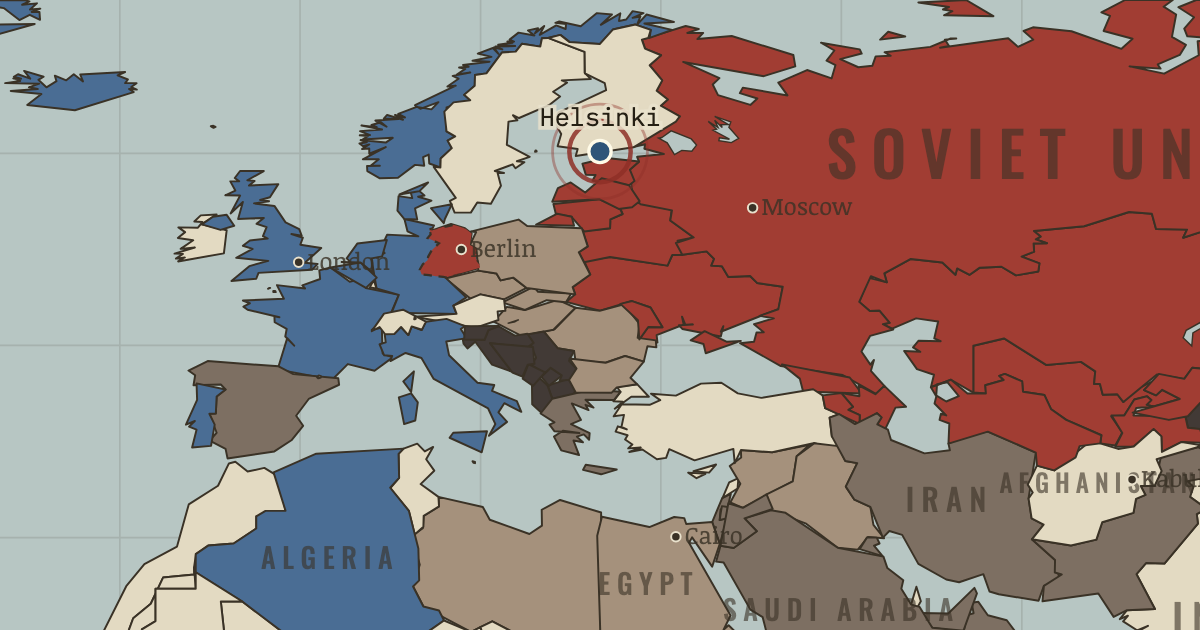
1 Aug 1975 — Thirty-five states ratify Europe’s postwar borders, giving Moscow a prize it has sought. In exchange, they make the “Basket III” human-rights pledges. Moscow regards those promises as decoration, but dissidents will insist that the government honor their words.
WW2 is free in full, and chapter 1 of every atlas is free. A free account opens 3 more chapters a day. Starter, at $9 a month, opens all 21 with no daily limit — see the plans.
The communist alliance had already broken apart before Washington tried to use the division. Moscow withdrew nuclear assistance in 1959; Khrushchev’s de-Stalinization indirectly challenged Mao’s cult, and Beijing condemned the Soviet retreat in Cuba as “capitulationism.” Behind these disputes was a question neither government was willing to leave to the other: who should lead world revolution? In 1969 Soviet and Chinese troops fought on the Ussuri. The communist “monolith” that Washington had spent two decades containing had become two hostile powers.
Why it happened — The split that made the triangle possible. The alliance’s collapse had several causes. Khrushchev’s de-Stalinization undermined Mao’s cult indirectly, the Soviet withdrawal of nuclear…
The turn — Beijing and Shanghai, 21–28 February 1972. Nixon’s visit to Beijing and Shanghai on 21–28 February 1972 became known as “The week that changed the world.” Its effect lay in the choices it…
What it changed — Helsinki’s slow fuse. Helsinki’s rights provisions gave dissidents a standard their governments had publicly accepted. The Moscow Helsinki Group formed in 1976, with…