ON THIS DAY ·
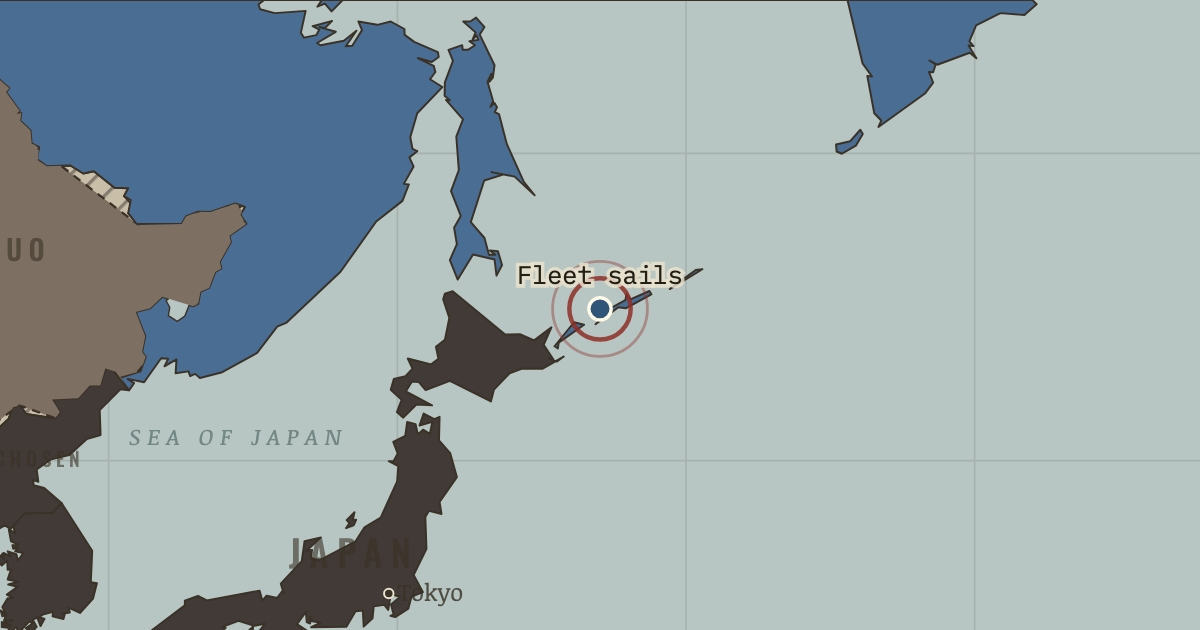
Japanese fleet sails from Hitokappu Bay
26 Nov 1941 — Six carriers sail from fog-bound Hitokappu Bay into the empty north Pacific, keeping radio silence. On the same day, the Hull note is delivered in Washington.
WW2 is free in full, and chapter 1 of every atlas is free. A free account opens 3 more chapters a day. Starter, at $9 a month, opens all 21 with no daily limit — see the plans.
The moment in context
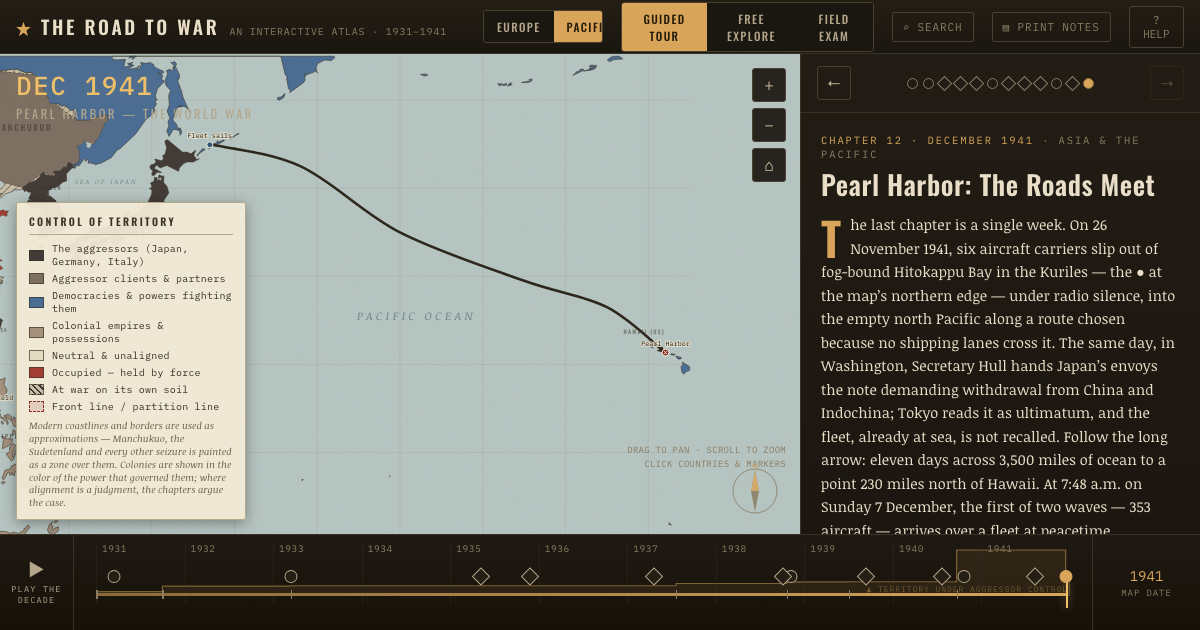
On 26 November 1941, six Japanese carriers departed Hitokappu Bay while negotiations continued in Washington. Eleven days later, on 7 December, their aircraft reached Pearl Harbor. The two waves, comprising 353 aircraft, killed 2,403 Americans and sank or damaged eight battleships. The attackers had crossed the Pacific undetected and achieved devastating surprise.
From Pearl Harbor and US entry into WW2, chapter 12 of The Road to War, 1931–1941 (1941).
The place: Japanese fleet sails from Hitokappu Bay — map and full story →
Teach this in 5 minutes
- Why it happened — The oil clock ran out. The August freeze described in Chapter 10 made oil stocks a measure of time as well as supply. Japanese planners expected their capacity for war to…
- The turn — Pearl Harbor, 7:48 a.m., 7 December 1941. The ships at Pearl Harbor tell only part of the result: most damaged battleships eventually returned to service. The change in American opinion was…
- What it changed — The perimeter, then the tide. Japan’s advance continued for roughly the six months Yamamoto had described. Malaya, Singapore in February 1942, the Indies and the Philippines…
Then ask the room: “A date which will live in infamy” — was Pearl Harbor a surprise attack, or a foreseen war at a surprising place? The argued answer is on the chapter page →
The atlas that shows it
THE FREE PRINTABLE STUDY GUIDE
Get the printable study guide for The Road to War free. I’ll send you a few short letters, then one when a new atlas opens. That’s all. — Paul
NO TRACKING · YOUR ADDRESS IS USED FOR THE DISPATCH AND NOTHING ELSE · UNSUBSCRIBE ANYTIME