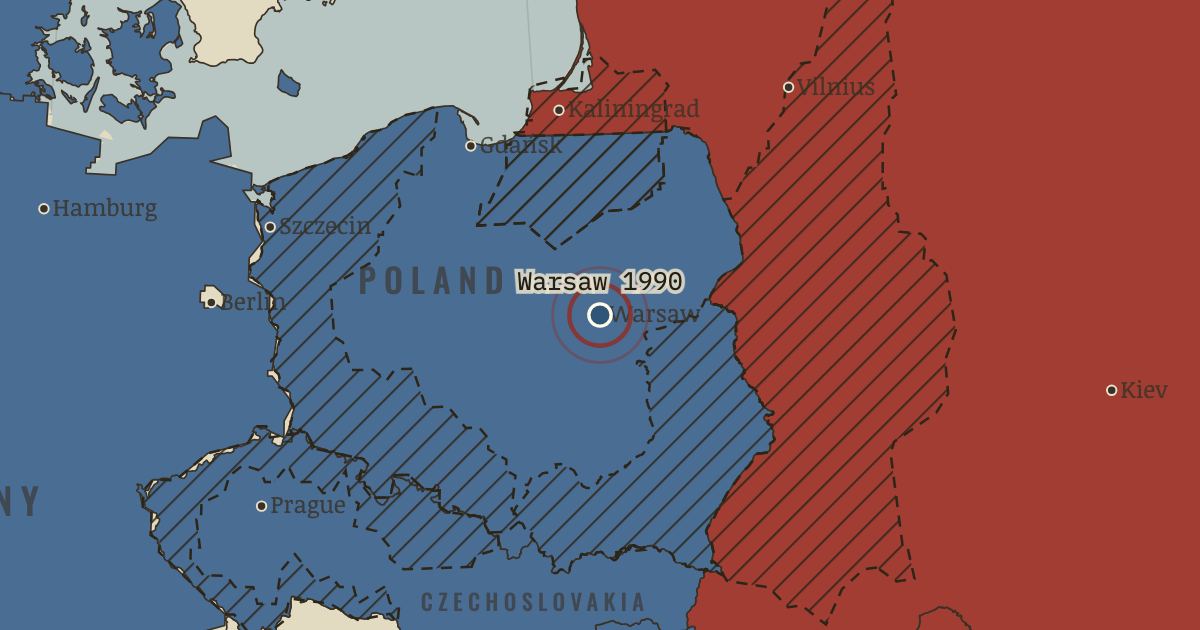
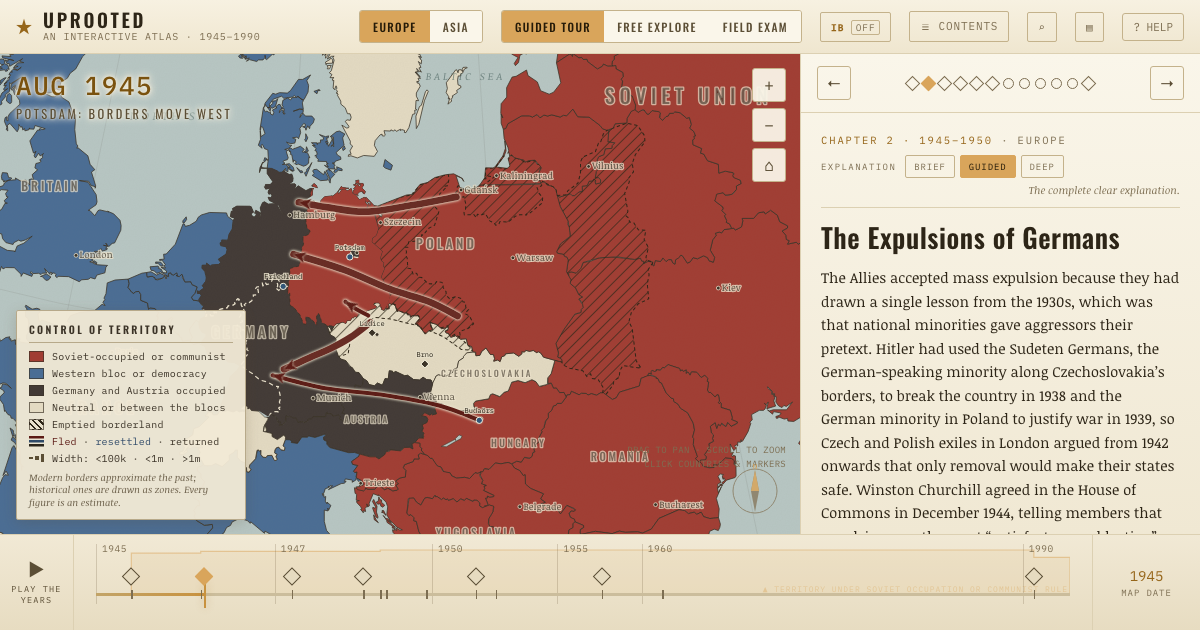
14 Nov 1990 — In Warsaw, the foreign ministers of united Germany and Poland sign a treaty confirming the Oder–Neisse line as their permanent border. Forty-five years after Potsdam, the frontier that uprooted millions becomes final in international law, though memories of displacement remain contested.
WW2 is free in full, and chapter 1 of every atlas is free. A free account opens 3 more chapters a day. Starter, at $9 a month, opens all 21 with no daily limit — see the plans.
14 NOVEMBER 1990 · UPROOTED: REFUGEES IN EUROPE 1945–1960 AND INDOCHINA 1975–1990
The moment in context
A comparison begins with what the victors wanted to build. In Europe, Poland moved west and Germany lost territory. Removing minorities was meant to bring borders and national populations into closer alignment. Nazi Germany had already expelled populations; at Potsdam in 1945 the Allies endorsed transfers of Germans. In Indochina, the new rulers sought a social revolution. Re-education camps, collectivized trade and the emptying of cities targeted political enemies and classes, while Vietnam’s break with China made the Hoa a suspect minority.
Why it happened — Victors with plans. The end of war gave the victors power to pursue political programs: the Allies redrew central Europe in 1945, and communist parties undertook…
The turn — Warsaw, 14 November 1990. On 14 November 1990, united Germany and Poland signed the treaty confirming the Oder–Neisse boundary. The border was formally settled 45 years after…
What it changed — A global refugee regime. Europe’s postwar crisis produced UNHCR and the 1951 Convention, later extended by the 1967 Protocol into a worldwide framework. Indochina tested and…
Then ask the room: Compare and contrast the responses of states and international organisations to displacement in Europe between 1945 and 1960 and in Indochina between 1975 and 1990. The argued answer is on the chapter page →