Ancient Rome · AD 271
What mainly caused the Crisis of the Third Century?
The seminar question: “Which mattered most in the third-century crisis: military and political conflict, economic strain, or disease? What difference does your ranking make?”
Between 235 and 284 Rome had about 26 emperors, nearly all raised and then killed by their own soldiers. Goths raided across the Danube, Sasanid Persia captured Emperor Valerian at Edessa in 260, and plague and a debased coinage deepened the crisis, while breakaway regimes ruled in Gaul and at Palmyra.
Chapter 8 is included with every paid plan. WW2 is free in full, and chapter 1 of every atlas is free. A free account opens 3 more chapters a day. Starter, at $9 a month, opens all 21 with no daily limit — see the plans.
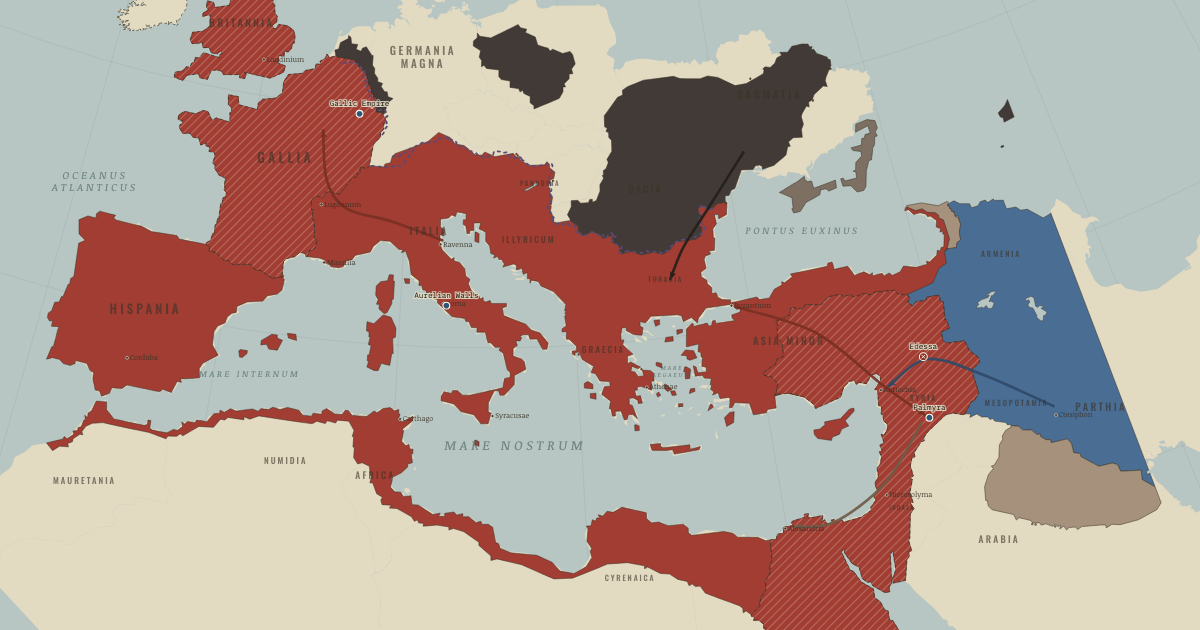
Between 235 and 284 Rome had about twenty-six emperors. Soldiers raised commanders to power, and often killed them in turn. Each claimant had to defeat Roman rivals as well as defend the empire; troops drawn into those contests could not also guard the frontiers they left behind.
The short answer
- Armies and succession. Augustus’ monarchy lacked a consistently accepted procedure for transferring power. After 235 an army could acclaim its commander, and every emperor had reason to fear another army doing the same. Fighting a rival could require troops from the frontier; a defeat on the weakened frontier could then encourage another claimant. The contest for power and the danger from outside fed each other.
- A new Persian rival. The Sasanid dynasty, established in 224, built a more centralized Persian monarchy than the Parthian state it replaced. Its rulers pressed claims associated with the old Achaemenid lands, including Rome’s east, and their armies could besiege and take cities. Rome faced a major power on the Euphrates just as the Danube also demanded serious attention.
- Paying for war. Debasement gave an emperor more coins with which to pay soldiers and accession bonuses. The immediate payment did not settle the longer problem: rising prices reduced purchasing power and made taxation less reliable. Soldiers whose real pay fell could demand more, while city elites facing costly obligations had reason to evade them. The government increasingly took goods directly and used coercion, which itself required officials and force.
- The Plague of Cyprian. During the 250s and 260s, the Plague of Cyprian struck cities while invasions and usurpations placed exceptional demands on the empire. Deaths among workers, taxpayers and potential recruits would have reduced the resources available to meet those demands. Its timing makes disease a serious part of the explanation, even though its scale and precise contribution remain debated.
THE TURNING POINT
Edessa and the divided empire. At Edessa in 260, Valerian became a captive of Persia. Rome had lost an emperor alive, and rival claims to power made a coordinated response harder. Yet the division that followed also shows the continuing appeal of Roman authority. Gaul established a rival Roman regime; Palmyra defended the east in Rome’s name before asserting its own authority. Neither offered itself as a Persian or Gothic replacement. Local institutions and Roman legitimacy survived the center’s inability to protect its provinces, helping Aurelian recover them in a few years after a much longer disintegration. Chapter 11 meets a different challenge to Roman rule.
What it changed
Leaving Dacia. Aurelian withdrew garrisons and officials from Dacia beyond the Danube in 271–275. South of the river he established another province called Dacia: the name survived, but the frontier to supply and defend was shorter. The next snapshot shows the territory changing color. Latin-derived speech survived in Romania long after the legions left, a question about the endurance of Roman culture taken up in Chapter 12.
A changed army and currency. The crisis accelerated changes in command and organization. Soldier-emperors from the Danubian provinces rose at the expense of the Italian senatorial class, and mobile forces were used more extensively to respond to emergencies behind the frontier. Currency changed later too. Constantine’s gold solidus became a durable foundation of Mediterranean trade for some 700 years. Chapter 9 follows the reforms of the army and fiscal system.
A growing church. The church continued to grow amid war and plague. Bishops linked communities across the empire; Christians cared for poor people and buried their own dead and others. Persecution under Decius and Valerian produced martyrs and could strengthen solidarity. By 300 Christians may have made up a tenth of the empire, though estimates are uncertain. Diocletian later tried to suppress the church, while Constantine supported it. Both policies took account of an institution with an extensive network of its own.
The full answer, argued
One case gives priority to military and constitutional conflict. The mutiny of 235 preceded the worst invasions, and rival armies drew soldiers away from frontiers that needed defense. An economic argument starts earlier: Marcus Aurelius had already used debasement to finance wars, and by the 260s unreliable pay and taxation threatened the means of defense. A biological argument points to plague’s timing and asks why a system that survived succession crises in 69 and 193 faced a deeper crisis after 250. Each argument must establish how much weight its factor deserves, not simply show that it mattered. The pressures can also be combined: plague and invasion strained resources, succession disputes turned armies against one another, and fiscal measures created further difficulties. The ranking changes where we look for a remedy—succession rules, sound finance or public health—but a convincing choice must still account for the other pressures.
An interesting fact
The walls Aurelian built around Rome during the crisis served as working defenses for some 1,600 years. Popes repaired and re-crenellated them in the Middle Ages. On 20 September 1870 Italian artillery breached them at Porta Pia, ending papal rule in Rome, which became the capital of united Italy. Much of the roughly nineteen-kilometer circuit still stands, and Romans travel through its gates today.
This is the study layer of Crisis of the Third Century, chapter 8 of The Rise and Fall of Rome, 264 BC – AD 476; the full index of the atlas is here.
Related questions
THE FREE PRINTABLE STUDY GUIDE
Get the printable study guide for Rome free. I’ll send you a few short letters, then one when a new atlas opens. That’s all. — Paul
NO TRACKING · YOUR ADDRESS IS USED FOR THE DISPATCH AND NOTHING ELSE · UNSUBSCRIBE ANYTIME