Ancient Rome · 146 BC
Did Rome plan its Mediterranean empire or stumble into it?
The seminar question: “Did Rome intend to build a Mediterranean empire, or did its empire grow from successive interventions? What evidence would help distinguish the two?”
Rome entered the Greek east as an ally and referee, then broke Macedon at Cynoscephalae and at Pydna in 168 BC and drove the Seleucid king Antiochus III out of Greece. In 146 BC it destroyed both Carthage and Corinth, and in 133 BC the last king of Pergamon bequeathed his realm to Rome.
Chapter 3 is included with every paid plan. WW2 is free in full, and chapter 1 of every atlas is free. A free account opens 3 more chapters a day. Starter, at $9 a month, opens all 21 with no daily limit — see the plans.
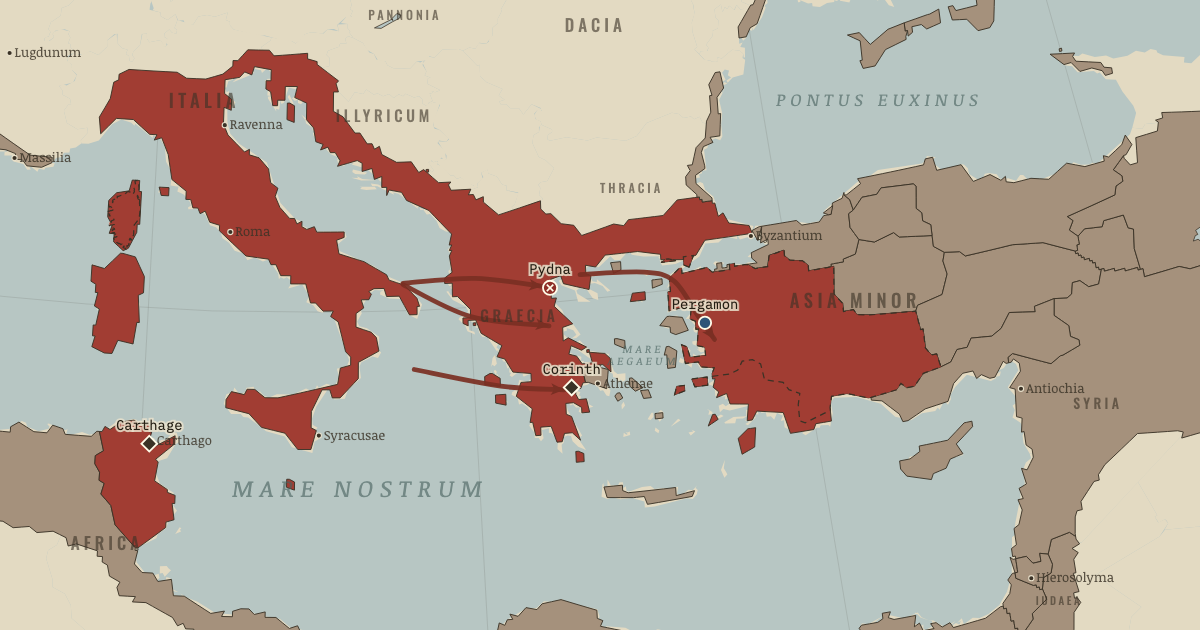
The Greek states that sought Roman help against Macedon had a practical reason for doing so: a powerful ally could protect them from a stronger neighbor. Rome, for its part, could present itself as their protector. But protection created relationships that lasted after an army went home. Clients brought further disputes to Rome, and each intervention strengthened its authority to decide what should happen next.
The short answer
- A power vacuum with an invitation. The eastern balance had depended on three great Hellenistic monarchies checking one another. By 200 BC Egypt had a child king, and Macedon and Syria were dividing its possessions. Smaller powers had reason to look for help: Pergamon, Rhodes and Athens appealed to Rome. They wanted an ally against their neighbors, and their invitations gave Rome a place in eastern disputes.
- The phalanx meets the maniple. The phalanx depended on a wall of pikes held together across its front. On level ground it was formidable; where terrain or casualties opened a gap, separately led Roman units could get through. This difference mattered at Cynoscephalae and Pydna. Roman sources claim 20,000 phalangites died at Pydna against about 100 Romans. Those figures need caution, though the formations help explain the victories.
- Fear, honor, and the Hannibal reflex. Hannibal’s invasion gave Romans a reason to fear what a powerful enemy might do if left unchecked. Antiochus sheltered the exiled Carthaginian, making that danger easier to imagine. Historians disagree about whether such fears directed Roman policy or supplied glory-seeking aristocrats with a convenient justification. Both interpretations must account for the same eastern wars.
- Plunder as fiscal policy. Victory brought money as well as security and prestige. In 167 Aemilius Paullus returned with enough wealth for Rome to abolish direct taxation of its citizens for the long term. Commanders could gain glory and the treasury could gain revenue; these rewards gave influential Romans an interest in further conquest.
THE TURNING POINT
Pydna, 22 June 168 BC. The battle of Pydna on 22 June 168 BC lasted about an hour and ended the 150-year-old kingdom in Alexander’s homeland. Its consequences reached beyond Macedon. A few weeks later, near Alexandria at Eleusis, Antiochus IV was invading Egypt when a Roman envoy drew a circle around the Seleucid king in the sand and demanded an answer before he stepped out. Antiochus withdrew his army. The envoy had won compliance without a battle or a treaty because Roman military power stood behind his demand.
What it changed
A slave society hardens. The scale of enslavement was immense: 150,000 Epirotes were enslaved in a single day in 167, and whole cities were sold after 146. Enslaved labor fed the growth of Italian estates called latifundia, while dispossessed free people moved to Rome. Enslaved people resisted in two Sicilian servile wars and later in Spartacus’s revolt. These changes helped form the Republic’s approaching crisis.
Asia: the province that corrupts. The kingdom left to Rome became the province of Asia. Private tax syndicates, the publicani, bid for the right to collect its revenues. Their extraction enriched the equestrian class while impoverishing people in Anatolia, and provincial misgovernment became an issue in Roman politics. Resentment of tax farmers later helped Mithridates, whose campaign brought the killing of 80,000 Italians in a single day.
Greek culture conquers its conqueror. The flow from Greece to Rome included ideas as well as wealth. Greek became a second language for the Roman elite, and Greek philosophy, historiography, medicine, art and urbanism entered Roman high culture. They traveled onward with Roman roads and law. The eastern empire that endured beyond this atlas was Greek-speaking and rich in cities; the ties formed here helped shape that later world.
The full answer, argued
Those who favor “defensive imperialism” point to roughly fifty years in which Rome annexed little. It fought, imposed settlements and withdrew, governing through clients; Macedon became a province only after four wars. Harris and other advocates of the aggression school instead stress the rewards available to annual consuls, soldiers and the treasury, and the gains that followed Rome’s repeated claims of danger. The events of 146 BC test the explanations. Neither Corinth nor disarmed Carthage posed an immediate threat, yet Rome destroyed both as examples. That does not establish that Rome had planned its whole empire in advance. It does show why intention and institutions must be considered separately: even without a blueprint, careers, the army and the treasury rewarded expansion. The distinction can also be applied to other powers’ claims of “reluctant” growth.
An interesting fact
The destruction of Carthage in 146 BC gave rise to a persistent story: Rome supposedly sowed the soil with salt. No ancient source records it. The story entered textbooks in the nineteenth and twentieth centuries, and a historian traced it in 1986. Rome did curse the site, yet about a century later it founded a colony there. The new Carthage became one of the empire’s greatest cities; its loss in AD 439 would damage the western empire, as Chapter 11 shows. The destruction was real; the salt was a later invention.
This is the study layer of Roman conquest of Greece, chapter 3 of The Rise and Fall of Rome, 264 BC – AD 476; the full index of the atlas is here.
Related questions
THE FREE PRINTABLE STUDY GUIDE
Get the printable study guide for Rome free. I’ll send you a few short letters, then one when a new atlas opens. That’s all. — Paul
NO TRACKING · YOUR ADDRESS IS USED FOR THE DISPATCH AND NOTHING ELSE · UNSUBSCRIBE ANYTIME